The average American rarely thinks about manufacturing, and if he or she does, it is as “dying” or “dead.” We’ve considered plenty of evidence that American manufacturing is indeed in serious trouble and may need to be on life support. Many may wonder why we should even try to save American manu-facturing. So…what difference would it make if we lost vir-tually all our domestic manufacturing?
In reality, American manufacturing is far from dead. Our manufacturing output is actually at the highest level in our history and continues to rise. If American manufacturing were a country, it would be tied with Germany as the world’s third largest economy, and it would be larger than India and Russia combined.
As recently as 2007, America was the world’s number one manufacturer, accounting for 25 percent of global manu-facturing output. China has since become number one: in 2010, it accounted for 19.8 percent of world manufacturing output, slightly ahead of our 19.4 percent. But the U.S. still maintains a huge productivity advantage: in 2010, we produced only slightly less than China, but with only 11.5 million manufacturing workers, compared to 215 million over there.
In 2010, our manufacturing sector accounted for $1.7trillion, or 11.7percent of GDP. While manufacturing’s share of GDP declined from 28.3 percent in 1953 to a low of 11.2 percent in 2009, much of our money today is spent on business services, health care, and education, areas where inflation has been much higher than in manufactured goods. This difference in inflation rates explains much of why manufacturing has become a relatively smaller part of our economy.
The Importance of Manufacturing
Manufacturing is the key engine that drives American prosperity. Federal Reserve Chair Ben Bernanke said, on February 28, 2007, “I would say that our economy needs machines and new factories and new buildings and so forth in order for us to have a strong and growing economy.” Similarly, in 2011 the Center for American Progress released a report entitled “The Importance and Promise of American Manufacturing: Why It Matters if We Make It in America and Where We Stand Today,” by Michael Ettlinger and Kate Gordon. It asserts that,
Manufacturing is critically important to the American economy. For generations, the strength of our country rested on the power of our factory floors—both the machines and the men and women who worked them. We need manufacturing to continue to be bedrock of strength for generations to come.... The strength or weakness of American manufacturing carries impli-cations for the entire economy, our national security, and the well-being of all Americans.
The report argues that supplying our own needs through a strong manufacturing sector protects us from foreign economic and political disruptions and protects our national security, where the risk of a weak manufacturing capability is obvious. Over-reliance on imports and high manufacturing trade deficits make us vulnerable to everything from exchange rate fluctuations to trade embargoes and natural disasters. The report notes that whether the U.S. still dominates world manufacturing, as it once did, is a different question than whether U.S. manufacturing can compete. American manufacturers still successfully make and sell goods on a massive scale. One reason is that we are the biggest-consuming country in the world, and “as a result, we cannot avoid being a large manufacturer. There are enough products that are expensive or difficult enough to ship that it’s hard to avoid making them here. There’s certainly truth to the story that some U.S. manufacturing succeeds because of this advan-tage.”
The report observes that manufacturing in the U.S. covers a broad range of activities, but there are six large subsectors that account for the bulk of it. The top six subsectors by value added are these:
| |
Value Added |
Shipments |
Capital Expenditures |
Exports |
Compensation |
Worker Hours |
Chemicals |
16% |
14% |
13% |
15% |
8% |
5% |
Transportation Equipment |
11% |
12% |
10% |
22% |
14% |
11% |
Food |
11% |
12% |
9% |
5% |
8% |
13% |
Computers & Electronics |
10% |
7% |
13% |
14% |
11% |
5% |
Fabricated Metals |
8% |
7% |
7% |
5% |
11% |
13% |
Machinery |
7% |
7% |
6% |
13% |
9% |
8% |
| |
64% |
58% |
58% |
73% |
62% |
56% |
Source: Census Bureau Annual Survey of Manufactures, 2008
The report concludes that as “long as there is demand in the United States for manufactured goods as well as the innovators, manufacturing workers, and available capital necessary to remain competitive, manufacturing can continue to be important in the U.S. economy.” The report concludes that American manufacturing is not too far gone to save, and that while manufacturing in the U.S. is under threat and faces serious challenges, it is by no means a mere relic of the past. It is a large, vibrant sector– even if sometimes it is hard to see this as manufacturing jobs are lost, factories close, and sections of the country deindustrialize.
However, a study commissioned by NAM’s Council of Manufacturing Associations, “Securing America’s Future: The Case for a Strong Manufacturing Base,” prepared by the noted economist and former Council of Economic Advisors member Joel Popkin, warns that “if the U.S. manufacturing base continues to shrink at the present rate and the critical mass is lost, the manufacturing innovation process will shift to other global centers. If this happens, a decline in U.S. living standards in the future is virtually assured.”
I personally believe that while manufacturing is not likely to fall below critical mass in the short term, it may in the longer term. U.S. manufacturers produce 65 percent of the manufactured goods our country consumes, down from 80 percent three decades ago. Many goods that were once manufactured here are now imported. For example, in the 1960s U.S. manufacturers made 98 percent of America’s shoes, but today 90 percent are imported. American factories still provide much of the processed food that Americans buy, everything from fish sticks to beer. And U.S. companies make a considerable share of personal-hygiene products like soap and shampoo, cleaning supplies, and prescription drugs that are sold in pharmacies. But many other consumer goods now come from overseas.
We need to be able to produce the goods that allow us to defend America. American manufacturers supply the military with essentials including tanks, fighter jets, submarines, and other high-tech equipment. The same advances in technology that consumers take for granted support our soldiers. Kerri Houston, senior vice president for policy at the Institute for Liberty and a member of the U.S.-China Economic and Security Review Commission, writes that,
If we are to retain our military superiority at home and abroad, we must maintain the ability to manufacture original equipment and replacement parts in the U.S. Needlessly sending defense jobs overseas will do nothing to ensure our long-term national security, which history shows will require a robust research and development, technical and manufacturing base.
In his keynote address, “Lessons for a Rapidly Changing World,” at Computer Associates’ CA World 2003 conference, former Secretary of State Henry Kissinger said, “The question really is whether America can remain a great power or a dominant power if it becomes primarily a service economy, and I doubt that. I think that a country has to have a major in-dustrial base in order to play a significant role in the world. And I am concerned from that point of view.” He added, “But if the outsourcing would continue to a point of stripping the U.S. of its industrial base and of the act of getting out its own technology, I think this requires some really careful thought and national policy probably can create incentives to prevent that from happening.”
The U.S. cannot rely on other countries to supply its military because their interests may run counter to ours. If we faced a military threat to our homeland, how could we assure access to the goods needed to defend our country when these items are being manufactured in China? We cannot risk being held hostage by foreign manufacturers, so it is crucial that the capacity to produce components and technologies critical to U.S. weapons be located within the United States.
Col. Joe Muckerman, former director of emergency planning and mobilization for the secretary of defense, wrote a guest editorial entitled “Without a Robust Industrial Base DOD Will Lose Future Wars” in the April 17, 2008 Manufacturing & Technology News. He opined:
Joe Stalin said that World War II was not won on the battlefields of Europe but in Detroit. Had Stalin lived until the end of the Cold War, he probably would have arrived at a similar conclusion. The U.S. won the Cold War because it maintained technologically superior strategic weapons at a level that deterred the Soviet Union from attacking our vital interests. The United States was able to sustain this force for half a century during which the U.S. economy prospered while that of the USSR collapsed…Today the U.S. industrial base is fast becoming global and the U.S. economy is in trouble.
Similarly, “The Case for a National Manufacturing Strategy,” released in April 2011 by the Information Tech-nology & Innovation Foundation, echoes the idea that manufacturing is critical to our national security:
If we lose our preeminence in manufacturing technology, then we lose our national security. This is because as the U.S. industrial base moves offshore, so does the defense industrial base. And reliance on foreign manufacturers increases vulnerability to counterfeit goods.
This report quotes Joel Yudken, who explains in his book Manufacturing Insecurity that “Continued migration of manufacturing offshore is both undercutting U.S. technology leadership while enabling foreign countries to catch up to, if not leapfrog, U.S. capabilities in critical technologies important to national security.” The report reveals that the U.S. has “diminishing or no capability in lithium-ion battery production, yttrium barium copper oxide high-temperature superconductors, and photovoltaic solar cell encapsulants, among others.… Additional examples of defense-critical tech-nologies where domestic sourcing is endangered include pro-pellant chemicals, space-qualified electronics, power sources for space and military applications (especially batteries and photovoltaics), specialty metals, hard disk drives, and flat panel displays (LCDs).”
The ITIF report shows that most manufacturing sectors actually shrank, in terms of real value-added, from 2000 to 2009. In fact, from 2000 to 2009, 15 of 19 U.S. manufacturing sectors saw absolute declines in output; they were producing less in 2009 than they were at the start of the decade. U.S. manufacturing declined noticeably over the last decade, and not just in the number of jobs. Data from the Bureau of Economic Analysis shows that from January 2000 to January 2010, manufacturing jobs fell by 6.17 million, or 34 percent. The report also presents convincing evidence that the government’s official calculation that manufacturing accounts for an 11.2 percent share of U.S. GDP is too high because it overstates output from the computer and electronics industry.
Reliance on foreign manufacturers also increases our vulnerability to counterfeit goods. According to a recent study by the Bureau of Industry and Security, in 2008 there were 9,356 incidents of counterfeit foreign products making their way into Defense Department supply chains – a 142 percent increase since 2005.The U.S. cannot rely on other countries to supply its military because their interests may run counter to ours. If we faced a military threat to our homeland, how could we assure access to the goods needed to defend our country when these items are being manufactured in China? We cannot risk being held hostage by foreign manufacturers, so it is crucial that the capacity to produce components and tech-nologies critical to U.S. weapons be located within the United States.
Many people do not realize that, although the U.S. has lost millions of manufacturing jobs in the last 20 years, these jobs are still the foundation of the U.S. economy and a major basis of our middle class. Manufacturing provides high-paying jobs for nearly 12 million Americans and creates an additional eight million jobs in related sectors. The states with the largest manufacturing workforces are California, Texas, Ohio, Illinois, and Pennsylvania. (California’s manufacturing workforce of more than 1.9 million is almost the size of the Texas and Illinois manufacturing workforces combined.)
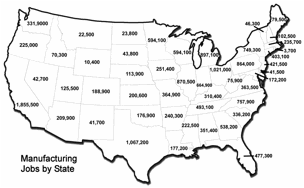 Source: Census Bureau, 2010
Part of the loss of manufacturing jobs is simply due to automation and the increasing productivity of American workers. American workers have achieved high productivity growth year in and year out, increasing their productivity by more than 50 percent in the past decade alone. In the past 20 years, manufacturing productivity, measured in output per man-hour, has more than doubled, much faster growth than other economic sectors. And in the decade ahead, productivity growth will be the major source of growth in manufacturing output as Baby Boomers leave the workforce to retire.
Automation has helped keep American manufacturers not only competitive, but the most productive in the world. The growing trend of training manufacturing workers in so-called “lean” manufacturing is accelerating this. For example, one metal stamping company we represented went through lean manufacturing training in 2001. As a result, its productivity per employee doubled and the time it took for a part to go through the shop, from the first workstation to the last, went down from an average of four weeks to one day.
Another trend is the domestic outsourcing of service jobs within manufacturers, like janitorial services, cafeteria and food services, accounting, payroll, and legal departments. Thus jobs that may have once been classified as manufacturing are now classified as service jobs. As companies get rid of business units and the people who used to work in them, they get smaller. And as they get smaller and more efficient, their revenues go down but their profits go up.
Manufacturing wages and benefits average about 25 percent higher than in non-manufacturing jobs. According to the National Association of Manufacturers, “In 2010, the average U.S. manufacturing worker earned $77,186 annually, including pay and benefits. The average non-manufacturing worker earned $56,436.” As manufacturing jobs have declined over the past 40 years, the difference between the lowest and highest income brackets has steadily grown, as shown in the chart on the next page.
This difference is projected to get even worse, according to the Department of Labor’s Occupational Outlook for 2006-2016. Employment growth is projected to continue to be concentrated in service-providing sectors of the economy. Service industries will generate almost all employment gains, and more than three-quarters of all jobs, by 2016.Professional and business services, and health care and social assistance, the sectors with the largest employment growth, will add 8.1 million jobs, more than half of the total projected increase in employment. The 10 industries with the largest projected wage and salary employment growth – led by management, scien-tific, and technical consulting services; employment services; and general medical and surgical hospitals – all are in the service sector.
Within the goods-producing sector, construction is the only area projected to grow. Employment in manufacturing is expected to decline by 1.5 million jobs. This is half the three million manufacturing jobs lost in the previous decade (1996-2006). Employment in goods-producing industries is expected to decrease from 14.9 to 13.1 percent of total employment. Four of the 10 industries with the largest projected wage and employment declines are in manufacturing, including printing and related support activities and motor vehicle parts manufacturing.
Because of the recent recession, construction has lost millions of jobs, and the manufacturing sector has declined by 2.5 million jobs in the five years since 2006 – one million more than the Department of Labor had projected for the entire 2006-2016 decade. The outlook for 2008-2018 is even worse, as service industries are projected to add 14.6 million jobs, or 96 percent of the total increase.
Percent Change in Income Share, 1967-2010
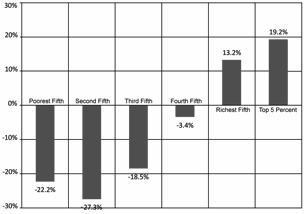
Source: Census Bureau
As the manufacturing percentage of our GDP has declined, the percentage of GDP produced by the financial sector has increased. The problem is that a large share of the finance industry consists of unproductive speculation and the expan-sion of debt. In an article in Industry Week magazine, John Madigan, a consultant with Madigan Associates, observes:
Jobs paying $20 per hour that historically enabled wage earners to support a middle-class standard of living are leaving the U.S. Public sector aside; only 16 percent of today's workers earn the $20-per-hour baseline wage, down 60 percent since 1979. Service and transportation jobs, per se, cease to exist in the absence of wealth. Rather, they exist and thrive as byproducts of middle-class incomes buying products and services.
By contrast, the average salary for manufacturing manage-ment is $98,120, according to Industry Week’s 2010 Salary Survey, down from $104,581 in 2008. By industry sector, salaries ranged from a low of $88,352 in the plastic and rubber products sector to a high of $133,077 in the chemicals sector. The survey noted that “More manufacturing managers work in the metals industry (13 percent) and industrial machinery producers (13 percent) than any other industries, followed by automobile and transportation manufacturers (11 percent).”
Manufacturing vs. Finance as % of U.S. GDP
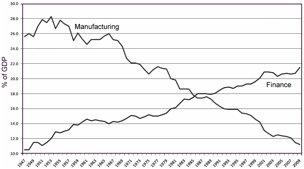
Source: Bureau of Economic Analysis
The glass ceiling for women is still intact among companies that responded to the survey: 92 percent of man-agers are male, making an average of $31,300 more than female managers (up from $28,000 in 2008). While 92 percent of managers are white, it is interesting to note that their average salary is $97,998, while an African-American manager’s average salary is $84,009 and a Native American manager’s average salary is $82,444. (The average salary for a Hispanic is the lowest, at $80,684.) Sixty-eight percent of managers are between the ages of 40 to 59, and 65 percent of managers have more than 21 years of experience.
Most outsiders have no idea of the variety of management jobs available at manufacturing companies. Besides the usual executive jobs, other management jobs available at medium and large manufacturers are in these areas: operations, plant and facilities, manufacturing and production, purchasing and procurement, sales and marketing, quality, supply chain, lean manufacturing and continuous improvement, human resources, R&D and product development, and safety and regulatory compliance. And, despite the challenges that the manufacturing industry has faced in the last several years, especially during the 2008-2009 recession, 80 percent of the people responding to the survey were either “satisfied’ or “very satisfied” with manufacturing as a career path, and 70 percent were either “satisfied” or “very satisfied” with their current job.
Inside modern manufacturing facilities in the U.S., you will see the most productive, skilled labor force in the world applying the latest in innovation and technology. And contrary to popular opinion, the industrial age is not over. In reality, we are on the edge of incredible advances in manufacturing, from nanotechnology to lasers to biotechnology.
Manufacturing also creates more secondary jobs, as there is a multiplier effect that reflects linkages running deep into the economy. For example, every 100 steel or automotive jobs create between 400 and 500 new jobs in the rest of the econ-omy. This contrasts with the retail sector, where every 100 jobs generate 94 new jobs elsewhere, and the personal and service sectors, where 100 jobs create 147 new jobs. Each manufacturing dollar generates an additional $1.37 in economic activity, as manufacturers hire services like banking, finance, legal, and information technology.
Another important point to consider is that the decline in high-paying jobs in manufacturing may be making the federal budget deficit worse. A high percentage of manufacturers are unincorporated small businesses. Thus, the owners of these businesses pay personal income tax, rather than corporate income tax. As the U.S. loses more and more manufacturers, tax receipts from these business owners are going down. In addition, their employees are paid an average of 25 percent more than employees in other sectors of the economy. When manufacturing employees lose their jobs due to plant closures, fewer than half return to manufacturing jobs. When they do find new full-time jobs, or are forced to take part-time jobs, they tend to take a pay cut. Thus their tax payments go down. The U.S. needs to keep as many manufacturing jobs as possible so that federal budget deficits don’t go from bad to worse.
An Engine of Technology Development and Innovation
American manufacturers are responsible for more than two-thirds of private sector R&D, which ultimately benefits both manufacturing and non-manufacturing activities. More than 90 percent of new patents derive from the manufacturing sector and the closely related engineering and technology-intensive services sectors. Manufacturing R&D is conducted in a wide array of industries and businesses of all sizes. The heaviest R&D expenditures take place in computers and electronics, transportation equipment, and chemicals (primarily in pharma-ceuticals).
Manufacturing innovation leads to investments in equipment and people, productivity gains, the spread of improved technology to other sectors, and new and better products and processes. It is an intricate process that begins with R&D for new products and improvements to existing ones. As products are improved in speed, accuracy, ease of use, and quality, new manufacturing processes are utilized. Education and training of employees is required to reap the benefits of these improvements in manufacturing processes.
The process through which R&D generates prosperity is complex and multifaceted. First, there are the direct benefits to firms from their own R&D. Second, other companies derive benefits from the R&D of the innovating company in a spillover effect. Third, the feedback from R&D improves other products and processes. Fourth, one industry’s R&D has a beneficial effect on other industries and the economy as a whole. Spillover effects are increased through sales transactions and knowledge transfers when the parties involved are interdependent and in close geographic proximity.
Innovation in manufacturing requires a critical mass of interconnected activities. Innovation and production are intertwined because you need to know how to make a product in order to make it better. In his book Great Again, Hank Nothhaft, CEO of Tessera Technologies, writes that “In our arrogance and our own naiveté, we told ourselves that so long as America did the ‘creative’ work, the inventing, we could let other nations do the ‘grunt’ work – the manufacturing. We did not yet understand that a nation that no longer makes things will eventually forget how to invent them.” Manufacturing is an incubator for technology and requires proximity to the facilities where innovative ideas can be tested and worker feedback can fuel product innovation. Without this proximity, technology jobs, like customer service jobs, eventually follow manufacturing jobs overseas.
Funding for R&D comes largely from the profits that companies invest back into their businesses. Thus the cash flow of manufacturing companies is closely linked to their ability to conduct R&D and make capital investments. The severe recession of 2008-2009 dramatically reduced corporate profits and resulted in a drop in corporate R&D. According to the 2011 Annual Survey by the Industrial Research Institute (IRI), 94 percent of R&D managers surveyed said they expected R&D spending to remain the same or increase in 2012. Managers expected this increase to be focused on new-business projects. While most expected that capital spending, support of existing businesses, and directed basic research would remain relatively flat, almost 70 percent thought that R&D budgets focused on new-business development would increase, while only 8 percent thought their spending in this area might decrease. (This will be the second year of increase since 2008, after a 30 percent drop during 2009-2010.) For 2012, this year’s respondents project a change of plus 13 percent. External collaborations continue to be an area of increased emphasis. The overwhelming majority of companies continue to utilize these tools at the same or greater level than in previous years. The most disturbing trend is that about 70 percent of companies surveyed now have R&D facilities overseas.
Maintaining an effective U.S. R&D network is essential for attracting domestic and foreign R&D funds and the manufacturing that results from the innovation process. This increases U.S.-based value added, producing economic growth. But today, with the offshoring of so much manufac-turing, certain tiers in the high-tech supply chain are disappearing in the U.S. (This is the case, for example, with electronic components like capacitors and resistors.) When one tier in a supply chain has moved offshore, domestic research and supporting infrastructure are degraded. This can be a major problem for U.S. manufacturers transitioning to the next product life cycle. In the past, technology would flow from new domestic R&D-intensive industries into the remainder of the economy, boosting overall national pro-ductivity. Today, emerging technologies are flowing at least as rapidly to the innovators’ foreign partners and suppliers.
In an article, “Rationales and Mechanisms for Revitalizing U.S. Manufacturing R&D Strategies,” Gregory Tassey, senior economist at the National Institute of Standards and Technology, notes that U.S. R&D relative to GDP is the same as it was in 1960, while other counties have steadily increased their R&D intensity. In addition, American firms have shifted their R&D investments toward an increasingly global scope and shorter-term objectives, rather than radically new technologies with greater long-term potential.
A related ITIF report, “The Case for a National Manufacturing Strategy,” notes that “Manufacturing, R&D, and innovation go hand-in-hand.” It quotes Susan Houseman, of the Institute for Employment Research, who writes, “The big debate is whether we can continue to be competitive in R&D when we are not making the stuff that we innovate. I think not; the two cannot be separated.” It confirms that “the process of innovation and industrial loss becomes additive. Once one technological life cycle is lost to foreign competitors, subsequent technology life cycles are likely to be lost as well.”
This report examples the U.S. losing leadership in rechargeable battery manufacturing years ago, largely because increasing demands in consumer electronics for more and more power in smaller packages drove most innovation in batteries. As a result, GM now has to source the advanced battery for its Chevy Volt from Korea. According to the report, “There is a deeply symbiotic, interdependent relationship between the health of a nation’s manufacturing and services sectors: the health of one sector greatly shapes the health of the other. In particular, the technology-based services sector depends heavily on manufactured goods.” It concludes that:
The U.S. economy’s ability to remain competitive in services sectors, particularly high-technology ones, requires close interactions with the creators and suppliers of technologically advanced hardware and software. The message is clear: manufacturing and ser-vices are not separable ─ they are joined at the hip. The United States must discard the notion that it can give up its manufacturing industries but retain a robust set of services sectors capable of propelling the economy forward by themselves.
In my opinion, it doesn’t matter whether American companies do R&D within their own facility or hire it to be done by outside consultants or product development firms. But it does matter whether the R&D is done in America. We need to keep innovation in our own country if we want to remain on the cutting edge of technology and maintain the critical mass of our manufacturing industry. Outsourcing R&D to China is like a mayor giving the key to his city to a would-be conqueror. We need to protect the key to our future security as a nation and keep R&D and manufacturing here. If the U.S. manufacturing base continues to shrink at its present rate, the critical mass will be lost. The manufacturing innovation process will shift to other global centers and a decline in U.S. living standards will result.
The United States was the world’s largest exporter until 1992, when Germany took over this title. The U.S. then maintained its position as second-largest until China surpassed us in 2008. Germany remained number one until 2009, when China surpassed it. The difference between the top three, however, has been small: Germany in 2009 exported $1.17 trillion, compared to $1.06 trillion for the U.S. and $1.2 trillion for China. The U. S. took back second place in 2010 when U.S. exports rose to $1.3 trillion, but China’s exports went up also to $1.5 trillion.
Manufactured goods make up just fewer than 70 percent of U.S. exports. While agricultural exports are about $150 billion a year, manufacturers export roughly eight times that. High-tech products are America’s single largest export sector, at $287 billion, or 13.6 percent of total U.S. exports, in 2011.The European Union was the top importer of these goods, fol-lowed by Canada, Mexico, and China.
U.S. Manufactured Exports (in Billions)
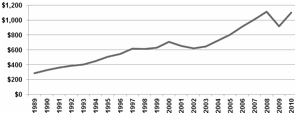
Source: International Trade Administration
According to the Small Business Administration, small- and medium-sized enterprises (SMEs) comprised 97.6 percent of all identified U.S. exporters, generated 64 percent of net new jobs between 1992 to 2009, and represented 31 percent of U.S. export value in 2008. The number of small-and medium-sized exporters more than doubled between 1992 and 2007, and nearly three-quarters of exporters have fewer than 20 employees.
On March 11, 2010, President Obama established the Export Promotion Cabinet by executive order, and tasked it with developing a plan to achieve the doubling U.S. exports in five years he had proposed in his 2010 State of the Union address. Sixteen representatives, from the secretary of state to the director of the U.S. Trade and Development Agency, were appointed to this cabinet. Its final report, released on September 15, 2010, was the product of an intensive six-month collaboration between this cabinet and the 20 federal agencies that make up the Trade Promotion Coordinating Committee. The report states:
The National Export Initiative (NEI) is a key component of the President’s plan to help the United States transition from the legacy of the most severe financial and economic crisis in generations to a sustained recovery…The NEI’s goal of doubling exports over five years is ambitious. Exports need to grow from $1.57 trillion in 2009 to $3.14 trillion by 2015.
The NEI has five components: 1) improve advocacy and trade promotion, 2) increase access to export financing, 3) remove barriers to trade, 4) enforce current trade rules, and 5) promote strong, sustainable, and balanced growth. It has identified eight priorities, and the Export Promotion Cabinet has developed recommendations to address each of them. These recommendations cover all five components, cut across many federal agencies, and focus on areas where concerted governmental efforts can help.
One of the eight priorities promotes free trade agreements, which is unhelpful, but the other seven have merit and are worth pursuing. Although I’m skeptical about the ability of the plan to double exports in five years when we are fighting against the predatory mercantilism of countries like China, it is well worth pursuing these other priorities to improve the ratio of our exports to imports as much as possible, which helps to improve our all-important net exports.
The question is whether the plan will actually work. The biggest problem is that the U.S. is no longer the manufacturing source for consumer and household goods it once was. American brands like IBM, General Electric, and Ford were once known worldwide for their quality and innovation. But these products are now largely being made in Asia, mostly in China, and imported by the U.S., rather than being made here for export worldwide. It is no surprise that since the initiative was announced, America’s monthly export figures have sometimes reached the needed trend of growth, but more often fallen short, and it unclear in 2012 whether the goal will be reached.
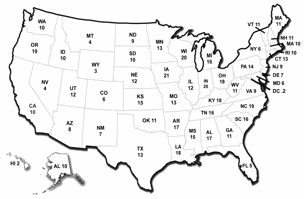
Manufacturing is a vital part of the economies of most states – even in those areas where manufacturing has declined as a portion of Gross State Product (GSP). And manufacturers are a significant component of state tax bases and the tax bases of manufacturing communities. As a share of GSP, manu-facturing is among the three largest private-industry sectors in all but 10 states and the District of Columbia. It is the single largest sector in 10 states and in the Midwest as a whole. It is the second largest in nine states, and the third largest in 21 others. The states with the most manufacturing employees are California, Texas, Ohio, Illinois, Pennsylvania, and Michigan (Michigan dropped below Pennsylvania after the bankruptcy of General Motors in 2009).
Manufacturing as Percent of Gross State Product
Source: Census Bureau
“Infrastructure” refers to the assets that support an economy, like highways, streets, roads, bridges, dams, mass transit systems, airports, water supply systems, wastewater systems, electric power generation and transmission, telecommuni-cations, flood management, and public recreational facilities. In the 1980s, the National Research Council adopted the term “public works infrastructure” because these various elements are public works, although they may sometimes be developed and operated as private sector enterprises.
Economically, infrastructure constitutes the structural elements of an economy that allow for the production of goods and services without themselves being part of the production process. For example, roads allow the transport of raw materials and finished products. Infrastructure in this sense also includes transmission systems for data, including telephone lines, cable television lines, satellites and antennas, and also routers, aggregators, repeaters, and other control devices.
These infrastructure networks are a vital link between the production of goods and services and their delivery to buyers. They are much more capital intensive than other service-producing industries, requiring much capital and manufactured goods to construct and maintain them. Manufacturers build the equipment used to construct, implement, and maintain this infrastructure. Thus the production of goods drives the demand for infrastructure, and the growth of infrastructure fuels the demand for manufacturers, creating synergies in both sectors.
Manufacturers also use public works infrastructure, either internally in their manufacturing processes (as in gas or electricity provided by a municipal power plant) or externally, as in the highways, streets, bridges, and airports used to transport their products. Most goods delivered by the major modes of transportation in the U.S. are tied to manufacturing. Manufactured products account for 87 percent of the value, and 70 percent of the ton-miles, of products carried by truck. (These percentages are even higher if one includes raw materials transported for use in manufacturing.) Manu-facturers’ need for and use of infrastructure makes it profitable for infrastructure producers to make investments to improve the infrastructure, but these improvements then benefit everyone.
A July 2011 poll of 1,000 likely voters by the Alliance for American Manufacturing revealed that Americans want Washington to act on jobs, especially manufacturing jobs, which they believe will help restore America’s status as the world’s number one economy. “This poll is a stark reminder that while official Washington goes back and forth in our newest crisis, Americans still feel no one is focusing on the real problems that matter to them: losing jobs, losing our manufacturing base, and the decline of our position in the world,” said Scott Paul, executive director of the Alliance.
Americans don’t believe that Congress or the President have done enough to support manufacturing. Poll results showed that, by a more than two-to-one margin (67 to 29 percent), voters would prefer Washington focus on job creation, rather than deficit reduction. This was down from the 2010 poll, where 94 percent of voters wanted Washington to focus more on jobs, with 85 percent specifying creating manufacturing jobs and 88 percent wanting Congress and the President to strengthen manufacturing.
In the 2011 poll, voters gave the President and Congress even worse marks than in 2010 for taking action on jobs and manufacturing. In the 2011 poll, there was little difference between the opinions of independents, Democrats, and Republicans (64 percent, 67 percent, and 66 percent, res-pectively) on the viewpoint that “manufacturing is a critical part of the American economy and we need a manufacturing base here if this country and our children are to thrive in the future.” A few of the key results:
- 90 percent had a favorable view of American manufacturing companies – up 22 percent from 2010.
- 97 percent had a favorable view of U.S.-made goods – up five percent from 2010.
- 72 percent had an unfavorable view of goods made in China.
- 83 percent had an unfavorable view of companies that go to China to manufacture.
- 90 percent supported Buy American policies “to ensure that taxpayer funded government projects use only U.S.-made goods and supplies wherever possible.”
- 95 percent favored keeping “America’s trade laws strong and strictly enforced to provide a level playing field for our workers and businesses.”
Conclusion
Manufacturing is the foundation of the U.S. economy and our country’s large middle class. Losing the critical mass of our manufacturing base would result in larger state and federal budget deficits and a decline in U.S. living standards. This, in turn, would result in the loss of the large portion of our middle class which depends on manufacturing jobs. America’s national defense would be in danger and it would be impossible to maintain the country’s position as a superpower. It will take cooperative efforts on the part of industry, government, and individual Americans to ensure that American manufacturing survives and grows in the global economy.

2009 Copyright Michele Nash-Hoff All Rights
Reserved
No part of this chapter may be reproduced
or transmitted, in any form or by any means, electronic,
mechanical, photocopying, recording, or otherwise, without
the prior written permission of the publisher.