During his campaign for re-election for President, President Trump pledged to address the unfair and unbalanced trade that the U.S. has experienced for many years. Contrary to many politicians, President Trump kept his campaign promise by establishing an America First Trade Policy in which trade and economic policies would “put the American economy, the American worker, and our national security first.” He announced, “I am establishing a robust and reinvigorated trade policy that promotes investment and productivity, enhances our Nation’s industrial and technological advantages, defends our economic and national security, and — above all — benefits American workers, manufacturers, farmers, ranchers, entrepreneurs, and businesses.”
The remedies to address unfair and unbalanced trade included investigating “the causes of our country’s large and persistent annual trade deficits in goods, as well as the economic and national security implications and risks resulting from such deficits, and recommend appropriate measures, such as a global supplemental tariff or other policies, to remedy such deficits.”
As CNN Business reported, “In April, Trump imposed “reciprocal” tariffs as high as 50% on most of America’s trading partners.”. On April 9, President Donald Trump gave the world a three-month window to negotiate trade deals with the United States or face higher “reciprocal” tariffs. With just five days remaining in that tariff moratorium, the White House is expected to begin delivering a message to a dozen or so countries: Time is up, and here’s your new tariff rate.”
The article stated that Trump “told reporters that he would notify 10 to 12 nations a day over the course of the next five days, detailing their new tariffs in letters that the White House would begin sending on Friday. In most cases, the new rates would go into effect August 1, Trump said. “They’ll range in value from maybe 60% or 70% tariffs to 10% and 20% tariffs, but they’re going to be starting to go out sometime tomorrow,” Trump said. “We’ve done the final form, and it’s basically going to explain what the countries are going to be paying in tariffs.”
A July, 19, 2025, ABC News article titled, “What have Trump’s tariffs achieved so far? Experts weigh in,” Max Zahn wrote “The Trump administration touts tariffs as part of a wider set of “America First economic policies,” which have “sparked trillions of dollars in new investment in U.S. manufacturing, technology, and infrastructure,” according to the White House’s website.
The article stated, “Scores of companies have pledged new investment in the U.S., including tech giants Apple and Nvidia, pharmaceutical companies Merck and Johnson & Johnson as well as automakers Hyundai and Stellantis, the White House says. The whole idea is to encourage reshoring of manufacturing and change the balance of trade. That could all have some positive impact,” Morris Cohen, a professor emeritus of manufacturing and supply chains at Duke University, told ABC News.”
The Trump Effect page on the White House website states, “Since President Donald J. Trump returned to office, his America First economic policies have sparked trillions of dollars in new investment in U.S. manufacturing, technology, and infrastructure…The U.S. has seen a surge of private and foreign investment that are fueling job growth, innovation, and opportunity across every corner of the country. The website provides a list of the major investments by foreign countries and companies at this link.
Adding up the totals on the link comes to about 40 billion dollars. Of course, these pledges were made under threat of high tariffs, so time will tell if the companies and countries keep their pledges.
On July 29th, MSN Markets Today reported “The U.S. trade deficit in goods narrowed to the lowest level in nearly two years in June as imports fell sharply, cementing economists’ expectations that trade likely accounted for much of an anticipated rebound in economic growth in the second quarter.
The goods trade gap narrowed 10.8% to $86.0 billion last month, the lowest level since September 2023, the Commerce Department’s Census Bureau said. Economists polled by Reuters had forecast the goods trade deficit would rise to $98.20 billion. Imports of goods decreased $11.5 billion, or 4.2%, to $264.2 billion, the lowest level since March 2024. The decline was led by a 12.4% plunge in consumer goods imports.”
On Sunday, August 3, 2025, the English edition of Trending News & Research reported: “The US government under Donald Trump is collecting more money than ever from import tariffs, with customs duty revenue crossing $100 billion in fiscal year 2025—more than double what it brought in just five years ago. Treasury and Homeland Security figures suggest the final tally could reach $300 billion by year’s end, fueled by sweeping tariffs imposed on goods from over 100 countries, including India, Brazil, Russia, China and Canada. Customs duties now make up nearly 5% of total federal revenue, up from an average of 1.6% in previous decades. July alone saw the US collect a record $28 billion in tariff duties, with economists projecting that number could climb as high as $37 billion per month from August onward, when new rate hikes take effect.”
The Bi-Partisan Policy Center Tariff Tracker shows that the U.S. has brought in $128 billion in revenue from gross tariffs and other excise taxes in 2025 as shown by the following chart.
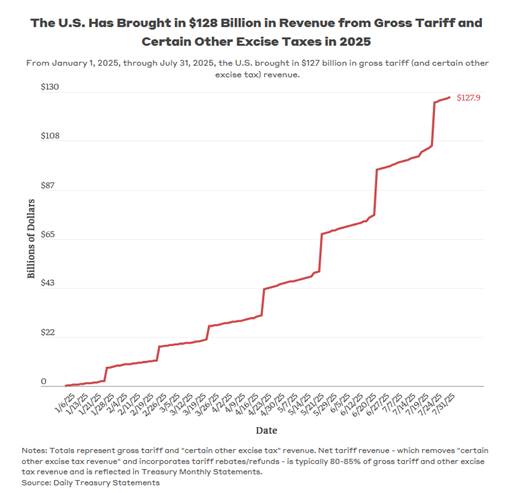
Note: “An important caveat is that the above data represent gross tariff and certain other excise tax revenue (emphasis ours)…Net tariff revenue in recent years has been 80% to 85% of gross tariff and certain other excise tax revenue.”
The Global Business Alliance recently published a Country-By-Country Reciprocal Tariff Rates Schedule available at this link: GBA notes “This document serves as a reference tool for country-by-country tariff rates. As they are subject to change at any time, depending on the progress of trade negotiations and President Trump’s discretion, updates to the following table will not be instantaneous. Barring any additional extensions or individual agreements, these rates are expected to go into effect on August 1, 2025.”
Of course, not everyone is happy with the tariffs. Companies that focus on selling imported goods, such as clothes, toys, consumer electronics, and electronic and electrical products are being hit the hardest due to rising costs, and small businesses that rely on imported materials from China to produce their products are also being hit hard due to rising costs. The problem is that for some products, there are no longer any U.S. sources.
As long tariff rates get imposed, rescinded, increased or reduced, it will make inventory management complicated as businesses big and small have to decide how and when to allocate capital. They have to decide whether to stockpile inventory before more increases come down the line or do they minimize inventory to preserve cash. Larger businesses will be better able to absorb the tariff costs or negotiate alternative supply cost arrangements than small business.
It takes time, resources, and administrative skill to navigate the kinds of sweeping changes to operations that tariffs require. Small business owners will need to navigate sourcing new suppliers, deal with increased paperwork and compliance costs, and decide how and when to use cash reserves to navigate the new playing field that tariffs require.
If international tariffs become permanent as I have recommended, they will transform business models, market dynamics, and innovation in the global economy. Tariffs will engender supply chain disruption away from previously reliable partners, modify product reformulation to use different inputs unaffected by tariffs, and strategic repositioning in the market based on new cost structures. It’s going to become crucial to build relationships with domestic suppliers.
One of the goals of tariffs is to help domestic industries expand as it pushes consumers to buy from U.S. brands. The danger is that tariffs may lead to higher domestic prices as imports become more expensive, competition is reduced, and prices increase as U.S. companies are able to charge more.
We will likely see a faster adoption of automation and utilization of AI to offset input costs and domestic alternatives to imported materials. This will create new business opportunities for U.S. manufacturers.
This transition to a new global playing field maybe difficult for some, but it is necessary if the U S. ever hopes to become self-sufficient again in producing the goods we need to protect the health and welfare of all Americans and remain an independent nation by protecting our national security and sovereignty.