Archive for the ‘Manufacturing’ Category

What is the Status of Legislation that Would Help Rebuild American Manufacturing?

Tuesday, May 26th, 2026

This past January, I wrote an article titled, “Has the 119th Congress Passed Legislation to Help Rebuild American Manufacturing?” in which I gave an update on whether or not Congress passed any of the legislation I had recommended in my article of January 2025, “What Legislation Should Congress Pass to Help Rebuild American Manufacturing?  to fulfill their campaign promise to support President’s Trump goal to Make America Great Again and help rebuild American manufacturing. 

We are now nearly six months later, so it’s time to examine if any of the bills I recommended have passed. 

Number one on my list was legislation to establish a Market Access Charge (MAC), defined as a proposed fee on foreign purchases of U.S. financial assets (like stocks, bonds, and treasuries)—intended to manage large capital inflows, influence exchange rates, and promote economic stability. This is a concept promoted by some economists and organizations like the Coalition for a Prosperous America (CPA).

Legislative Activity:

  • As of May 2026, no bill specifically titled “Market Access Charge” or directly imposing such a charge has been introduced in the 119th Congress (2025–2026).
  • The concept is discussed in economic policy circles but has not yet reached the stage of formal legislation.
  • Related proposals may occasionally surface in hearings or working papers, but have not led to a standalone bill. Senate Finance and House Ways and Means Committees have occasionally heard testimony on capital flows and financial stability, where the MAC is sometimes raised, but to date there is no active bill establishing a MAC.

2. H.R. 5811 – Restoring America’s Leadership in Innovation Act of 2023 (RALIA)

  • Status: Introduced 10/24/2025 by Rep. Thomas Massie (R-KY) with Rep. Marcy Kaptur (D-OH)
  • Summary: This bill aims to reform the U.S. patent system, making changes to post-grant proceedings and patent eligibility.
  • Latest Action: As of May 2026, H.R. 5811 was introduced in the House and referred to the House Committee on the Judiciary. No further action (such as a hearing or vote) has been reported.

3. H.R. 694 – The Restoring Trade Fairness Act

  • Status: Introduced January 23, 2025 Rep. John Molenaar (R-MI)
  • Summary: A bill to address perceived unfair trade practices, particularly relating to China.
  • Latest Action: H.R. 694 was introduced and referred to the House Committee on Ways and Means. There have been no further reported actions or movement out of committee.

3. S. 206 – The Restoring Trade Fairness Act

  • Status: Introduced on January 23, 2025 by Sen. Tom Cotton (R-AR)
  • Summary: Companion bill to H.R. 694 in the Senate.
  • Latest Action: S. 206 was introduced and referred to the Senate Committee on Finance. No additional reported activity at this time.

4. Legislation to Reduce the Allowed Value of De Minimis Imports

  • Status:  Multiple bills have been introduced in Congress to reduce the de minimis threshold (the value below which imports can enter the U.S. duty-free and with minimal documentation).
  • Latest Action: None have passed either chamber or advanced beyond committee.

5. S. 1053 – FIGHT China Act of 2025

  • Status: Introduced on March 13, 2025 by Sen. John Cornyn (R-TX).
  • Summary: This bill is aimed at countering economic and national security threats posed by China.
  • Latest Action: Introduced and referred to the Senate Committee on Finance. No additional major actions have been reported.

6. H.R. 3946 – FIGHT Act of 2026

  • Status: Introduced on March 13, 2025 by Rep. Andy Barr (R-KY)
  • Summary: Similar in intent to S. 1053, but focuses on U.S.-China relations and economic policy.
  • Latest Action: Referred to the House Committee on Ways and Means. Awaiting further action.

7. S. 1357 – SAFE Act (Secure America’s Financial Exchanges Act)

  • Status: Introduced April 8, 2025 by Rep. Rick Scott (R-FL) Marsha Blackburn (R), Bill Cassidy (R), Cindy Hyde-Smith (R), and John Neely Kennedy (R) are co-sponsors.
  • Summary: Seeks to ensure the security and integrity of U.S. financial exchanges.
  • Latest Action: Referred to the Senate Committee on Banking, Housing, and Urban Affairs. No additional committee activity reported.

8. S. 1358 – TASK Act (Transaction and Sourcing Knowledge Act)

  • Status: Introduced
  • Summary: Aims to improve the transparency of financial transactions crossing U.S. borders.
  • Latest Action: Referred to the Senate Committee on Banking, Housing, and Urban Affairs. No further movement to date.

Summary Table

Bill NumberTitleLatest StatusCommittee
H.R. 5811Restoring America’s Leadership in Innovation ActReferred to JudiciaryHouse Judiciary
H.R. 694Restoring Trade Fairness ActReferred to Ways & MeansHouse Ways & Means
S. 206Restoring Trade Fairness ActReferred to FinanceSenate Finance
    
S. 1053FIGHT China Act of 2025Referred to FinanceSenate Finance
H.R. 3946FIGHT Act of 2026Referred to Ways & MeansHouse Ways & Means
S. 1357SAFE ActReferred to BankingSenate Banking
S. 1358TASK ActReferred to BankingSenate Banking

You can use the links provided for each bill to read the bill text, see the sponsors and cosponsors, view all actions and amendments, and sign up for alerts by creating a free account on Congress.gov. These Congress.gov pages are updated in real time.

There was one bill that I had overlooked previously:  S.99 – Strengthening Support for American Manufacturing Act introduced into the Senate on January 15,2025 by Sen. Gary Peters (D-MI).

“This bill requires the Department of Commerce to contract with the National Academy of Public Administration to study and report on the offices and bureaus of the department that are relevant to critical supply chain resilience and manufacturing and industrial innovation.

The report must evaluate the purpose, statutory authority, effectiveness, efficiency, and limitations of each such office and bureau and provide recommendations to improve their effectiveness, efficiency, and impact.” This bill passed the Senate on October 23, 2025 without amendment by Unanimous Consent, but hasn’t been voted on by the House. 

It’s not enough just to introduce a bill; the bill’s sponsor needs to recruit as many co-sponsors as possible to gain support to hold committee hearings so that the bill can get enough votes to be passed out of committee for a vote by the House or Senate. Then, the sponsors and co-sponsors have to work to gain enough support for the bill to pass the House and Senate.

We need to stop the destruction of American industry and innovation, the loss of high-paying manufacturing jobs, and the collapse of communities. The bills listed above would be a big help in rebuilding American manufacturing’s capacity and eliminate dependence on China. They would help rebuild manufacturing capacity in industries that are critical to U.S. economic and national security. They would help to create prosperity for our children and grandchildren and ensure that they will continue to live in a free country. 

Because of the shorter legislative cycle caused by the mid-term elections in November, we only have a few months for Congress to pass these critical bills.  Each of us needs to pick one of the above bills that we support and then call our Congressional Representative and Senator to urge them to support that bill. 

Remember, “We the People” are supposed to be the basis for our Constitutional form of government.  If “We the People” are silent and do nothing, then the lobbyists for the multinational globalist corporations and organizations will have the power to influence our elected representatives to support their interests to the detriment of the American people as a whole.  If we want to remain an independent country, we need to be citizen activists and urge our elected Representatives not to allow us to become an economic vassal state of China.

The Globalization Trap: Reclaiming American Prosperity

Wednesday, April 29th, 2026

Michael Collinsadded to his extensive body of work as an American Manufacturing advocate with a fifth book, The Globalizaton Trap: Reclaiming American Prosperity.  This book is about “how neoliberalism and globalization were adopted by American Corporations and the U.S. government and how they radically changed the American economy and exploited the working class…globalization and the rise of neoliberalism as a political ideology turned out to be a trap where the average middle-class citizen bore the brunt of the economic changes through job losses, stagnant wages, and not being able to keep up with inflation.”

The preface sates: “From 1940 to 1980 the growth of the middle class increased with productivity growth and all boats rose with the tide.  He explains that “Neoliberalism is an ideology that emphasizes globalism, free trade, and letting the markets regulate the economy…The resultant deindustrialization has led to the decline of the middle class, and sacrificing jobs, industries, technologies, suppliers, and communities.”

Chapter One, “The Rise of Neoliberalism,” describes how Milton Friedman and Frederick Hayek developed a new theory called neoliberalism.” Neoliberalism is an ideology that emphasizes globalism, free trade, privatization, and deregulation.  Neoliberalism was a 180-degree reversal from Keynesian economics used in the New Deal…”  It incorporated Freidman’s dictum “An entity’s greatest responsibility lies in the satisfaction of the shareholders.”  

I believe this theory is fallacious because recent data from the U.S. Small Business Administration (SBA), shows that “approximately 98% to 99% of American manufacturing firms are privately owned” and “98.6% are classified as small businesses (fewer than 500 employees),” meaning that less than 2% of companies are benefiting. which Michael calls Multi-National Corporations (MNCs).

Also, “Neoliberalism was the theoretical foundation for radical economic changes and was closely connected to the strategy of outsourcing and globalization.”

He then documents the role Presidents Ronald Reagan, Bill Clinton, George W. Bush, and Barack Obama played in advancing neoliberalism and globalism. He concludes the chapter writing that “The good news is that the era of neoliberalism, free trade, and globalism is coming to an end.”

Chapter Two, “The Middle-Class Decline,” quotes a Pew Research Center analysis of government data, showing that “the middle class, has steadily contracted in the past five decades. The share of adults who live in middle-class households fell from 61 percent in 1971 to 50 percent in 2021.”  He attributes the decline to the following major reasons:

  • Automation
  • Outsourcing
  • Job losses in manufacturing (since 1979, 7.5 million jobs were lost due to automation and outsourcing)
  • Trade Agreements
  • Decline of Unions
  • Deregulation of Financial Industry
  • Rising prices for essential costs like housing, energy. health care, education, and food

In Chapter 3, “Winners and Losers in the Free Market,” he shows how globalization and free trade has led to: worker insecurity, abandonment of cities and towns in the Heartland, middle class despair, and evidence of the failure of the Service Economy.  As a result, he writes “since 1990, job quality as measured by the income earned by workers, has significantly declined. Less hours worked with less pay and little room for growth is becoming the norm.”

In Chapter four, “The Decline of American Manufacturing,” he presents these facts:

  • “U.S. manufacturing has fallen from 21 to 25 percent of Gross Domestic Product, in the 1950s to about 10 percent today.”
  • “American manufacturers have lost 11 percent of our domestic market since China was given most favored nation status in 2002 [now down to a Domestic Market Share Index of 66.9 percent.”
  • “In 1979, manufacturing jobs represented approximately 22% (19.7 million) of the total U.S. nonfarm workforce. By 2025, that figure had fallen to about 8% (12.7 million).”

He discusses why economists don’t think manufacturing is important to the U.S. economy, the damage caused by granting China Most Favored Nation Status (MFN), Free Trade Agreements, and outsourcing.  He concludes the chapter with a discussion of Why America must have a strong and growing manufacturing sector, much of the information corroborating information I have included in my three books and hundreds of blog articles.  I agree with his declaration, “The decline of manufacturing is the high price we pay for cheap imports.

Chapter five, “The Disintegration of American Industry” discusses what has happened to the critical sectors of the manufacturing industry that all other manufacturing industries depend on, such as machine shops, tool and die makers, Industrial mold companies, Ferrous, Iron, Steel Foundries, Nonferrous Foundries, Forging and stamping shops, Cutting tool accessories, and the plastic and rubber industries.

Representing manufacturers in these sectors is how I have made a living as a sales representative for over 40 years, so I have personally experienced the decline of these manufacturing industry sectors.

He also documents the decline in other industries, such as automobiles, shipbuilding, semiconductors, magnetic media, communications equipment, paper, textile and apparel, ceramics, pottery, tile, hardware, cutlery and hand tools.  I agree with his two major conclusions: “We won’t remain the number one economy and a world power if we allow the continued disintegration of American manufacturing industries and transition to the postindustrial service economy, and we can’t maintain national security and weapon systems if materials like aluminum, steel, and rare earth have shortages and cannot be controlled by the United States.”

In Chapter Six, Michael opines that the policy of Globalization that led to deindustrialization, redistribution of wealth, stagnant wages, the decline of living standards, and insecurity not experienced for generations, resulted in the backlash that resulted in the election of Donald Trump as President in the 2024 election when the middle class voted for their pocketbook.

In conclusion, he recommends, “If we are to have a chance of reducing inequality and reindustrializing the country, the United States needs a more robust industrial policy that protects key industries, manufacturing jobs…with a general goal of increasing manufacturing’s share of GDP to at least 15 percent. Perhaps the best solution is for millions of workers who are struggling financially to vote out their congressional representatives and elect politicians that are more sympathetic to the middle-class problems.”

In Chapter 7, “Protecting our Technologies,” he poses the question “How many technologies and industries are we willing to lose, before we lose our ability to compete using innovation as our primary strategy?”  He describes the problem and then examines the pros and cons of outsourcing. He discusses the importance of protecting the Advanced Technology Industries (ATIs), which are at the forefront of economic growth.

Chapter 8, “Critical Minerals and Metals Shortages,” is a well-documented and thorough discussion of this major problem. Two glaring statistics stood out the most:

  • “The United States remains fully import-dependent for rare earths and 14 critical minerals and more than 50 percent dependent for another 34.
  • The United States currently imports roughly half, or about 47 percent, of the aluminum consumed in the United States.”

Michael provides suggestions to solve these problems that are too complex and numerous to cite.  You will have to read them yourself.

The shortages of American-made pharmaceuticals are equally if not more critical than minerals and metals, and this topic is thoroughly discussed in Chapter 9. Two points to ponder are:

  • “The United States is dependent on imports for two-thirds of generic medicines, which are 90 percent of all prescriptions.
  • In 2002, U.S. manufacturers produced 84 percent of domestically consumed pharmaceuticals. In 2023, the number declined to 37 percent of the domestic market.”

He concludes, “The collapse of U.S. pharmaceutical manufacturing is the result of decades of free trade, increased market penetration due to state-sponsored subsidies and dumping, and the absence of government protection or and industry strategy.” Michael proposes a number of solutions that you need to read for yourself.

Chapter 10 discusses the many other industries and products that are also facing shortages, such as semiconductors, auto parts, rechargeable batteries, aviation components, solar panels, magnets. Michael asserts” Losing control of the supply of many critical products has made us susceptible to price manipulation and economic extortion…we must reclaim supply chains from China and other countries for everything from pharmaceuticals to semiconductors. I don’t think it is possible without some kind of monetary pressure on:

  • U.S. companies to reshore products
  • Foreign countries to reduce exports to the United States, running surpluses, manipulating currencies and dumping products into the United States below their production costs
  • The government to help find new sources of products that can’t be sourced from the United States.”

Chapter 11 discusses the role the overvalued U.S. dollar and finalization of the economy have played in the globalization trap. The concepts of the value of the dollar, currency manipulation, and unfair trade practices by China are too complex to describe in this article. I like his support for a Market Access Charge to balance the value of the dollar and achieve a current account balance within five years, about which I have written articles previously.

Chapter 12, “How Will We Solve the Problems Caused by Free Trade Policies,” Michael writes. “America must abandon free trade and globalism, bring manufacturing back to the United States, reduce our trade deficit, and protect our industries and technologies. We will also have to incentivize U.S. multinationals to stop outsourcing and incentivize both foreign and U.S. companies to establish manufacturing operations within the United States.” 

After summarizing the main problems caused by free trade policies, he concludes, “I think it can be done and will require a combination of tariffs, tax credits, quotas, selecting key industries, and adjusting the value of the dollar.”

In Chapter 13, “Productivism – A Plan for American Manufacturing,” he explains that “A new economic policy that favors production and investment is called “productivism.” The term was invented by Dani Rodrik of Harvard…Productivism is a supply side strategy to boost the most productive industries so it is important to select and prioritize the key industries that must be protected. “

He states, “Productivism using tariffs, tax credits, quotas, key industries, technology protection and training will generate economic growth, create jobs, raise household incomes, and with a forecasted one-time increase in consumer prices. But productivism also needs to be part of a federal plan that defines the goals and measurable objectives.”

With regard to tariffs. Michael echoes what I have expressed, “Tariffs are the first step in developing a new industrial policy…If using tariffs to incentivize U.S. corporations to reshore products is to work, the government must convince the corporations that tariffs are permanent and that the government is in it for the long haul.” He reminds us that “In fact, the U.S. tariffs averaged 30 to 40 percent from 1890 to 1945.”

The rest of the chapter discusses the pros and cons of tax credits, tax incentives, quotas, and protecting key industries.  Then he asks the question: “Where Will We Find the Workers?He cites that “A recent study by Deloitte and the Manufacturing Institute found that U.S. manufacturing could need as many as 3.8 million new employees by 2033, and nearly 2 million of those jobs could be left unfilled.”  The rest of the chapter provides suggestions on how to solve this problem

Chapter 14, “Economic Factors that Must Be Considered to Make the Trump Plan Work,” outlines the following factors and provides suggestions on how to address these factors:

  • Decline in federal basic research
  • Loss of Technology Dominance
  • Capital investment and Stock Buybacks
  • Growth of National Debt
  • Transshipping to Avoid Tariffs
  • Banning Specific Products or Specific Companies
  • Artificial Intelligence and Additional Energy

In Chapter 15, “Refloating the Boats – What do we Have to Do to Grow the Middle Class?” Michael summarizes some of the points he wrote about in previous chapters.  Then, he posed the question: “is it still possible for the average worker to attain the American Dream and can the decline of the middle class be reversed? He states, “I think it is possible to grow the middle class, increase wages, and improve living standards and income for much of the middle class if the country can commit to production, not consumption.” This book was an easy read and holds your attention right up to the end.  I highly recommend this book to everyone who is concerned about the future of the manufacturing industry, the decline of the middle class, and our country’s ability to protect our national security.  Every Senator and Congressional Representative needs to read this book.  I suggest you buy one book for yourself and one to give to your Representative.

Made in America Manufacturer Prospers in Rust Belt

Tuesday, February 17th, 2026

Last November, I watched a video interview on LinkedIn where Drew Greenblatt, President of Marlin Steel Wire Products, was talking about how he was investing in his companies located in rural areas of Indiana and Michigan.  I connected with him and asked him if he would be willing to let me interview him about his company’s success as I like to write articles about successful American manufacturers.

Our schedules final coincided last Friday, and to start the interview, I asked Drew to provide a brief history of Marlin Steel.  He said, “The company was founded in 1968 by another fellow. I owned a company that made medical devices and burglar alarms. I did very nicely with it. It was hard hours, early in the morning appointments, late in the night appointments, and it was a business selling to consumers. It didn’t match my personal deportment. I like dealing and working with engineers that are very black and white, that are very precise.  So, I craved working with more scientifically bent people.

We got an offer to buy my company, and I used the proceeds of the sale to buy Marlin Steel in 1998 when it was in a 3,000 sq. ft. building, The newest piece of equipment was from the 1950s. The company had no health insurance plan. The health insurance plan was going to the emergency room. They had no retirement plan.  The retirement plan was Social Security. So, we’ve come a long way. Everybody has the same health insurance plan my wife and I have, and my three boys have. And we’re very fortunate. More than half the employees own a home. Most employees own at least one car, most have two cars, and they all have 401ks, and they’re very well paid.  Manufacturing is fabulous for American workers, and they’re feeling it at Marlin. It’s great stuff.  I moved the company to Baltimore, MD, and the plant is now 37 times bigger than the Brooklyn plant.”  

I asked Drew what kind of equipment he has now.  He said, “We have press brakes up to 230 tons and 10 ft. wide, laser cutting machines, and we just acquired a new Trumatic 3000 robotic laser punch combo machine that is 10x faster than our other machines. It’s going to enable us to cut brass, cut copper, as well as stainless steel, aluminum, and sheet metal like we’ve done in the past.  Separately, in our Indiana plant, we also have a lot of wire equipment, three-dimensional benders. We have automated mesh welders.  We do cable access trays, wire baskets, carts, point of purchase displays. We do a tremendous amount of Top-of-the-line quality production out of all these three facilities.”

I asked Drew when he acquired the plant in Orland, IN, and he answered, “Marsden Steel Wire Products was established in 1938, and it was a fabulous company in the rural Indiana. We I heard through the grapevine in 2021 that it was available for sale. We bought the company and put over $5 million dollars of cash into it:   brand new bathrooms, brand new break rooms, brand new offices, brand new roof, just made the building sparkle.  We now have 100,000 sq. ft. of manufacturing space and took the company from 33 employees to 80 employees We have wire fabrication equipment, 3D benders, and automated mesh welder. We are hiring people there, and we’re growing. “

I next asked Drew when he expanded to having a plant in Bronson, MI., and he responded, “In March 2023, we wanted Marsden Steel to have their own powder coating plant, and we heard about a building ten miles north of Orland in Bronson that was available. The building had been empty since the recession of 2008 when the company closed down after being the major employer of this small rural community.  We bought this decrepit building and had a career fair where 350 people applied for jobs.  We put millions of dollars into the plant buying equipment, modernizing the bathrooms, lunch break room, and offices.  We are hiring more people and growing to become the major manufacturer in the community. We pay good wages and provide good benefits to our employees. We’re very excited. We love Michigan. We love Indiana. They have great manufacturing communities. We look at how fabulous the workforce is. It’s just tremendous. We’re just so fortunate and blessed to be in these communities. 

I changed the subject to ask how tariffs are affecting his company.  He responded, “Tariffs are fabulous for Marlin and Madsen Steel Wire because we only make in America and we only use American steel.  So, entities that build in America don’t have a tariff problem. I would recommend to people that are having a hardship with tariffs, build in America, and then you don’t have to pay a tariff. 

It’s really good for the local community because what happens is you hire locals. And then these locals buy homes, and they buy cars, and they go to the local dry cleaner, and they go to the local barbershop, and they’re gainfully employed, and they’re making a nice middle-class living.  I implore communities to encourage manufacturing. This policy is about time because it gives us an opportunity to make a level playing field with people that have been subsidizing their steel, subsidizing their currency, despoiling their environment.  You know, we treat our environment A++. I live right by the Chesapeake Bay in Baltimore. I love eating Maryland crabs. We want to have a clean environment. It’s not right that people bring in things from dirty factories that are putting smog in the world and despoiling the Yangtze River and their environment, and then shipping to us for a ‘low price.’  The low price is despoiling our environment. They’re using slave labor, and it’s just not a fair fight competing with state-owned enterprises over in China.  I believe that we have to recalibrate our thought process, buy from the hometown heroes in Maryland, Indiana, Michigan, and other American local communities so that they can support a middle-class lifestyle.”

Drew said, “I think there’s a dramatic change that’s about to happen. We are right now at a junction point. I contend that we are right now de-risking as a nation and decoupling from China. For decades, we’ve had a very poor policy description of outsourcing all of our factories to China and not making things as much as we used to.   And that was a foolish policy.

We are now pivoting, thankfully, to a policy where we embrace American manufacturing because we need to make things here.  We can’t be beholden to outsiders that they will make us ships and they will make us shoes and they will make us baskets and they will make us racks and they will make us carts when times get tough.  We have to be self-sufficient. We have to make our own printed circuit boards. We have to make our own silicon chips.  We have to make things here in America. I think there’s a realization by our policymakers that we have to re-look at how we did things in the past, and there is a fabulous, bright opportunity for the American people because there’s going to be a lot of new avenues to make a decent, solid, middle-class living again in our country.  We can’t just be a nation of baristas and housekeepers and service workers at restaurants.  We have to have very fulfilling jobs, jobs with dignity, making high-end pay with great benefits.”

I told him that couldn’t have said it better and have said it similarly in my books and articles. We have been outsourcing our pollution by sourcing manufacturing in China and other Asian countries. China is one of the most polluted countries in the world.  What China and India have done to their countries is criminal.  I agree that we need to make things in America because we make them in a non-polluting way because of beneficial environmental regulations.

Next, I asked if he was involved in any kind of industry association, and he answered, “Yes,

I’m a proud member of the National Association of Manufacturers and the Regional Manufacturing Institute.  I am a former member of the NAM Executive Board, and I was the chairman of the small and medium-sized manufacturers comprising 14,000 members.   I love NAM. I think they’re fabulous. I think there are discussions at NAM about the right way to approach the tariffs and some of these other policies. I think NAM is an important advocate for American manufacturing and think they’re doing a great job for our country.”

Finally, I asked him if his company practiced the principles of Lean manufacturing and done any training in lean. He replied, “I had the honor and privilege as the chairman of the Regional Manufacturing Institute here in Baltimore to introduce Ellie Goldratt on his last speech in public to a huge crowd in Baltimore, Maryland. He spoke at a local community college in a huge auditorium, and I was privileged to introduce him before his speech.  He was unfortunately dying of lung cancer, and he gave a most beautiful speech for his class public speech. 

Afterwards, he pulled me aside, and he said that he was touched by my intro because I expressed to the crowd that his book had changed my life and changed how we ran the business and saved my business because we followed his methods. He said that he was heading back to the hotel before he went to the airport and invited me to ride in his limo to talk.  I accepted his offer even though I had my own car in the parking lot because I realized that this was one of the greatest opportunities of my life. For the next 20 minutes, he basically did an autopsy on me even though I was alive.  All of his piercing, smart questions really dove deep into Marlon Steele and gave me some great ideas. Unfortunately, he soon passed after returning to Israel. It was a touching moment in my life, and we changed our business because of him.  A lot of my success is because of his great advice.”

In conclusion, I asked him if he has any plans to expand to any other locations in the future. He responded, “Yes, absolutely. We are going to be growing in America, only in America. We need more thriving small and medium-sized manufacturers, but we also need big ones because, you know, I hope to be one of the big boys and keep on growing.  We’re 37 times bigger than the day I bought the factory in 1998, and I want to be 37 times bigger than I am today. We are having discussions with several other entities.  We are aggressively looking to acquire other manufacturers that make wire fabrications and sheet metal fabrications. We’re very optimistic about the future.  We’re very bullish on America.”

I told him that his company was definitely the kind of company that I like to write about and he is the type of company owner we need to have more of in America —  people that appreciate our country, appreciate making things in America in the communities in which they live, appreciate the people that work for them by giving them the right kind of benefits and safe working conditions, and training. I want more companies to be successful like his company because it’s beneficial to the communities you’re in and beneficial to our economy because manufacturing jobs create taxpayers instead of people who receive benefits.

Are Tariffs Creating Inflation?

Tuesday, October 14th, 2025

There is considerable debate on whether or not President Trump’s tariffs are creating inflation. Many economists argue that tariffs are inflationary because they directly raise the cost of imported goods and may lead to higher prices for domestic alternatives. This perspective was echoed by former Federal Reserve Chair Janet Yellen, who stated in 2022, “Tariffs tend to boost domestic prices and make goods more expensive.” This article will examine the data to determine whether tariffs are causing inflation.

When a government imposes tariffs on imports, the immediate effect can be raising the price of those imported goods. And, if domestic producers also increase their own prices, this can create upward pressure on the overall price level—an effect referred to as inflation.

However, some analysts believe the inflationary impact of tariffs depends on context. For instance, if tariffs are targeted at goods with plentiful domestic alternatives, or if the affected imports are a minor component of household spending, the inflationary effect might be muted. The Congressional Research Service notes: “The overall effect on inflation depends on the share of products subject to tariffs and the ability of consumers to substitute away from higher-priced imports.”

While there is agreement that tariffs tend to increase the prices of affected goods, the extent to which they contribute to overall inflation depends on the structure of the economy and the scope of the tariffs. Most empirical evidence suggests tariffs do put upward pressure on prices, but the scale and significance can vary.

After President Trump announced new and expanded tariffs on a wide range of Chinese imports in 2025—covering sectors like electric vehicles, batteries, and advanced technology—economists expressed their opinions on the likely impact on inflation. Here’s an overview of professional opinions from several economists and economic organizations:

1. Goldman Sachs

Goldman Sachs economists argued that “The new tariffs are likely to have a small direct impact on inflation, since the targeted products account for a minor share of consumer spending. However, if tariffs are broadened or trigger retaliation, the impact could be more significant, especially if supply chains are disrupted.” However, they noted that “broader or retaliatory tariffs could have a more meaningful effect if they lead to supply chain disruptions or higher costs for intermediate goods.”

2. Lawrence Summers (Former U.S. Treasury Secretary and Harvard Professor)

Lawrence Summers criticized the 2025 tariffs, stating, “Tariffs are taxes that get passed on to consumers. The more tariffs, the more upward pressure on prices,” and that the new measures “risk modest but noticeable increases in prices for consumers, especially on goods made with Chinese components.”

3. Paul Krugman (Nobel Laureate, New York Times Columnist)

Krugman wrote that while the immediate, direct impact of the 2025 tariffs on inflation “will likely be limited and largely sector-specific,” there’s a risk that trade wars escalate: “Retaliation and further trade barriers could eventually seep into broader price increases.”

4. Moody’s Analytics (Mark Zandi, Chief Economist)

Mark Zandi of Moody’s Analytics stated the 2025 tariffs “will have a marginal, temporary effect on inflation,” estimating an increase of “less than 0.1 percentage point” on the Consumer Price Index in the following year. He cautioned, however, that “if the trade conflict escalates, the inflation impact could be more significant.”

5. Peterson Institute for International Economics

A policy brief from PIIE pointed out, “Past experience shows that tariffs are paid by U.S. importers and often passed on to consumers, though the 2025 set of tariffs mainly target industries where substitution is possible, potentially blunting the inflation impact.”


Summary Table

Economist/OrganizationOpinion on Inflation EffectSource Link
Goldman SachsSmall direct impact, higher risk if escalation occursGS Research
Lawrence SummersModest but noticeable upward pressure on pricesFinancial Times
Paul KrugmanLimited sectoral effect, bigger risk if trade war escalatesNYT
Mark Zandi (Moody’s)Marginal, temporary rise; more if conflict escalatesMoody’s Analytics
Peterson Institute (PIIE)Tariffs paid by importers, inflation muted by substitutionsPIIE

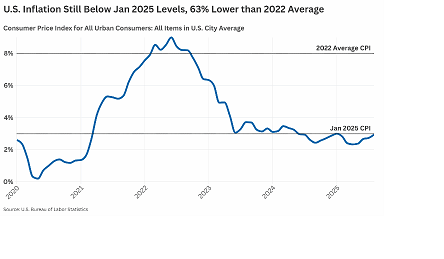
A September 25, 2025 report titled , “Tariffs Are Not Causing Inflation: Breaking Down August 2025 CPI” by Andrew Rechenberg of the Coalition for  Prosperous America argues “Inflation today is moderate, running far below the post-COVID peak and even below January 2025 levels, before any new tariffs were enacted. Furthermore, the main drivers of August 2025 inflation are housing shortages, energy demand, and food supply shocks — not tariffs.”

The report breaks down the August Consumer Price Index showing that the following drivers for inflation were:

  • Shelter: +0.4% m/m
  • Airline Fares: +5.9% m/m.
  • Beef: +2.7% m/m retail; +8% wholesale PPI.
  • Coffee: +6.9% m/m.
  • Electricity: +0.3% m/m
  • Eggs: flat m/m, but +10.9% Year over Year

Surprising to economists was the fact that many imported goods were not the drivers of inflation as shown below:

  • Autos: New vehicles rose +0.3% m/m and used vehicles +1.0% m/m
  • Steel & Aluminum: +0.4% m/m
  • Electronics: flat to +0.1% m/m
  • Pasta, Olive Oil, and Spices: 0.0–0.2% m/m

Andrew concludes: “If tariffs caused “economic disaster,” inflation wouldn’t be at 2.9% — it would look like 2022 all over again. Inflation data does not support these dire warnings. CPI rose just 0.2% in August, while PPI actually declined. As shown in Figure 1, Inflation today is running 63% below the 2022 average and even just below January 2025 inflation levels, hardly the sign of an “economic disaster.”

In reality, an examination of the Consumer Price Index (CPI) from March 2025 to July 2025 shows that the main drivers of price increases (inflation) are similar to the August report examined by CPA. 

1. Energy Prices

  • Import-related: Increases in global oil and gas prices due to geopolitical tensions or supply constraints (e.g., OPEC+ production cuts, Middle East instability) drove up domestic fuel and electricity prices.
  • Domestic: Infrastructure failures or domestic supply chain issues (e.g., refinery outages, grid failures) also boosted local energy prices.

2. Food Prices

  • Import-related: Rising prices of imported foodstuffs (such as coffee, cocoa, grains, or meat) due to poor harvests, supply chain disruptions, or currency depreciation.
  • Domestic: Domestic droughts, floods, or other adverse weather events affected local crop yields, and labor shortages increased local production costs.

3. Wages and Labor Costs

  • Domestic: Wage increases from tight labor markets or new government policies (minimum wage hikes) led to higher costs for services and goods, which was passed on to consumers.

4. Rents and Housing Costs

  • Domestic: Continued demand for housing, supply shortages, and higher mortgage interest rates pushed up rents and property costs.

As we can determine from data for the CPI from March to July 2025, the main drivers for inflation are related to domestic policies, not tariffs.  Each of these drivers could be explored in separate articles, but that would be out of my area of focus and expertise. 

Thus, I continue to support President Trump’s tariffs that will balance our trade deficit and help rebuild American manufacturing.  I still believe that fluctuating tariffs on Chinese imports that are only temporary and at lower levels won’t have the lasting effect needed to rebuild America’s industrial base.  Tariffs on Chinese imports need to be made permanent at a high level (100-125%) to influence CEOs of American companies to decide to reshore manufacturing to America, expand existing plants, and/or build plants in new locations.  This action is truly the only way to Make America Great Again.

What is the Impact of Tariffs on the Manufacturing Industry

Tuesday, September 23rd, 2025

The reciprocal tariffs mentioned in my previous article went into effect August 1, 2025.  These tariffs are intended to protect domestic industries from foreign competition, encourage returning manufacturing from China and other countries to the U.S, and raise revenue.  Tariffs aren’t affecting U. S. companies that manufacture Made in America products; however, they are affecting U.S. manufacturers that rely on imports for parts and subassemblies.

A tariff on imported goods may increase the cost of those goods for manufacturers that depend on imported parts or raw materials.  These cost increase may be too significant to be absorbed entirely by the manufacturer and manufacturers may also face intense market competition forcing them to absorb some or all of the added costs.  These higher costs may lead to higher prices or reduced profit margins for the company, which directly reduces their profitability. Furthermore, retaliatory tariffs from other countries can limit export opportunities for manufacturers, shrinking their revenue streams.

For example. When the U.S. Steel and Aluminum Tariffs of 2018 imposed tariffs of 25% on imported steel and 10% on imported aluminum, it had a negative impact on manufacturers that used these materials, such as carmakers and appliance manufacturers.  Ford Motor Company reported that the steel tariffs cost them $1 billion in additional expenses, leading to lower profits. Similarly, Whirlpool, a major U.S. appliance maker, saw higher costs for washing machine components and announced price increases on its products.

 However, long-term data shows that these tariffs boosted domestic production of U.S. steel and aluminum and actually saved the industry from substantially contracting further.  U.S. production of steel and aluminum has greatly increased since 2018, plants have been expanded and new plants have been built, increasing jobs in this industry.

The reciprocal tariffs President Trump promised to impose went into effect August 1, 2025.  Here’s a summary of the reciprocal tariffs on the top ten U.S. trading partners:

RankCountryU.S. Imports Value (2024, est.)Reciprocal Tariff Actions (2025)
1China$515 billionTariffs on U.S. soybeans (30%), autos (25%), pork (35%), liquefied natural gas (LNG) (25%), and whiskey (20%). Electronics and agricultural products heavily targeted.
2Mexico$385 billionTariffs mostly on U.S. pork (20%), apples (20%), cheese (25%), and various steel products (15–25%). Focus on U.S. agricultural and steel/aluminum exports.
3Canada$340 billionTariffs on steel (25%), aluminum (10%), U.S. whiskey (10%), orange juice (20%), and various household products (10–30%). Application is selective and closely mirrors U.S. tariff lists.
4Japan$170 billionTariffs on U.S. beef (38%), wine (15%), and motorcycles (20%). Also, technical restrictions on auto parts.
5Germany$145 billion*EU-wide tariffs: autos (25%), motorcycles (31%), bourbon (25%), peanuts (25%), denim (25%). Retaliation is coordinated through the EU.
6South Korea$110 billionTariffs on U.S. beef (18%), whiskey (20%), certain chemical exports (15–25%), and various machinery components (10–20%).
7United Kingdom$87 billionTariffs (via the UK’s post-Brexit regime): bourbon and other whiskies (25%), motorcycles (25%), orange juice (20%), jeans (10–15%).
8France$80 billion*EU-wide retaliation as in Germany: cheeses, bourbon, textiles (10–25%), and Harley-Davidson motorcycles (31%).
9India$73 billionTariffs on U.S. almonds (20%), apples (20%), walnuts (20%), Harley-Davidson motorcycles (50%), and medical devices (15–30%).
10Italy$68 billion*EU-wide retaliation: affected products include denim, motorcycles, whiskey, and certain agricultural goods (10–31%).

President Trump’s renewed tariff policy has affected a wide array of industries, from automobiles to electronics and telecommunications. Here’s how several key sectors have been hit, with up-to-date statistics:

1. Automobiles

  • Tariff Details: On April 3, 2025, the U.S. imposed a 25% tariff on Chinese-made automobiles and car parts.
  • Cost Increases: According to the Alliance for Automotive Innovation, average U.S. auto manufacturing costs rose by $1,800 per vehicle.
  • Price Impact: Ford and General Motors reported MSRP increases between $1,500–$2,300 for popular models, affecting consumer demand.
  • Profits: GM’s Q2 2025 earnings fell by 10%, attributing $650 million in added costs directly to tariffs.

2. Motorcycles

  • Tariff Details: Motorcycles imported from China and the EU are subject to 31% tariffs in 2025.
  • Cost Increases: Harley-Davidson estimated that tariffs have added $2,200 to the production cost of each exported bike.
  • Sales Decline: U.S. motorcycle exports to the EU dropped by 22% in the first half of 2025, according to U.S. Department of Commerce data.
  • Profits: Harley-Davidson’s international profit margins shrank by 14% compared to Q2 2023.

3. Electronic Equipment

  • Tariff Details: A 25% tariff was placed in 2025 on Chinese electronic components, including circuit boards and sensors.
  • Cost Increases: The Consumer Technology Association reported the average cost for U.S. electronics manufacturers rose by 11% across the board.
  • Price Impact: Apple raised iPad and MacBook prices by 7% this year, and smaller manufacturers like Sonos reported 12% lower earnings due to increased import costs and delayed shipments.
  • Industry-wide effect: According to the Electronic Components Industry Association, U.S. imports of certain components from China fell by 19% due to the higher costs, forcing some manufacturers to consider moving production outside the U.S.

4. Telecommunication Products

  • Tariff Details: Key telecom products—including modems, routers, and 5G networking gear—now face a 15% tariff when imported from China in 2025.
  • Cost Increases: Cisco Systems reported a $300 million increase in production expenses over the first two quarters of 2025, which it directly attributed to these tariffs.
  • Price Impact: U.S. telecom providers such as AT&T and Verizon announced average price hikes of 8% on internet hardware and new installations.
  • Market Share: U.S. telecom equipment exports to Asia declined by 15%, largely because of reciprocal tariffs on American products.

The electronics industry, characterized by complex global supply chains, has been particularly affected by U.S.-China trade tensions. Tariffs on Chinese-made circuit boards and components have increased costs for American manufacturers of computers, smartphones, and consumer electronics. Many smaller manufacturers, lacking the resources to absorb higher costs or negotiate new supply contracts, have faced shrinking profit margins and, in some cases, layoffs or business closures.

Here are examples of the effect on specific companies:

  1. Tesla: With the reintroduction of 25% tariffs on Chinese-made electric vehicles and batteries in 2024, Tesla has seen increased costs for its U.S.-assembled vehicles that use Chinese batteries and electronics. The company announced in May 2025 that the price of its Model Y and Model 3 would rise by $2,000 in North America, citing higher costs for batteries and electronic components. Elon Musk publicly stated that profit margins had dropped in Q2 2025 as a direct result of the tariffs.
  2. Caterpillar and Construction Equipment:
    Caterpillar, a leading U.S. maker of construction and mining equipment, relies on imported steel and engine parts from Asia. Trump’s new tariffs on Chinese and Southeast Asian metals have increased input costs by an estimated $200 million in 2024 alone. The company’s quarterly earnings report in July 2024 cited tariffs as a key factor in a 12% drop in net profit.
  3. Apple and Consumer Electronics:
    Apple, which assembles many of its products in China, is facing new 2024 tariffs on imported computer parts and finished devices. This has forced Apple to increase the prices of iPads and MacBooks in the U.S., and the company warned investors that gross margins would be tighter in the second half of 2024. Smaller electronics makers have reported even greater challenges, with some delaying product launches or laying off staff.
  4. General Motors (GM) and Car Parts:
    GM sources many car components, such as sensors and wiring harnesses, from Chinese suppliers. The 2024 tariffs have pushed up the cost of these parts, forcing the company to trim its profit outlook for the year. In its June 2024 investor call, GM confirmed that U.S. consumers would see higher prices for popular models like the Chevrolet Equinox and Silverado.

Why Tariffs Are Affecting the Manufacturing Industry So Greatly

For the past 30 years, outsourcing has been a cornerstone of U.S. manufacturing. First, manufacturers outsourced to Mexico, Puerto Rico, and the Philippines.  After China was granted Most Favored Nation status in the year 2000, manufacturers turned to Chinese suppliers for components, subassemblies, and finished goods, leveraging advantages of lower cost labor and materials, as well as less regulatory and environmental burdens. Many of my previous articles have outlined in detail the adverse effects of outsourcing to China on the U.S. manufacturing industry. 

Now, the introduction of these new tariffs is fundamentally changing this equation, turning an once cost-saving strategy into a financial burden for many U.S. manufacturers. Outsourcing has now become more expensive in the following ways:

1. Direct Tariff Costs

  • Tariff Rates: Tariffs on Chinese goods are now as high as 25% on electronics parts, 20% on automobile components, and 15% on telecom equipment. Any component or assembly imported from China is now subject to these elevated fees.

2. Supply Chain Disruption and Rushed Re-Sourcing

  • Supplier Shifts: Many manufacturers tried to pivot quickly to suppliers in Vietnam, Mexico, or India to avoid tariffs, but these regions often do not have the scale, experience, or infrastructure China offers.
  • Startup and Transition Costs: Changing suppliers requires significant investment, including qualifying new vendors, adapting designs to new materials, and sometimes retooling factories.

3. Increased Lead Times and Logistical Challenges

  • Shipping Delays: With tariffs in place, the process of importing from China became slower due to increased customs inspections and complex paperwork.
  • Inventory Costs: Companies like Apple and Dell reported having to maintain higher inventory levels—tying up capital and storage space—to avoid disruptions in the event of customs-related delays at ports.

4. Loss of Economies of Scale

  • Production Costs: Many U.S. manufacturers once benefited from China’s massive scale, which kept per-unit costs very low. With some companies moving only part of their production elsewhere to avoid tariffs, both U.S. and Chinese suppliers often increased prices due to reduced order volumes, further eroding cost advantages.

Outsourcing to China, once a reliable way to cut costs, has become a liability under the 2025 tariffs.  The solution to avoid paying tariffs is to “reshore” – return manufacturing to America.  It may be difficult if not impossible to find U.S. suppliers for some commodities, such as some electronic components. Manufacturers can get help finding U.S. manufacturers to replace their Chinese vendors through consulting services offered by The Reshoring Initiative at this link.

In addition, we may need to establish Federal grants similar to SBIR grants for companies to startup producing critical components again the in U.S. The end goal is worth doing whatever it takes to rebuild American manufacturing to the point where we are once again self-sufficient in producing the goods we need to protect the health and welfare of all Americans and remain an independent nation by having the goods we need to protect our national security and sovereignty.

What Have Been the Effects of President Trump’s Tariffs?

Tuesday, August 5th, 2025

During his campaign for re-election for President, President Trump pledged to address the unfair and unbalanced trade that the U.S. has experienced for many years.  Contrary to many politicians, President Trump kept his campaign promise by establishing an America First Trade Policy in which trade and economic policies would “put the American economy, the American worker, and our national security first.”  He announced, “I am establishing a robust and reinvigorated trade policy that promotes investment and productivity, enhances our Nation’s industrial and technological advantages, defends our economic and national security, and — above all — benefits American workers, manufacturers, farmers, ranchers, entrepreneurs, and businesses.” 

The remedies to address unfair and unbalanced trade included investigating “the causes of our country’s large and persistent annual trade deficits in goods, as well as the economic and national security implications and risks resulting from such deficits, and recommend appropriate measures, such as a global supplemental tariff or other policies, to remedy such deficits.”

As CNN Business reported, “In April, Trump imposed “reciprocal” tariffs as high as 50% on most of America’s trading partners.”. On April 9, President Donald Trump gave the world a three-month window to negotiate trade deals with the United States or face higher “reciprocal” tariffs. With just five days remaining in that tariff moratorium, the White House is expected to begin delivering a message to a dozen or so countries: Time is up, and here’s your new tariff rate.”

The article stated that Trump “told reporters that he would notify 10 to 12 nations a day over the course of the next five days, detailing their new tariffs in letters that the White House would begin sending on Friday. In most cases, the new rates would go into effect August 1, Trump said. “They’ll range in value from maybe 60% or 70% tariffs to 10% and 20% tariffs, but they’re going to be starting to go out sometime tomorrow,” Trump said. “We’ve done the final form, and it’s basically going to explain what the countries are going to be paying in tariffs.”

A July, 19, 2025, ABC News article titled, “What have Trump’s tariffs achieved so far? Experts weigh in,” Max Zahn wrote “The Trump administration touts tariffs as part of a wider set of “America First economic policies,” which have “sparked trillions of dollars in new investment in U.S. manufacturing, technology, and infrastructure,” according to the White House’s website.

The article stated, “Scores of companies have pledged new investment in the U.S., including tech giants Apple and Nvidia, pharmaceutical companies Merck and Johnson & Johnson as well as automakers Hyundai and Stellantis, the White House says. The whole idea is to encourage reshoring of manufacturing and change the balance of trade. That could all have some positive impact,” Morris Cohen, a professor emeritus of manufacturing and supply chains at Duke University, told ABC News.”

The Trump Effect page on the White House website states, “Since President Donald J. Trump returned to office, his America First economic policies have sparked trillions of dollars in new investment in U.S. manufacturing, technology, and infrastructure…The U.S. has seen a surge of private and foreign investment that are fueling job growth, innovation, and opportunity across every corner of the country. The website provides a list of the major investments by foreign countries and companies at this link.

Adding up the totals on the link comes to about 40 billion dollars. Of course, these pledges were made under threat of high tariffs, so time will tell if the companies and countries keep their pledges.

On July 29th, MSN Markets Today reported “The U.S. trade deficit in goods narrowed to the lowest level in nearly two years in June as imports fell sharply, cementing economists’ expectations that trade likely accounted for much of an anticipated rebound in economic growth in the second quarter.

The goods trade gap narrowed 10.8% to $86.0 billion last month, the lowest level since September 2023, the Commerce Department’s Census Bureau said. Economists polled by Reuters had forecast the goods trade deficit would rise to $98.20 billion. Imports of goods decreased $11.5 billion, or 4.2%, to $264.2 billion, the lowest level since March 2024. The decline was led by a 12.4% plunge in consumer goods imports.” 

On Sunday, August 3, 2025, the English edition of Trending News & Research reported:  “The US government under Donald Trump is collecting more money than ever from import tariffs, with customs duty revenue crossing $100 billion in fiscal year 2025—more than double what it brought in just five years ago. Treasury and Homeland Security figures suggest the final tally could reach $300 billion by year’s end, fueled by sweeping tariffs imposed on goods from over 100 countries, including India, Brazil, Russia, China and Canada. Customs duties now make up nearly 5% of total federal revenue, up from an average of 1.6% in previous decades. July alone saw the US collect a record $28 billion in tariff duties, with economists projecting that number could climb as high as $37 billion per month from August onward, when new rate hikes take effect.”

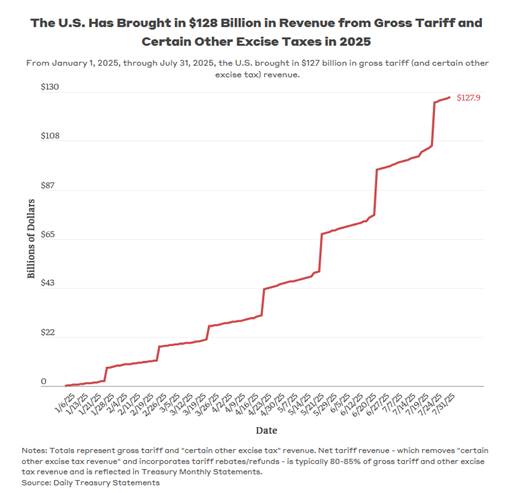
The Bi-Partisan Policy Center Tariff Tracker shows that the U.S. has brought in $128 billion in revenue from gross tariffs and other excise taxes in 2025 as shown by the following chart.

Note: “An important caveat is that the above data represent gross tariff and certain other excise tax revenue (emphasis ours)…Net tariff revenue in recent years has been 80% to 85% of gross tariff and certain other excise tax revenue.”

The Global Business Alliance recently published a Country-By-Country Reciprocal Tariff Rates Schedule available at this link:  GBA notes “This document serves as a reference tool for country-by-country tariff rates. As they are subject to change at any time, depending on the progress of trade negotiations and President Trump’s discretion, updates to the following table will not be instantaneous. Barring any additional extensions or individual agreements, these rates are expected to go into effect on August 1, 2025.”

Of course, not everyone is happy with the tariffs. Companies that focus on selling imported goods, such as clothes, toys, consumer electronics, and electronic and electrical products are being hit the hardest due to rising costs, and small businesses that rely on imported materials from China to produce their products are also being hit hard due to rising costs.  The problem is that for some products, there are no longer any U.S. sources.

As long tariff rates get imposed, rescinded, increased or reduced, it will make inventory management complicated as businesses big and small have to decide how and when to allocate capital. They have to decide whether to stockpile inventory before more increases come down the line or do they minimize inventory to preserve cash. Larger businesses will be better able to absorb the tariff costs or negotiate alternative supply cost arrangements than small business.

It takes time, resources, and administrative skill to navigate the kinds of sweeping changes to operations that tariffs require.  Small business owners will need to navigate sourcing new suppliers, deal with increased paperwork and compliance costs, and decide how and when to use cash reserves to navigate the new playing field that tariffs require.

If international tariffs become permanent as I have recommended, they will transform business models, market dynamics, and innovation in the global economy. Tariffs will engender supply chain disruption away from previously reliable partners, modify product reformulation to use different inputs unaffected by tariffs, and strategic repositioning in the market based on new cost structures. It’s going to become crucial to build relationships with domestic suppliers.

One of the goals of tariffs is to help domestic industries expand as it pushes consumers to buy from U.S. brands. The danger is that tariffs may lead to higher domestic prices as imports become more expensive, competition is reduced, and prices increase as U.S. companies are able to charge more.

We will likely see a faster adoption of automation and utilization of AI to offset input costs and domestic alternatives to imported materials. This will create new business opportunities for U.S. manufacturers. 

This transition to a new global playing field maybe difficult for some, but it is necessary if the U S. ever hopes to become self-sufficient again in producing the goods we need to protect the health and welfare of all Americans and remain an independent nation by protecting our national security and sovereignty.

Does the One Big Beautiful Bill Help Rebuild American Manufacturing?

Tuesday, July 22nd, 2025

In my January article titled, “What Legislation Should Congress Pass to Help Rebuild American Manufacturing? I made several recommendations.  Now, we will examine what provisions the One Big Beautiful Bill (OBBB) included that would help achieve the goal of rebuilding American manufacturing.

I asked one of my long-time business colleagues, Bruce Knowlton, to examine what tax benefits the OBBB provides for American manufacturers.  Bruce recently retired from being a long-time partner at Moss Adams LLP in San Diego and will begin teaching tax accounting at San Diego State University this fall.  He provided his analysis of the OBBB provisions with regard to the following tax-related recommendations I made in my article:

1.  Immediate cost recovery for investments in the types of machinery and equipment:

Bruce said “this was enacted and made permanent and called ‘bonus depreciation.’  It also increased the Section 179 expensing for companies that buy assets up from $1 million to $2.5 million.  This is now phased out when assets purchased exceed $4 million.  Please note that Section 179 expensing requires a business tax profit to the extent of the expensing but bonus depreciation does not.  A new provision was added to award manufacturers who build new manufacturing facilities (i.e. building structures) in terms of their “Qualifying Production Property” with 100% depreciation vs. a normal 39-year tax life.  This generally covers facilities used directly in the manufacturing process with construction starting in the U.S. after 1/19/25 and finished by 12/31/28 with a placed in-service date of after July 4, 2025 and before January 1, 2029.”

2. Immediate write-offs for investments in research and development: 

Buce said this was enacted. “The research credits also remain as is.  That said now a manufacturer that has gross revenue of no more than $31 million can go back and amend returns starting with their 2022 return to expense their previously capitalized R&D costs to get refunds.  Further, larger companies can elect to amortize the remaining capitalized R&D costs for 2022-2024 over a one- or two-year period.”

3. Reduce corporate tax rate to 15% from the 21% of the TCJA

Bruce said, “The corporate tax rate remains at 21% as it has been under TCJA. There was a permanent extension of the 20% qualifying business tax deduction which applies to closely held business (nonpublic companies) organized as S corporations or LLCs to continue their top marginal rate at 29.6% versus 37% for their individual U.S. resident owners. 

There was also a change in the business interest expensing rule that limits that deduction to 30% of EBITDA (earnings before income tax, depreciation and amortization) vs. EBIT (earnings before interest and taxes) currently.  Smaller companies with revenue of $31 million or less are still exempt from this rule. There were reductions for international companies as well to potentially lower the overall foreign intangible income tax.”

He added, “There were also a couple of indirect benefits.  One was the carve out reporting of overtime for their employees who receive overtime pay to qualify them for the new tax deduction of overtime pay.  The other was to expand the eligibility for qualified small business stock issued after 7/24/25 and the income exemption amounts on a sale of that stock as well as a shorter vesting period vs. the previous 5-year cliff vesting that was required.”

An article titled, “One Big Beautiful Bill Act” Tax Policies: Details and Analysis,” published on July 4, 2025 by the Tax Foundation stated the  OBBB Act would:

  • Permanently restore immediate expensing for domestic research and development (R&D) expenses; small businesses with gross receipts of $31 million or less can retroactively expense R&D back to after 12/31/21; all other domestic R&D between 12/21/21 and 1/1/25 can accelerate remaining deductions over a one- or two-year period.
  • Permanently reinstate the EBITDA-based limitation on business net interest deductions.
  • Permanently restore 100 percent bonus depreciation for short-lived investments.
  • Temporarily provide 100 percent expensing of qualifying structures, with the beginning of construction occurring after Jan. 19, 2025, and before Jan. 19, 2029, and placed in service before Jan. 1, 2031.
  • Make the Section 199A pass-through deduction permanent; increase phase-in range of limitation by $50,000 for non-joint returns and $100,000 for joint returns; create a minimum deduction of $400 for taxpayers with $1,000 or more of qualified business income (QBI) for material participants.
  • Implement a 1 percent floor on deduction of charitable contributions made by corporations.
  • Eliminate clean electricity production credit (45Y) and investment credit (48E) for projects placed in service after 2027, except for projects that begin construction within 12 months of passage and baseload power sources such as nuclear, hydropower, geothermal, and battery storage; introduce restrictions related to foreign entities of concern (FEOC).
  • Extend the clean fuel production credit (45Z) until 2030 and expand eligibility.
  • Introduce FEOC restrictions for several other credits, including the nuclear production credit (45U), the clean fuel production credit (45Z), the carbon oxide sequestration credit (45Q), and the advanced manufacturing production credit (45X); alter phaseouts and eligibility for 45X and 45Q.
  • Require intangible drilling and development costs to be taken into account for the purposes of computing adjusted financial statement income.
  • Add income from hydrogen storage, carbon capture, advanced nuclear, hydropower, and geothermal energy to qualifying income of certain publicly traded partnerships treated as C corporations.”

It is anticipated that these tax changes will help American manufacturers be more competitive in the global economy, but they do not specifically address the unfair trade practices, currency manipulation, product dumping, and Intellectual Property Theft done by China.  It would take passage of other bills to fulfill some of the other recommendations I made in my January article, namely:

Impose a Market Access Charge (MAC) as proposed by Dr. John R Hansen, (PhD economist and  Economic Advisor, The World Bank (retd.)  “Forcing foreigners to pay a market access charge (MAC) if they want to dump their speculative money into America’s financial markets when US trade deficits show that the global demand for dollars and dollar-based assets like stocks and bonds is already excessive. In addition to encouraging the dollar to move to a more competitive level, thus boosting economic growth and family incomes, the MAC could also generate hundreds of billion dollars of new government revenue per year.

Pass a Patent Reform Bill to restore inventors’ rights and end abuses by the Patent Trial and Appeal Board (PTAB)

A new bill similar to HR 8134, the Restoring America’s Leadership in Innovation Act (RALIA), introduced by Rep. Thomas Massie (R-KY) and Rep. Marcy Kaptur (D-OH) in the previous session of Congress would be supported  by the largest inventors’ organization, US Inventors.

Revoke China’s Most Favored Nation Status (aka Permanent Normal Trade Relations (PNTR) that was granted by President Clinton on October 10th, 2000 when he signed the U.S.-China Relations Act of 2000 into law. 

“Passing such a bill should be a major priority for the 119th Congress as soon as possible. Without PNTR status, all products from China would by default be subject to higher tariffs. This would reduce off-shoring by discouraging American investors and corporations from doing business in China. It would increase reshoring and diminish demand for Chinese goods, bolstering the sales of American manufactured products.”

Reduce the Allowed Value of De Minimis imports from the $800 allowed by the Trade Facilitation and Trade Enforcement Act of 2015 to a lower de minimis threshold.

The Coalition for a Prosperous America states: “U.S. companies and workers are subjected to a new level of job-destroying competition. Illicit drugs, such as fentanyl, and counterfeit goods are shipped directly to US consumers while evading detection. The predictable result is a major calamity putting U.S. producers and traditional retailers out of business and destroying jobs.” CPA urges “Congress to lower the de minimis threshold to $9 among other reforms.”

The One Big Beautiful Bill is a first step in passing legislation that would help in rebuilding American manufacturing’s capacity and eliminate dependence on China and other adversarial nations. Passing the other bills recommended by this article would especially help rebuild manufacturing capacity in industries that are critical to U.S. economic and national security. They would stop the destruction of American industry and innovation, the loss of high-paying manufacturing jobs, and the collapse of communities. They would help to create prosperity for our children and grandchildren and ensure that they will continue to live in a free country. 

Would the Benefits of Tariffs Outweigh the Threat of Increased Inflation

Tuesday, March 25th, 2025

On March 12, 2025, President Trump “imposed sweeping 25% tariffs on all steel and aluminum imported into the United States…” causing some economists to warn “that broad-based tariffs threaten to drive up prices on everything from food to new homes.” In answering the question of whether tariffs would increase inflation, we can consider whether or not inflation was increased by the imposition of Section 232 tariffs on steel and aluminum and the 301 tariffs levied on roughly half of U.S. imports from China, and we can consider the benefits achieved from these tariffs in 2018. 

Tariffs have traditionally had a two-fold purpose:  protect American manufacturers from unfair trade practices by mercantilist countries and stimulate domestic production. The Section 232 and 301 tariffs were aimed to protect the domestic steel and aluminum industries from what the government perceived as unfair competition and national security threats. Here are some benefits that were projected from these tariffs:

Section 232 Tariffs:

  1. Protection of Domestic Industries: By imposing tariffs on imported steel and aluminum, the U.S. government intended to protect and support domestic producers of these metals.
  2. Stimulating Job Growth: The tariffs were expected to create and maintain jobs in the U.S. steel and aluminum industries by making imported metals relatively more expensive compared to domestic products.
  3. Infrastructure Development: With a healthier domestic steel and aluminum industry, there was an expectation of increased capacity and capability to supply materials for critical infrastructure projects across the country.

Section 301 Tariffs:

  1. Addressing Intellectual Property Concerns: The Section 301 tariffs targeted imports from China and were aimed at addressing intellectual property theft and unfair trade practices in various industries, including steel and aluminum.
  2. Leveling the Playing Field: By imposing tariffs on Chinese goods, the U.S. sought to level the playing field for domestic steel and aluminum producers who may have been competing against subsidized Chinese products.
  3. Encouraging Fair Trade Practices: The tariffs were intended to push China towards adopting fair trade practices and addressing concerns related to market access, technology transfer, and intellectual property rights.

Here are some specific examples of how the Section 232 and 301 tariffs have benefited the U.S. steel and aluminum industries:

  1. Expanding Existing Plants:
    • Example: Nucor Corporation, a leading steel producer in the U.S., announced plans to invest $1.35 billion to build a new steel plate mill in Kentucky after the implementation of tariffs on steel imports under Section 232. This expansion will not only create more jobs but also increase production capacity, catering to the rising demand for steel products in the country.
  2. Building New Plants:
    • Example: Alcoa, a prominent aluminum producer, decided to restart its aluminum smelter in Evansville, Indiana, following the tariffs imposed on aluminum imports under Section 232. This move signifies a significant investment in building a new plant that will contribute to the growth of the domestic aluminum industry, providing employment opportunities and supporting the local economy.
  3. Adding Employees:
    • Example: U.S. Steel Corporation hired additional employees at its plant in Granite City, Illinois, in response to the tariffs imposed under Section 232. The increased demand for domestic steel prompted the company to bring back workers who were previously laid off and also recruit new talent to support the plant’s operations, showcasing the positive impact of tariffs on job creation within the industry.

Overall, the Section 232 and 301 tariffs have played a crucial role in revitalizing the U.S. steel and aluminum industries by encouraging investments in plant expansions, new construction projects, and workforce expansion, thereby fostering growth and competitiveness in these sectors.

Now, let’s examine whether or not these tariffs increased inflation since going into effect in 2018. The U.S. International Trade Commission (USITC) released the report,  Economic Impact of the Section 232 and 301 Tariffs on U.S. Industries in March 2023.  “It took an in-depth look at the effects of these tariffs on the importing industries and on industries dependent on them…over the years 2019 through 2021. In every one of the ten industries the authors studied, the 301 tariffs led to significant increases in domestic production.”  An article titled “USITC Report Shows Tariffs Boosted U.S. Production” by Jeff Ferry, Chief Economist of the Coalition for a Prosperous America, states that the key points of the report were:

  • “Section 301 and 232 tariffs boosted production in all twelve of the industries studied.
  • Price increases in the product categories targeted with tariffs were very small, in the 3%-4% range, contrary to mainstream media narrative.
  • Most of the tariffs targeted intermediate (industrial) goods. Downstream goods, including consumer goods, saw barely visible tariff-related price increases.
  • Downstream price increases due to steel and aluminum tariffs were estimated to be 0.2%.
  • Section 232 steel tariffs unleashed a huge wave of steel investment, likely creating some 20,000 direct jobs.
  • Tariffs are a valuable tool for generating growth in the U.S. economy.”

Since these tariffs were beneficial for the steel and aluminum industries, additional tariffs would be beneficial to other American manufacturing industries and help reduce our increasing trade deficits.

The Press Release on March 19, 2025 by the Coalition for  Prosperous America  titled:  “Importers Front-Run Global Tariffs; Deficit Expands a Record Breaking 34% in January” by Kenneth Rapoza states:

 “January imports rose 10% to $401.2 billion while exports rose at their usual pace, around 1% to $269.8 billion, according to the Bureau of Economic Analysis (BEA)…The January goods deficit is the biggest in years, if not ever.”

The top 10 deficit countries as measured inbillions of dollars were: “China ($29.7), the European Union ($25.5), Switzerland ($22.8), Mexico ($15.5), Ireland ($12.4), Vietnam ($11.9), Canada ($11.3), Germany ($7.6), Taiwan ($7.5) and Japan ($7.4).”

These high trade deficits explain why President Trump is proposing 25% tariffs on imports from China, Canada, and Mexico. 

On March 19, 2025, the Coalition for a Prosperous America released a memorandum titled “CPA Recommendations for Implementing Tariffs Pursuant to the America First Trade Policy” by Charles Benoit as a response to the Presidential Memorandum titled America First Trade Policy President Trump issued on his Inauguration Day.

It states: “CPA is strongly supportive of President Trump’s Trade and Tariff Agenda that seeks to broadly reindustrialize the United States and raise significant revenue as outlined in the America First Trade Policy Memorandum.”

“However, CPA cautions against adopting a reciprocal tariff strategy aimed primarily at negotiating lower foreign trade barriers and more favorable investment conditions abroad. A reciprocal tariff strategy that prioritizes foreign governments’ willingness to reduce their trade barriers or be more receptive to foreign investment is in conflict with the stated goals of the America First Trade Policy Memorandum and undermines the predictability and stability American businesses need to confidently invest in long-term domestic production.”

CPA offers the following recommendations as they relate to the use of tariffs for protection, for revenue, and for reciprocity.

Tariffs for Revenue:

  • CPA fully supports President Trump’s concept of a 10% to 20% supplemental, universal tariff. CPA estimates that even a modest 10% supplemental universal tariff would lead to $728 billion in economic growth and 2.8 million new jobs, while generating $263 billion in new federal revenue to pay for domestic tax cuts.

Tariffs for Protection:

  • Section 232 is an excellent Presidential tool for protecting American producers, and CPA applauds the Trump Administration for already initiating new Section 232 investigations on copper and lumber.
  • CPA believes it is essential that entire supply chains be considered for the successful deployment of tariffs. Conveniently, Sections I through XX (1 through 20) of the Harmonized Tariff System (HTS) are organized in this way. The Trump Administration should consider initiating a Section 232 review for each of Sections 1 through 20 of the HTS.

Tariffs for Reciprocity

Reciprocal tariffshaven’t worked to the benefit of the United States ever since the General Agreement on Tariffs and Trade (GATT) went into effect in 1948.  When the World Trade Organization was established in 1995, “every WTO Member, including the United States, has pledged maximum tariff rates applicable to every other WTO member…Under the WTO system, there’s no single maximum rate, but rather specific maximum rates — known as ‘bound rates’ — itemized across 5,000+ product categories. Bound rates for each WTO country are listed in that country’s ‘Schedules of Concessions,’ which is annexed to the General Agreement on Tariffs and Trade (GATT.)”

Supposedly level tariff rates haven’t prevented the United States from incurring an ever-increasing trade deficit with its trading partners because of mercantilist practices such as undervalued currency, subsidies to the manufacturing industries of the respective countries, intellectual property theft, and product dumping, among other practices. Thus, CPA concludes: “These reciprocity requirements have all failed while simultaneously pitting American producers against each other.” 

Instead,” CPA calls on the Trump Administration to either withdraw from the World Trade Organization entirely, or to “Unbound” the United States’ Schedule of Concessions to the GATT.”

The Trade and Tariffs page of the CPA website states, “The Coalition for a Prosperous America (CPA) has proposed a model that uses a simple, four-level structure of global tariffs at 0%, 15%, 35% and 55% (explained more in the document). CPA projects that this tariff would create 10 million new producer jobs, increasing real household incomes by 10%, grow the economy by 7% and generate $603 billion in new revenue. This revenue is more than sufficient to eliminate income taxes on the large majority of American wage earners.

The economic benefits of imposing tariffs on all imported goods can be summarized to be:

  1. Protection of domestic industries: Tariffs can protect domestic industries from foreign competition by making imported goods more expensive. This can help prevent job losses in sectors that are unable to compete with cheaper imports.
  2. Revenue generation: Tariffs can generate revenue for the government. The revenue collected from tariffs can be used to fund government programs, infrastructure projects, or reduce budget deficits.
  3. Trade balance improvement: By making imported goods more expensive, tariffs can help reduce imports and improve the trade balance of the country. This can help decrease trade deficits and strengthen the economy.
  4. Encouraging domestic production: Higher tariffs can incentivize businesses to produce goods domestically rather than importing them. This can lead to increased investment in domestic production facilities and create jobs.
  5. National security: Imposing tariffs on certain imported goods can also be used as a strategic tool to protect industries that are deemed critical to national security.

In my opinion, these benefits make tariffs an attractive alternative to the free-trade policies that have dominated the past 70 years of international trade. Protecting and encouraging more domestic production would increase manufacturing’s share of the Gross Domestic Product (GDP) and improve the financial wellbeing of many more Americans.  

Is Reshoring Making a Difference and Increasing?

Wednesday, March 12th, 2025

Because the U.S. trade deficit in goods and services continues to surge, many people wonder if reshoring is really happening and whether it is having a beneficial effect and increasing.

According to data from the U.S. Bureau of Economic Analysis, the U.S. trade deficit surged to a new record in January.  The “goods and services deficit was $131.4 billion in January,” ballooning up by 34% from December’s deficit of $98.1 billion.  “This was the widest deficit for a month on record, dating back to 1992, and the expansion was more than analysts anticipated.”

As usual, China ($29.7) topped the list of countries with which we have trade deficits. The other top ten were the “European Union ($25.5), Switzerland ($22.8), Mexico ($15.5), Ireland ($12.4), Vietnam ($11.9), Canada ($11.3), Germany ($7.6), Taiwan ($7.5), [and] Japan ($7.4).”

The good news is that reshoring is increasing and improving our country’s self-sufficiency capacity for goods essential to our economy and national security according to a number of recent surveys and reports.

The article titled, “The Rise of Onshore Manufacturing” in the January-February 2025 issue of Design2part magazine, reports that “Research released in November by global management consultancy Bain & Company revealed an acceleration in strategic reshoring moves by businesses worldwide—to shift operations and supply chains closer to their home markets…The survey found that the percentage of CEOs and chief operating officers who reported their companies are planning to bring supply chains closer to market rose from 63 percent of those surveyed in 2022, to 81 percent in 2024—a sharp 18 percent increase…Survey results show that the proportion of companies reporting moves to shift operations out of China rose from 55 percent in 2022, to 69 percent in 2024.”

The research stated “Factors such as geopolitical turbulence, rising costs, and pressures for reduced carbon footprints are fueling the trend toward onshoring” In addition, “reshoring as having been further stimulated by the 2022 Inflation Reduction Act (IRA). The IRA offers U.S. companies subsidies and tax credits that incentivize reshoring and near-shoring to boost domestic manufacturing and job creation…Moves toward reshoring of semiconductor manufacturing have also been intensified by the U.S. CHIPS Act, which put in place tax incentives and $52 billion in funding to stimulate U.S. domestic production of chips.”

The results of this research are corroborated by “Kearney’s 2024 annual Reshoring Index (KRI) report, which “concludes that as reshoring and nearshoring activity increase, ‘Made in America, for America’…describes the foreseeable future of industrial manufacturing in the Western hemisphere.”

The KRI was launched in 2018 to track the extent to which manufacturers are reshoring manufacturing from Asia back to the US.  “The Reshoring Index is determined by dividing the import of manufactured goods from the 14 Asian low-cost countries by the US domestic gross manufacturing output to calculate a manufacturing import ratio (MIR)”

Based on data from 2023, the report showed “US imports from 14 Asian LCCRs declined by $143 billion, from $1,021 billion in 2022 to $878 billion in 2023. The majority of the drop in Asian LCCR imports was caused by a 20 percent (or $105 billion) reduction in Chinese imports.” However, “Mexico surpassed mainland China as the largest exporter to the US. US imports of Mexican manufacturing goods grew from $320 billion to $422 billion (32 percent).”

The Kearny report also stated: “Thirty-eight percent of manufacturing executives responding are looking to continue to reshore or nearshore operations from mainland China, while another 25 percent are discussing moving operations away from India, and 14 percent are thinking about exiting Vietnam.”

The organization that originated the term “reshoring” is the Reshoring Initiative founded by Harry Moser in 2010 to help manufacturers return manufacturing to the U. S. by changing the mindset from “offshored is cheaper” to “local reduces the Total Cost of Ownership.” A Free Total Cost of Ownership (TCO) worksheet calculator is available at www.reshorenow.org.

The latest e-news by the Reshoring Initiative includes this link to take the annual industry-wide Reshoring Survey that examines manufacturers’ decisions on whether to reshore factories and supply chains. The results of the survey will be released in April.

Last year’s report featuring 2023 data showed that reshoring is continuing to climb, adding 263,583 jobs, the second highest year on record compared to 349,408 jobs in 2022.  The preliminary data for 2024 is 244,940.  The website reports “As of March 2023, we have recorded over 6400 cases of manufacturing companies that have brought work back to the U.S.” The total number of jobs created by reshoring and FDI came to 1,214,3343 at the end of 2024. 

Reprinted with permission of the Reshoring Initiative

We lost 5.8 million jobs between 2000 to 2020, and it’s taken 11 years to add the first million jobs, but only three years to add the second million.  Even at the current faster rate, it would take at least another 12-15 years to recoup the 3.8 million jobs we lost.

The key findings of the 2024 report were:

  • Geopolitical Risk is a top driving force in the reshoring and FDI trends.
  • Skilled workforce is another top factor
  • The Southern U.S. remains the most competitive manufacturing region
  • Nearshoring and trade with allies are becoming more prevalent in the shifting global dynamics
  • Wall Street is embracing reshoring, with mentions in earnings calls up sharply and
  • a 300% increase in spending on reshoring and FDI data

Foreign Direct Investment refers to foreign companies either investing in the U.S. by expanding existing U.S. plants or building new plants.

The report noted:

  • Israel – “the October 7 Hamas attack was too late in 2023 to impact 2023 data, but we anticipate it will have a ripple effect across various industries with broad economic and supply chain disruptions that will influence costs, availability of materials, and production schedules.”
  • Taiwan – “U. S. Chinese tension has been mounting for several years. Geopoliticians and corporate strategists are anticipating reshoring as insurance.”
  • China – China has the highest combination of huge trade dependency, single sourcing and geopolitical risk. Reshoring and FDI from China are near historical highs, with reshoring alone at an all-time high of 87%.”

Since these geo-political threats have only increased in the past year, there is a greater incentive to consider reshoring.  According to this report, the number of CEOs actively reshoring went from under 10% in 2012 to nearly 90% in 2023.

The latest e-news from the Reshoring Initiative states:  “the mere threat of tariffs seems to be doing a sufficient job of defining the objective: the U.S. must boost domestic manufacturing to strengthen national security, reduce the trade deficit, and support economic stability. And the Trump administration appears serious about making that happen.  Regardless of how tariffs are implemented, the pressure is driving companies to rethink their supply chains and commit to localization.” 

However, the e-news cautions: “While the mere threat of tariffs could be enough to firm up some of the plans, many projects will only move forward when the tariffs are in place and likely to remain in place for at least the next four years. As Michael Todd Speetzen?of Polaris said, “We have a presence that we would be able to leverage if we viewed this as a more permanent situation.”  The Reshoring Initiative’s industrial policy says that if tariffs are used, they should be “forever” or at least until trade in the product or with the other country becomes balanced. Companies will not make large investments if the rules are likely to change.” 

While tariffs are being criticized by economists and those who would be subject to the tariffs, it appears that tariffs could become the major driver of reshoring by American manufacturers. It could also accelerate Foreign Direct Investment as more foreign companies expand existing plants in the U.S. or build new manufacturing plants in the U.S. to avoid tariffs.

Some economists say that tariffs protect and prop up inefficient American manufacturers that should be allowed to fail if they can’t compete against foreign competitors.

I agree with the Victor Davis Hanson’s opinion about President Trump’s tariffs in his article, “Are Trump’s Tariffs Really Tariffs?”  He wrote, Consider the various Trump “tariffs” leveled by an exasperated, and now $36 trillion-indebted, America. Almost none of them meet the traditional definitions of an industry-protecting tariff. Instead, they are the last-gasp tools of American leverage used only when decades of bipartisan diplomacy, summits, entreaties, and empty threats have all failed…The Trump tariffs are the last, desperate effort to reestablish global reciprocity and keep America safe.”

American manufacturers have had to compete on an unlevel playing field in international trade for decades.  We need to do whatever it takes to rebuild our manufacturing industry to ensure that we have the commercial and military/defense products needed to keep Americans healthy and safe. If tariffs would level the playing field for American manufacturers and accelerate reshoring significantly, I’m all in favor of implementing tariffs until our trade is balanced.

What are Some Innovative Approaches to Solving the Manufacturing Skills Gap?

Tuesday, February 25th, 2025

The Industry 4.0 technologies of Artificial Intelligence (AI), automation, Internet of things (IoT), and robotics are transforming all sectors of our economy including manufacturing. Manufacturers are using these technologies to increase productivity and capacity, improve quality, analyze data, and improve worker safety. These technologies are actually creating more jobs within operations rather than reducing the number of workers.  A 2024 report from Deloitte and the Manufacturing Institute “claims that manufacturers could need as many as 3.8 million new workers by 2033. Roughly 1.9 million of those could go unfilled if current labor gaps remain unsolved.” 

Manufacturers need workers at every level, but especially in technical roles. Addressing the growing skills gap in manufacturing is a crucial task that requires a multi-faceted approach. Here are some strategies and innovative approaches that manufacturers can implement to bridge the gap:

  1. Collaboration with Educational Institutions: Establish partnerships with schools, colleges, and technical institutions to develop curriculum that is aligned with the needs of the manufacturing industry. This can include offering apprenticeships, internships, and hands-on training programs.
  2. Industry Partnerships: Collaborate with other companies in the industry to develop joint training programs or share best practices. This can help in addressing common challenges and promoting a culture of continuous learning.
  3. Career Counseling: Education and training institutions, as well as employers, can offer career counseling services to help individuals identify their strengths, interests, and career goals in light of technological changes. This guidance can aid in making informed decisions about education and training pathways.
  4. Personalized Learning Paths: Utilize data analytics and AI to create personalized learning paths for employees based on their skills, interests, and career goals. This can help tailor training programs to individual needs, maximizing learning outcomes.
  5. Upskilling and Reskilling Programs: Provide opportunities for current workers to acquire new skills or upgrade their existing ones through training programs. This can be done through online courses, workshops, and on-the-job training.
  6. Specialized Training: Provide specialized training in emerging technologies like machine learning, robotics, and automation to help individuals transition into new roles and industries that are experiencing growth due to technological advancements.
  7. Microlearning Modules: Implement bite-sized and interactive microlearning modules that employees can access on-demand. This approach allows for quick and targeted skill development, fitting into busy work schedules.
  8. Remote and Virtual Training: Leverage remote and virtual training platforms to reach geographically dispersed employees and provide consistent training experiences. Virtual reality (VR) and augmented reality (AR) can simulate real-world scenarios for hands-on learning.
  9. Cross-Functional Training: Encourage cross-functional training opportunities where employees can learn skills outside their immediate roles. This fosters a culture of collaboration, innovation, and adaptability within the workforce
  10. Mentorship Programs: Establish mentorship programs where experienced employees can coach and guide new hires. This can help in knowledge transfer and skill development among employees.
  11. Diversity and Inclusion Initiatives: Encourage diversity in the manufacturing workforce by implementing programs that attract underrepresented groups, such as women and minorities. This can help bring in new perspectives and talent to the industry.
  12. Certification Programs: Offer certification programs in partnership with industry organizations or educational institutions to validate employees’ skills and expertise. This can enhance employee motivation and career progression opportunities.

With rapid advancements in technology reshaping the job market, it is essential for individuals to adapt and upskill through education and training to remain competitive in their careers.  

  1. Skill Development: Education and training programs can help individuals develop the skills needed to thrive in a technology-driven economy. This includes technical skills such as programming, data analysis, and digital literacy, as well as soft skills like problem-solving, adaptability, and creativity.
  2. Lifelong Learning: Continuous education and training encourage a culture of lifelong learning, enabling workers to stay updated with the latest technological trends and job requirements. This ongoing development is essential in a world where job roles will constantly evolve due to new technologies.

In California, there are several community colleges that offer training programs in manufacturing skills to help individuals gain the necessary knowledge and expertise for careers in the manufacturing. industry. Here are some community colleges in California known for providing training in manufacturing skills:

  1. American River College (located in Sacramento) has programs in Welding Technology and Precision Machining that focus on the skills needed for manufacturing industries.
  2. Chaffey College (located in Rancho Cucamonga, San Bernardino County), offers a Manufacturing Technology program that covers topics like blueprint reading, machining, and computer-aided design (CAD).
  3. El Camino College (located in Torrance, L.A. County) offers programs in Engineering Technology that include courses in manufacturing processes, materials, and quality control.
  4. Foothill College (located in Los Altos Hills) offers programs in Advanced Manufacturing Technology that provide hands-on training in areas such as CNC machining, welding, and industrial maintenance.
  5. Sierra College – With campuses in Rocklin, Grass Valley, and Tahoe-Truckee, Sierra College offers a Mechatronics program that combines mechanical and electrical engineering skills essential for modern manufacturing processes.

Orange County

  1. Fullerton College offers programs in Advanced Manufacturing Technology that cover various aspects of manufacturing processes and technologies.
  2. Orange Coast College (located in Costa Mesa) provides training in Industrial Automation Technology, preparing students for careers in automated manufacturing systems.
  3. Santiago Canyon College (located in the city of Orange), provides training in Industrial Technology with a focus on manufacturing-related courses such as machining and industrial automation.

Riverside County:

  1. Norco College provides training in Advanced Manufacturing and Mechatronics, preparing students for careers in high-tech manufacturing industries.
  2. Riverside City College offers programs in Manufacturing Technology that include courses in CNC machining, tooling, and industrial safety.

San Diego County:

  1. MiraCosta College offers extensive certificate program including Automation Technician,  Electromechanical Technician, Electronics Technician, Machining, PLC Technician, Robotics Technician, and Welding
  2. Miramar College provides training in Advanced Manufacturing Technology that covers topics such as manufacturing processes, materials, and automation.
  3. San Diego City College offers programs in Manufacturing Engineering Technology with a focus on CNC machining, CAD/CAM, and quality control.

These community colleges in California are just a few examples of institutions that offer training and certificate programs in manufacturing skills to equip individuals with the knowledge and hands-on experience necessary for careers in the manufacturing industry training.  Many states are now providing training in manufacturing jobs through their community colleges.  Previously, I have written articles about training available at community colleges in North and South Carlina, North Dakota, Ohio, Kentucky, and Texas.

Another way to increase the number of future manufacturing workers is to start training in high schools.  Since its founding in 2011, SME PRIME®(Partnership Response in Manufacturing Education), the signature program of the SME Education Foundation has been partnering private industry with academia to build custom manufacturing and engineering programs in high schools across the country — providing equipment, curriculum, teacher training, and student scholarships along with funding for manufacturing-related extracurricular activities and program sustainability. SME PRIME is the most comprehensive manufacturing and engineering program for high school students in the country.

SME PRIME is provided at no cost to high schools, and the curriculum is tailored to meet local manufacturers’ needs and aligned with state educational standards. The SME Foundation staff coordinates program development, alleviates administrative burdens, and provides ongoing financial support provided to sustain program longevity.

There are now 112 PRIME schools in 23 states serving 10,000 students annually. The success of this program is significant because 91% of PRIME seniors choose manufacturing/engineering post-graduation from high school. There are only six high schools in California, so there is plenty of opportunity for more high schools to become PRIME schools.

Incorporating these innovative approaches and strategies will help organizations build a future-ready workforce equipped with the skills, knowledge, and capabilities needed to thrive in an evolving business landscape. Implementing these innovative approaches and strategies will help the manufacturing industry work towards closing the skills gap and ensuring a well-trained workforce for the future. By investing in education and training programs that cater to the evolving needs of the workforce, society can better equip individuals to navigate the challenges and opportunities brought about by automation and artificial intelligence.