Artificial intelligence (AI) has rapidly transformed the landscape of American manufacturing. Once characterized by manual labor and repetitive assembly lines, factories across the United States are now leveraging AI-driven automation, smart robotics, and data analytics to enhance efficiency, reduce costs, and remain competitive on a global stage. The most fascinating evolution is the use of robots—guided by AI algorithms—to design, build, and assemble other robots, creating a self-sustaining ecosystem of automated production. This article explores how American manufacturers are adopting AI, highlights case studies and applications, presents statistical data on company sizes, discusses which firms stand to benefit most from this technological revolution, and whether or not it will decimate manufacturing employment.
The Scope of AI in American Manufacturing
AI technologies are deployed across virtually every stage of manufacturing—from design and prototyping to assembly, maintenance, quality assurance, and logistics. Key use cases include:
- Predictive Maintenance: Using machine learning to predict equipment failures before they happen, minimizing downtime.
- Quality Control: Automated vision systems to identify defects more accurately than human inspectors.
- Supply Chain Optimization: AI-powered analytics enable real-time decision-making to manage inventory and logistics.
- Collaborative Robots (Cobots): Robots that work alongside humans, learning from their behaviors and optimizing workflows.
Example: Tesla’s AI-Driven Manufacturing
Tesla, headquartered in Fremont, California, extensively incorporates AI in its Gigafactories. According to Elon Musk, “The factory is the product,” emphasizing the centrality of automation in their production process. AI-equipped robots not only assemble vehicles but also maintain and upgrade themselves, reducing the need for human intervention and increasing production speed.”
However, a recent article by The Manufacturing Institute warns, “As artificial intelligence moves from experimentation to execution, manufacturers face a leadership test on the factory floor. AI’s potential to improve safety, quality, productivity, and decision-making is clear. Its success, however, will depend on how effectively frontline leaders introduce, explain, and integrate AI into daily work. Their role extends beyond supporting adoption.”
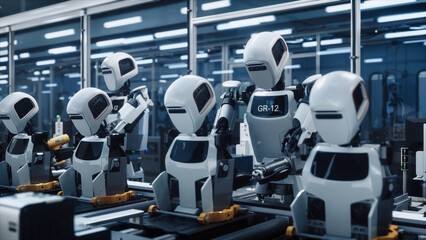
Robots Building Robots: A New Frontier
The concept of robots building robots is no longer science fiction. Today, American manufacturers utilize AI-driven robotic arms, automated guided vehicles (AGVs), and 3D printers to produce new generations of robots and components autonomously.
Example: FANUC America
FANUC America, a major robotics manufacturer based in Michigan, operates the CRX Collaborative Robot line. These robots are built with “smart factories” that use AI to self-diagnose issues, optimize production, and even coordinate with other robots for assembly [source][FANUC White Paper].
Visual: Robots Building Robots
Statistics of Adoption Across Company Sizes
To understand which American manufacturers, benefit most from AI adoption, it’s essential to examine the distribution of company sizes.
- Total manufacturing establishments in the USA (2021): Over 250,000 [U.S. Census Bureau]
- Large manufacturers (500+ employees): Approximately 3,700 companies [2021 Annual Survey of Manufactures]
- Small manufacturers (<100 employees): Over 200,000 companies
| Company Size | Number of Establishments | Percentage |
| 500+ | ~3,700 | ~1.5% |
| <100 | ~200,000 | ~80% |
| 100-499 | Remainder | ~18.5% |
In fact, according to the National Association of Manufacturers’ Facts About Manufacturing, “around three-quarters of these firms have fewer than 20 employees, and 93.1% have fewer than 100 employees.”
Case Studies: AI in Action
1. General Motors (GM): AI Optimized Assembly
GM has partnered with AI platform provider Drishti to track assembly operations through computer vision, identifying process bottlenecks and improving line efficiency. Their plant in Arlington, Texas, uses AI-based robots to weld, assemble, and inspect car bodies—creating a flexible and adaptive system capable of building multiple models on a single line [source].
2. Boston Dynamics: Robot Production
Boston Dynamics, renowned for robots like “Spot,” employs AI-guided robots to produce robotic frames and components. Their factory floor utilizes machine vision, predictive analytics, and self-calibrating machines—accelerating production and reducing error rates [source].
3. Voodoo Manufacturing: “Lights-Out” 3D Printing
Voodoo Manufacturing, a Brooklyn-based startup, developed a factory staffed by robotic arms that load and unload 3D printers. The entire process operates “lights-out,” meaning it can run without human presence, overseen by cloud-based AI monitoring systems. [Source]
Benefits for Small vs. Large Manufacturers
Large Manufacturers
Advantages:
- Ample resources for R&D and integration of cutting-edge AI.
- Ability to deploy custom, highly-specialized robots.
- Scale benefits from AI-driven optimizations.
Challenges:
- High capital expenditure and long implementation cycles.
There is a danger in thinking that AI and robotics can take the place of people with special skills and expertise in critical areas of the company. Ford learned this the hard way. “”Ford has admitted to rehiring hundreds of human workers after its aggressive AI adoption strategy backfired. The US automaker hired over 350 veteran engineers, referred to internally as “gray beards”, over the past three years in order to address mistakes made by automated systems.”
Small Manufacturers
Advantages:
- Access to affordable, plug-and-play AI solutions (e.g., SaaS-based robotics, cloud platforms).
- Rapid productivity gains aiding survival in competitive markets.
- Greater agility in process changes.
Challenges:
- Limited budgets and technical expertise.
- Need for accessible training and support.
While large manufacturers may possess the capital and scale to pioneer AI-driven robotics, small companies are limited by labor and capital, making AI unaffordable for most. In addition, many small companies manufacture products in low to very low volume compared to larger manufacturers.
My company, ElectroFab Sales, has been representing American manufacturers that perform fabrication services to make mechanical parts and assemblies for Original Equipment Manufacturers for 40 years. The largest company we’ve represented had 25 employees, and the smallest had four employees. Most of the metal fabrication companies that we have represented consistently get orders for 5, 10, 25, and 50 of a particular part. If the P. O. volume is the hundreds, the total quantity is divided into monthly shipments. Even the orders that the rubber molder and plastic molding company we represent get orders for hundreds and low thousands compared to quantities of high thousands and millions that goes to China.
These small companies don’t have the production volume or capital to be able to afford to use AI and robotics to boost their productivity, quality, and competitiveness. The employees of these small companies must be cross trained and wear “many hats” as part of their contribution to their employers.
Industry Outlook: The Road Ahead
Media headlines about AI-driven job losses reveal a massive shift in corporate strategy, with U.S. employers attributing nearly 90,000 layoffs to artificial intelligence. Major tech companies are actively replacing entry-level white-collar and middle management roles to reallocate capital toward expensive AI infrastructure and data centers
On June 8, 2026, Fox Business Reported, “AI remains top reason for US job cuts for third straight month as employers axed 97,000 workers in May; AI accounted for 40% of all job cuts…”
According to a 2023 report by Deloitte on smart manufacturing:
- 89% of surveyed American manufacturers have already increased AI/robotics investments post-pandemic [Deloitte 2023 Manufacturing Industry Outlook].
- The U.S. manufacturing AI market size is projected to exceed $20 billion by 2028.
- According to “The Impact of Technology in 2026 and Beyond: an IEEE Global Study,” 52% of technologists expect robotics to be among the areas most influenced by AI, while 35% cite supply chain and warehouse automation as top AI use cases.
If you are employed in manufacturing, you may be asking yourself, “Will AI eliminate my job?”
I share the outlook that Carolyn Lee, President of the Manufacturing Institute expressed in the State of the U.S. Manufacturing Workforce Address, she gave on February 26, 2026 in Plano, Texas. She said, “AI won’t take your job. But jobs will go to people who know how to use AI. People who can leverage new technologies into the way they operate—who can use it to help them solve problems, make better decisions and get more done—will succeed in the job market and power the future. And as AI evolves the way work is done, it’s opening doors to roles and opportunities we’re only beginning to see. Just as past technological shifts have changed the workplace, they’ve also created new paths for people to grow and contribute.”
This outlook is based on the facts that the 2023 Manufacturing Institute and Deloitte workforce report revealed that “workforce challenges are among the top concerns for U.S. manufacturers, and have been since Q4 2017, except during the pandemic. The MI and Deloitte projects that as many as 3.8 million additional employees could be needed in manufacturing between 2024 and 2033. Filling open positions — and keeping them filled — is a top concern for many manufacturers, 65% of respondents in the National Association of Manufacturers’ 2024 Q1 outlook pointed to attracting and retaining talent as their primary business challenge. As the need for higher-level skills grows, the MI and Deloitte predict that as many as 5 in 10 of the skilled open positions, 1.9 million jobs could remain unfilled if manufacturers are not able to address the skills and applicant gaps.”
As I have written in previous articles, workforce training by manufacturers, community colleges, trade schools and programs such as the Manufacturing Institute’s FAME program, and SME’s ToolingU curriculum are training the next generation of manufacturing workers.
While other industries are scrambling to figure out how to adapt, manufacturers have been integrating machine learning, data analytics, robotics and smart automation for decades. Long before AI was a headline, it was on the shop floors of manufacturers —powering machine vision, digital twins, predictive maintenance and advanced robotics.
AI and robotics are redefining American manufacturing, with “robots building robots” symbolizing the dawn of the self-reinforcing industrial revolution. Whether it’s Tesla’s AI-driven Gigafactories or small shops leveraging plug-and-play automation, the benefits—improved productivity, quality, and flexibility—are clear.