Archive for the ‘General’ Category

Manufacturing Jobs Pay Higher Wages than Retail or Service Jobs

Tuesday, June 9th, 2020

Continuing my series on why manufacturing is important to America, the second reason is that wages and benefits for manufacturing jobs are approximately 21 percent higher than for non-manufacturing jobs.

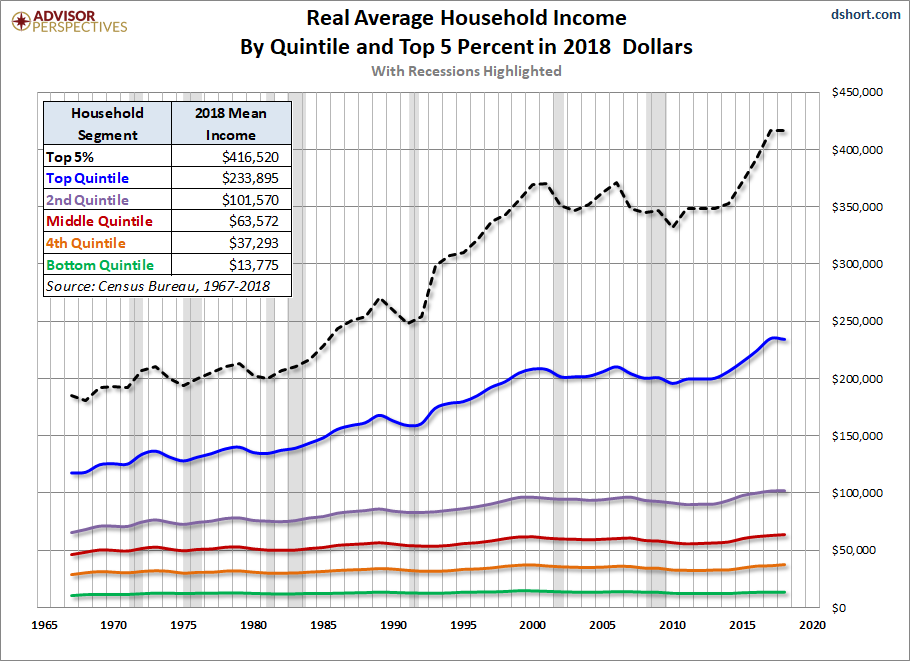
As manufacturing jobs have declined over the past 40 years, the difference between the lowest personal income and highest personal income has steadily grown wider.

This difference was projected to get even worse according to data from the U.S. Department of Labor Occupational Outlook for 2018-2028. Employment growth was projected to continue to be concentrated in the service-providing sector of the economy.

  • “The service-providing sector as a whole will grow at a projected rate of 0.6 percent annually, slightly faster than the annual rate of 0.5 percent for industry employment overall. This growth is projected to add more than 7.6 million jobs, resulting in 136.8 million jobs in the service-providing sector by 2028. After declining slightly from 2008 to 2018 (-0.3 percent annually), the goods-producing sector is expected to change little from 2018–28, with an annual growth rate of 0.1 percent.
  • The sectors projected to experience the fastest annual employment growth are health care and social assistance (1.6 percent), private educational services (1.2 percent), and construction (1.1 percent). These three sectors alone are projected to add more than 4.6 million jobs by 2028—including 3.4 million new jobs projected in healthcare and social assistance.”

In an opinion article in IndustryWeek magazine, John Madigan, a consultant with Madigan Associate, wrote:

“Jobs paying $20 per hour that historically enabled wage earners to support a middle-class standard of living are leaving the U.S. Public sector aside, only 16% of today’s workers earn the $20-per-hour baseline wage, down 60% since 1979.  Service and transportation jobs, per se, cease to exist in the absence of wealth. Rather, they exist and thrive as by-products of middle-class incomes buying products and services.” (source)

According to Facts about Manufacturing by The Center for Manufacturing Research of The Manufacturing Institute, “In 2018, the average manufacturing worker in the United States earned $87,185 annually, including pay and benefits. The average worker in all nonfarm

industries earned $68,782.  Looking specifically at wages, the average manufacturing worker earned more than $27 per hour, according to the latest figures, not including benefits.”

According to the IndustryWeek 2018 Salary Survey, the average salary for manufacturing management is $110,200. By industry sector, the salary ranged from a low of $88,500 in the textiles/apparel sector to a high of $142,500 in the medical device/lab equipment sector.

The 2018 Manufacturing Compensation Report, sponsored by the SME Education Foundation and the Arconic Foundation, “found an average compensation of $64,014 for hourly workers and $111,731 for salary workers, including base pay, bonus/commission and dividends/stock options/profit sharing, and such perks as a company car and mobile phone. Following the trend in the rest of the country, 68 percent of hourly workers and 73 percent of salary workers reported a wage increase in the last year.”

In this report, Christopher Barger, senior director of communications at SME, said, “There are multiple paths to success and good-paying careers at all levels of manufacturing, and the good news is these jobs are in high demand. Individuals who pursue a career in manufacturing have several options to gain solid training education, be it entering the workforce from high school through apprenticeships or internships, attending a vocational school and getting certifications, or attending community colleges, and obtaining associates or four-year degrees.”

Most people have no idea of the variety of jobs that are available at manufacturing companies. Besides the usual corporate/executive management jobs, some of the other management jobs available at medium to large manufacturers are in these areas: operations, plant/facilities, manufacturing/production, purchasing/procurement, sales/marketing, quality, supply chain, lean/continuous improvement, human resources, R&D/product development, and safety/ regulatory compliance.

If you have the opportunity to visit the modern manufacturing facilities in the U. S., you would see the most productive, highly skilled labor force in the world applying the latest in information, innovation, and technology. Contrary to popular opinion, the industrial age is not over. We are in the midst of incredible advances in manufacturing – from nanotechnology, Industrial Internet of Things, robotics, artificial intelligence, and biotechnology.

The innovation found in the manufacturing industry has helped to increase economic productivity too. Since the Industrial Revolution, the way we produce and consume goods has drastically changed, and it is continual innovation that allowed and continues to allow our country to become increasingly more productive in the services offered.

Automation and robotics have helped keep American manufacturers not only competitive but the most productive in the world. Manufacturing has long led U.S. industries in productivity growth. Gains in productivity raise a country’s standard of living. In the past 20 years, productivity – output per hour – has more than doubled – actually 2.5 times – that of other economic sectors.

There is also a multiplier effect of manufacturing jobs that reflects linkages that run deep into the economy. For example, every 100 steel or automotive jobs create between 400 and 500 new jobs in the rest of the economy. This contrasts with the retail sector, where every 100 jobs generate 94 new jobs elsewhere, and the personal and service sectors, where 100 jobs create 147 new jobs. In addition, for every $1.00 spent in manufacturing, another $2.74 is added to the economy. Thus, this economic data indicates that each manufacturing job creates three to four other jobs, while service jobs only create one to two other jobs.  

Thus, manufacturing is an important vehicle to grow and sustain a higher standard of living for our nation, our states, cities, communities and individual families. The higher wages of manufacturing jobs contribute to a better quality of life while ensuring that we have a strong domestic manufacturing sector to protect the health and welfare of all Americans as well as protect our national security. 

Why Manufacturing is Important to America

Wednesday, May 27th, 2020
This week’s article begins a series of short articles on why manufacturing is important to the America economy. Our country’s Founding Fathers recognized the importance of developing a domestic manufacturing base instead of continuing to rely on imports from England, France, and the Netherlands.  They established the U.S. patent system and protected the developing manufacturing industry with tariffs to discourage imports.  This allowed the United States to be the world’s number one manufacturer for more than 100 years, accounting for as much as 25 percent of global manufacturing output in 2007. In 2010, China overtook the U.S. to become the world’s top manufacturing country by output. 
The first reason why manufacturing is important is:  Manufacturing Supplies Millions of Jobs

Manufacturing is the engine that drives American prosperity and is the foundation of the U.S. economy and the basis for its middle class. In February 2020, manufacturing employed 12.6 million workers. According to the National Association of Manufacturers’ facts about manufacturing, “manufacturers contributed $2.381 trillion to the U.S. economy in the fourth quarter of 2019, a new all-time high…Overall, manufacturing accounted for 11% of GDP in the economy.”

In addition, “For every $1.00 spent in manufacturing, another $2.74 is added to the economy. That is the highest multiplier effect of any economic sector. In addition, for every one worker in manufacturing, there are another five employees hired elsewhere.”

The U.S. lost 5.8 million jobs in manufacturing from the year 2000 to 2010 due to a combination of factors, such as the offshoring of jobs to Asia, especially to China, increased productivity of American workers, automation, and robots, as well as the domestic outsourcing of service jobs within a manufacturing company, such as accounting and payroll services, janitorial services, cafeteria/food services, and legal departments. Thus, jobs that may have been classified as manufacturing are now classified as service jobs.

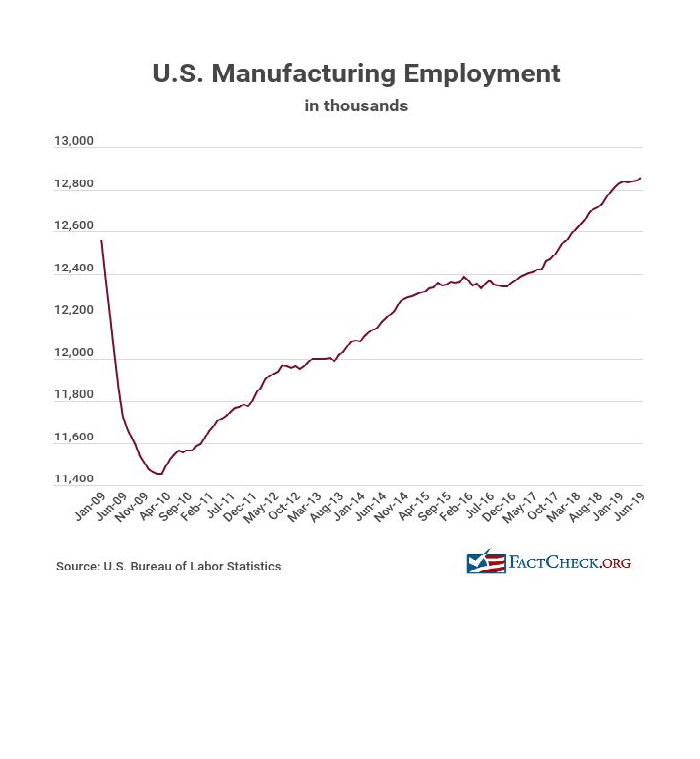
The below chart shows that the U. S. has regained about 1.5 million jobs since the end of the recession. 

American workers achieve a high productivity rate year in and year out, and the growing trend of training in “Lean manufacturing” has accelerated the increase in the productivity of American workers

In 2019, the ten states with the largest manufacturing workforces were:  California, Texas, Ohio, Michigan, Illinois, Pennsylvania, Indiana, Wisconsin, South Carolina, and New York. California’s manufacturing workforce of more than 1.2 million exceeds Illinois and Pennsylvania’s combined manufacturing workforce

A blog article by Alex Carrick of January 14, 2019 on the website www.constructconnect.com, states:  “The five major contributors to U.S. manufacturing employment are:  transportation equipment, a 13.2% share; food manufacturing, 12.9%; fabricated metal products, 11.7%; machinery, 8.9%; and computer and electronic products, 8.4%.

Michigan (with an 11.4% share) leads all states in number of transportation equipment jobs. It’s followed by Indiana (8.2%). California and Ohio (each with 7.3% shares) are tied for third.

By a wide margin, California is out front among states in number of food manufacturing jobs.

California and Texas provide the most ‘fabricated metal product’ jobs; Ohio is in third spot.

Texas, which is big in oil and gas drilling equipment, is the nation’s leader in machinery manufacturing jobs.

More than a quarter of U.S. ‘computer and electronic products’ manufacturing jobs are in California. Second-place Texas has only about one-third of California’s contingent.”

The sooner we reopen all manufacturing, instead of just allowing manufacturers in critical industries to remain open, the sooner we will get millions of manufacturing workers off the unemployment roles and back to producing the goods we need to remain a strong industrial nation, while protecting the health and national security of all Americans.  

Who Are My Heroes? Part One

Tuesday, April 21st, 2020

As you might expect my heroes are people who have played a role in trying to alert Americans to the effects to our economy of the decimation of American manufacturing and the dangers of outsourcing manufacturing to China and other countries.  These are real people and none are elected officials.

This month marks the 13th year of my journey to do what I could to save American manufacturing. In May 2007, I e published one of my periodic San Diego County Industry reports that I had been writing since 2003.  I titled it, “Can U.S. Manufacturing be Saved?” My report had grown from four pages to 13 pages, and I realized that what I was documenting about the loss of manufacturers in San Diego and California was going on all over the country.  That’s when I made the decision to start writing my first book, Can American Manufacturing be Saved? Why we should and how we can, published in May 2009.  In the course of researching and writing my first book, my second edition of the same (2012), and my third book, Rebuild Manufacturing – the key to American Prosperity (2017), I have connected with many people who shared my concerns and were early advocates of saving American manufacturing.

My first set of heroes are those who either wrote books, articles, or newsletters that I came across researching my first book. When I was writing my reports, I was blaming the loss of manufacturing in California on the bad business climate, high taxes, and the cheap Chinese wages. These heroes expanded my knowledge greatly by showing that it was our primarily our national trade and tax policies, the trade cheating of China and other Asian countries, and corporate greed that was responsible for losing over five million manufacturing jobs between the year 2000 and 2009.  In alphabetical order, my heroes are:

Michael P. Collins is author of Saving American Manufacturing, Growth Strategies for Small and Midsize Manufacturers, published in 2006 and its companion handbook, The Growth Planning Handbook. Prior to becoming a writer, he was Vice President and General Manager of two divisions of Columbia Machine in Vancouver Washington. He is President of MPC Management, a consulting company that focuses exclusively on the problems and challenges of small and midsize manufacturers (SMMs) of industrial products and services. His book is written from the viewpoint of what manufacturers can do to save themselves and grow their business.  I arranged for him to come to San Diego to give a presentation to the Operations Roundtable of the American Electronic Association in 2011.

Lou Dobbs, is an American television commentator, radio show host, and the anchor of Lou Dobbs Tonight on Fox Business Network, and author of Exporting America, Why Corporate Greed is Shipping American Jobs Overseas, published in 2004 as hard cover and 2006 as a paperback. In his book, he “takes aim at the corporate executives and Washington politicians who profit by exporting U.S. jobs overseas—and shows readers what they can do to save not only their own careers, but the American way of life.

Ralph Gomory, who is well-known for his mathematical research and his technical leadership. For twenty years he was responsible for IBM’s Research Division, and then for 18 years was the President of the Alfred P. Sloan Foundation. He is the co-author with the late William J. Baumol of the book, Global Trade and Conflicting National Interests, published by MIT Press in 2001. After connecting by phone and email for years, it was nice to finally meet him at the Coalition for a Prosperous America trade conference in Washington, D. C. in 2018.

Richard McCormack, journalist and founder/publisher of Manufacturing & Technology News which he found in 1994. McCormack also served as the editor of the 2013 book on revitalizing manufacturing, ReMaking America. I read every issue of MT&N from July 2007 until it stopped publication at the end of 2016. He was also recognized as an American Made Hero by AmericanMadeHeroes.com for his newsletter “coverage of the profound financial and economic ramifications of the shift of industrial capability from the United States to Asian competitors.” He wrote “thousands of articles on outsourcing, industrial and technological competitiveness, government policies, and trends related to management, quality, technology and markets.”Mr. McCormack is currently Press Secretary and Program Manager, Office of Public Affairs, for the Department of Commerce.

Peter Kent Navarro is a Harvard Ph.D. economist and author of several books. I read his book The Coming China Wars, published in 2006, while I was researching my book. At that time, he was a professor of public policy at the University of California, Irvine. He currently serves in the Trump administration as the Assistant to the President, Director of Trade and Manufacturing Policy, and the national Defense Production Act policy coordinator. I first met Mr. Navarro when he was a professor at the University of California, San Diego and running for mayor in 1992. I also had the pleasure of seeing him when I attended the trade conference in 2018. I also read his book, Death by China, which he co-authored with Greg Autry, published in 2012.

Raymond Richman, Howard Richman (son), and Jesse Richman (grandson), authors of Trading Away our Future: How to Fix Our Government-Driven Trade Deficits and faulty Tax System Before It’s Too Late, published by Ideal Taxes Association in 2008. Raymond died in October 2019 at the age of 101. His tribute by Ideal Taxes states, he “authored four books, dozens of journal articles and hundreds of commentaries about economic development, tax policy and trade policy…Beginning with a commentary in the Pittsburgh Tribune-Review on September 14, 2003 (The Great Trade Debate), he became one of the first advocates of a policy of balanced trade, an alternative to the free trade vsfair trade debateHis essential argument was that trade, free or not, benefits both countries if it is balanced.” I am sorry that I didn’t get to meet him before he died.

Roger Simmermaker, author of How Americans Can Buy American: The Power of Consumer Patriotism, third edition published in 2008. He also writes Buy American Mention of the Week articles for his website and World New Daily. His book provides a guide to assist American’s who wish to purchase products made in America and discusses the importance of “Buying American” for the future economic independence & prosperity of America. He earned special recognition as an American Made Hero. After years of connecting to him by phone and email, it was a pleasure to also meet him at the same trade conference in 2018.

Alan Tonelson, a Research Fellow at the U.S. Business and Industry Council Educational Foundation, and a columnist for the Foundation’s globalization website, Tradealert.org and a Research Associate at the George Washington University Center for International Science and Technology Policy. He is also the author of The Race to the Bottom, published in 2000. “He has written extensively on the trade deficit between the United States and other countries. He has also written on free trade, globalization and industrial decline. He argues that U.S. economic policy should aim for “preeminence” over other countries, just as, he believes, other countries’ economic policies seek their own national interests. He is critical of various forms of “globalism” and internationalism.”

When I was researching my first book, the U.S. Business and Industry Council was the only organization that had a written plan to save American Manufacturing.

I introduced my book as a speaker at the Del Mar Electronics Show in San Diego County, California on May 6, 2009, and had my book on display at my company’s booth at the show. One of the first persons to buy my book was Adrian Pelkus, President of contract manufacturer, A Squared Technologies.  He was also the informal leader of the steering group running the San Diego Inventors Forum.  He invited me to the next SDIF meeting which I attended, and then invited me to join the steering committee, which I did.  After reading my book and endorsing the purpose and ideas I presented in my book, the steering committee changed the focus of SDIF from helping inventors source their products in China to sourcing the manufacture of their products in the U.S.

The SDIF meetings have an informal curriculum of topics to cover in a year, and I have been giving an annual presentation on how to select the right manufacturing processes and vendors to make their products.  It has a pleasure to be able to help so many inventors and entrepreneurs source their products in America.

My connections to theses heroes led me to connections with many other people and organizations who became part of my second set of heroes after my book was published.  I will write about these people in My Heroes Part Two. 

U.S. Private Sector Jobs Have Declined since 1990

Tuesday, December 10th, 2019

On November 14, 2019, Cornel Law School “announced the launch of a new tool for evaluating the U.S. employment situation and predicting related variables: the U.S. Private Sector Job Quality Index (JQI).” The Index described in the White Paper represents 18 months of research by Daniel Alpert, adjunct professor at Cornell Law School and founding managing partner of the investment bank, Westwood Capital, LLC, Jeffrey Ferry, chief economist at the Coalition for a Prosperous America (CPA), Dr, Robert C. Hockett, Professor of Law at Cornell Law School, and Amir Khaleghi, a Research Fellow at the Global Institute for Sustainable Prosperity (GISP) and a PhD student at the University of Missouri–Kansas City.

At the many economic summits I’ve attended over the past 25 years, I’ve heard economists state that the U. S. is creating more low paying jobs than high paying jobs but there hasn’t been any data available to track this trend on a regular basis.  For the first time, the Job Quality Index provides a tool to measure “desirable higher-wage/higher-hour jobs versus lower-wage/lower-hour jobs.”

The authors define job quality as “the weekly dollar-income a job generates for an employee” They explain that “The JQI is an analysis of weekly incomes earned by the holders of each of the private sector P&NS jobs in U.S. It derives its data from the hourly wages paid, and hours worked by, holders of jobs in 180 separate sectors of the American economy.”

Since the end of WWII, the “percentage of private U.S. jobs in the service-providing sectors increased steadily from approximately 55%” to “around 83.5%” at the end of the Great Recession in 2009.  It has remained flat since that point. However, the paper states that “While service-sector growth as a percentage of all jobs has leveled off, job quality continues to worsen.”

The authors commented, “As weekly earnings of services sector jobs have, to an increasing degree, materially lagged those of jobs in the goods- producing sector (Figure 6), an increase of the percentage of service sector jobs would naturally result in an increase in the number of jobs below the mean, as reflected in the JQI.”

In addition, the authors note that the gap between higher-wage/higher-hour jobs versus lower-wage/lower-hour jobs” has widened almost four-fold to $402 in 2018 from $104 in 1990”  

The paper states, “jobs as tracked by the JQI are defined by reference to data on private sector (nongovernmental) employment provided by third party employers—it does not include self-employed workers. In the first iteration of the JQI being presented in this paper, the index covers only production and nonsupervisory (P&NS) positions, which account for approximately 82.3% of the total number of private sector job positions in the country.”

By the end of 2020, a second index (JQL-2) “will run and be maintained side-by-side with the original JQI-1 index. This will track all private sector jobs, with data commencing in 2000.”

Monthly revisions to the JQI-1 will be published “contemporaneously with the monthly release of U.S. employment data by the BLS (generally on the first Friday of each calendar month. In the future, the JQI will be “presented as a three-month rolling average of monthly readings. This is done to address month over month variability which is too volatile to be a reliable directional trend measure.”

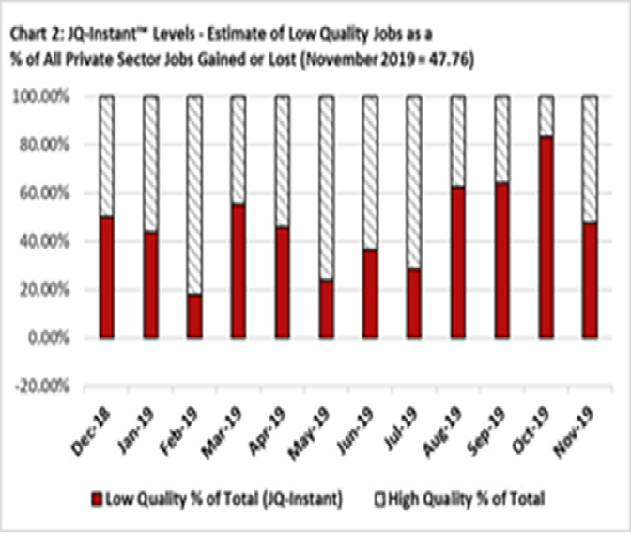
The November JQI stated:  “the U.S. Private Sector Job Quality Index (JQI)® has been revised to a level of 80.39, representing a minor decline of 0.04% from its level one month ago and reflecting a somewhat lower proportion of U.S. production and non-supervisory (P&NS) jobs paying less than the mean weekly income of all P&NS jobs, relative to those jobs paying more than such mean. The mean weekly income of all P&NS jobs as of the current reading (reflecting the level as of October 2019) was $794, a change of 0.9% from its level the month prior.”  The chart released is shown below:

The paper is divided into five parts:

Part I — Need for the JQI: The Unmeasured Problem with American Jobs

Part II — Construction of the JQI: Capturing and Tracking the Data (explains the development technical detail, setting forth the assumptions and algorithms inherent in its generation)

Part III — Applying the JQI: Illuminating Areas of Confusion in Economic Transmission (discusses the relationship and potential forecasting usefulness of the index in connection with other economic data)

Part IV — Further Developing the JQI: What the Future Holds for the Index (discusses future maintenance and expansion of the index)

Part V — Conclusion: An Index for our Time

Among other things, Part III discusses “The relevance of the resulting “Phillips Curve,” relating lower unemployment to higher levels of inflation…[which] remains—in various modified forms—part of central bank policy consideration to this day.”

It also discussed the impact of the JQI on household incomes and consumption with regard to the U.S. Balance of Trade in Goods. The authors comment, “…as American consumption has continued to rise, the goods consumed had to be produced by someone—even as U.S. goods production jobs plummeted. As evidenced by the U.S. balance of trade over the past several decades, goods consumed by Americans at the margin came increasingly to be manufactured abroad”

They later comment, “The decline in U.S. job quality over the past three decades is linked substantially to a decline in goods-producing jobs.”

 Some of the findings of the research that were of particular interest to me in Part III were:

  • “The JQI’s definition of high-quality jobs (those above mean weekly earnings) provided an average of 38.26 hours of weekly work at year-end 2018, compared with low quality (those below the mean) which provided 29.98 hours.”
  • The percentage of goods producing jobs as a percentage of total private sector jobs dropped from 25.6% in 1990 (down from a high of 43% in 1960) to 16.4% in 2018.

The researches commented, “Surprisingly, the data as analyzed with the JQI also tend to predict the performances of many other salient metrics of the national economy and—in the end—financial markets too…The JQI can significantly improve decision making of policymakers as well as better-inform participants in the financial markets.”

In their Conclusion, the authors remind us of the fact “that the US manufacturing workforce has declined dramatically in the past three decades.” Between 1970 and 1990, the decline was gradual, going down from “17.8 million manufacturing workers” to “17.7 million.” By the year 2000, “it was down 2.4 percent to 17.3 million manufacturing workers.” In the next decade, “manufacturing employment fell off a cliff. By 2010, manufacturing employment was down a shocking 33.2 percent at 11.5 million. Since 2010, the figure has crept up only somewhat, to reach 12.8 million in May 2019.”

 “Meanwhile, the total US working population has grown dramatically over those years. In 1970, manufacturing workers accounted for 22.6 percent of total US civilian employment. As of May 2019, they accounted for just 8.2 percent of the total.”

They comment, “An important question surrounding the decline of manufacturing is whether those leaving manufacturing are transitioning into better or worse jobs.  After building the new Job Quality Index, “the answer is that lost manufacturing jobs were chiefly replaced by lower-wage/lower hours service jobs.”

The White Paper confirms my research in writing three books and hundreds of articles in the past ten years — losing millions of manufacturing jobs between 2000 – 2010 resulted in a decline in the middle class because manufacturing jobs are the foundation of the middle class. Without a strong middle class, we risk becoming a nation of “haves” and “have nots.” I hope the Job quality Index will wake up more economists, Congressional representatives, and employees of government agencies to the dangers of this trend before it’s too late. 

San Diego Has Largest Woodworkers Guild in U.S.

Tuesday, August 6th, 2019

On June 29,2019, I attended the San Diego County Fair held at the Del Mar Fairgrounds with my family as I have done annually for the past 20 years. One of my favorite exhibits is the fine woodworking exhibits, actually divided into two exhibits, one for hobbyists and professionals and one for students.  For the first time, I picked up a pamphlet about the San Diego Fine Woodworkers Association (SDFWA) and a flyer for the Cabinet and Furniture technology program at Palomar Community College.

The pamphlet described the new woodworking shop in San Diego, open for all woodworkers to join. The shop is a membership based, non-profit, all volunteer shop run by the SDFWA.  I was able to interview Gary Anderson, Member Shop Chairman about the organization and its history.

Gary said, “The Association was started by Lynn Rybarczyk in 1981 after he had seen some beautiful custom furniture in the San Francisco Bay Area. At that time, woodworkers in San Diego had few opportunities to collaborate and had no way to show their work to the public. Lynn was motivated to present the idea of creating a fine woodworking exhibit at the San Diego County Fair to the exposition staff, who agreed to develop an exhibit as long as there was an active community woodworking organization to sponsor it. 

Fortunately, San Diego’s first retail store selling woodworking supplies, tools, and materials opened about the same time —The Cutting Edge. The owner allowed Lynn to set up a card table at the store during the grand opening, and Lynn began to sign up the members of what became the San Diego Fine Woodworkers Association.

During 1981, regular meetings were held at local public schools to attract members. The San Diego Fine Woodworkers Association (SDFWA) was organized as a 501(c)(3) non-profit corporation in early 1982, and by June of 1982, the first annual show, initially called The Southern California Expo Fine Woodworking Exhibit displayed 45 pieces selected from 95 entries, all submitted by SDFWA members.  The show was such a success that Fine Woodworking Magazine gave it a multi-page spread.”  

He added, “The exhibit at the Fair is now called the Design in Wood Exhibition, and has grown to display more than 300 entries. It has achieved national and international recognition and includes demonstrations by wood turners, scrollers, carvers, and model ship builders – all members of local organizations. A traditional woodworking shop at the exhibit produces red oak children’s chairs for donation to local social service organizations. More than 1,700 chairs have been donated over the past 34 years.”    

In answer to my question about the growth of the association, Gary said, “Membership steadily increased and peaked at 1690 members in 1999. There are actually over 200 woodworking guilds/associations in the US., but San Diego’s is the largest with about 1200 members.  As far as we know, only four have their own woodworking shop.”

I asked what the difference between a “guild” and “association,” and he said that the term “guild” is often used interchangeably with “association,” but guilds historically referred to individual craftsmen rather than company members.

He explained that most of their members are doing woodworking as a hobby, and only about 10% or less are professionals who make a living from woodworking.

Gary added, “Members have access to a variety of special interest groups that provide the opportunity to connect with experts in a variety of woodworking, such as carving, CNC machining, toy building, and women in woodworking.”

When I asked when the association opened the Member Shop, he replied, “We opened the shop in June 2017, and it is 4,000 sq. ft in size.  Membership provides access to just about every kind of power and hand tool and equipment that a woodworker would need to complete a project, including, saws, router, sanders, lathes, etc.  It also has an extensive library, design software, classes, and a 3D printer.”

He explained, “One of our reasons for opening the shop was that we were concerned about the diversity of membership, both with regards to age and ethnic diversity.  Before we opened our Member Shop, we were an association of “old white men,” above the age of 60. We recognized that we needed to attract more diversity in age and ethnicity. Now, we have a lot of young people joining as members. When the shop opened, only about 3% were female and now 40% of  our new members are female.” 

The SDFWA pamphlet listed two levels of annual membership:

Silver at $250/year, which provides 15 slots (a slot is one visit to the shop for up to three hours

Gold at $395/year, which provides 50 slots

When I asked if they also have an hourly rate like a “makerspace, he said, “no, you have to be a member to use the facilities.  We don’t have provision for using on an hourly rate.”

I told him that I had also picked up a flyer at the Fair for the Cabinet & Furniture Technology program at Palomar College and asked if the association has a relationship with the college

He replied, “We have an Informal, but students have to pay to be a member to use facilities.  Some of their members have taken or are taking woodworking classes at Palomar to get more training on to expand on the member shop classes.” 

When I asked if there are any other colleges in San Diego that have a similar program, he replied, “I don’t know of any other college that has a program as complete as Palomar, which is a nationally recognized program, but I did hear that SDSU has a small program as one of its instructors became a member.”

In answer to my question as to whether there are any high schools that have woodworking shop classes, he said that he heard that Oceanside High School has a program, but he didn’t know of any others. I told him that the San Diego Continuing Education Center on Oceanview Blvd. has a small woodworking shop and classes, and the MakerPlace on Morena Blvd. in San Diego also has a small woodworking shop and classes. After the interview, an internet search showed that Escondido High School also had a woodworking shop and classes

With regards to whether or not there are any local furniture manufacturers, he responded, “I don’t know of any furniture manufacturers in San Diego other than shops making cabinets. But, SDFWA President, Travis Good, recently visited a lumber supplier by the name of Bennett-Crone, and the vast amount of their business is with woodworking manufacturers in Mexico.

After doing search on the internet, I found seven furniture manufacturers listed in San Diego County, but three of the seven have addresses down in Otay Mesa, which is the industrial park on the U. S. side of the border with Mexico, and companies in this park usually have offices on the U. S. side and manufacturing plants on the other side of the border in Tijuana, Baja California, Mexico.

There are two musical instrument companies that would utilize the woodworking skills of SDFWA members:  Deering Banjo Company in Spring Valley, and Taylor Guitar Company in El Cajon.  However, Taylor Guitar also has a plant in Tecate, Baja California, Mexico.

I thanked Gary for all of the information and arranged to visit the Member Shop soon. I enjoyed learning about the background of my favorite exhibit at the San Diego County Fair. If any furniture manufacturers doing business in China and other parts of Asia decide to return manufacturing to America, the San Diego region would have an abundance of skilled workers to staff their plants

Urban Workshop Sets High Bar for Makerspaces

Tuesday, May 21st, 2019

·         Autodesk Fusion 360 Software -Free Fusion 360 software for Urban Workshop and for all members.

After the NACCE summit I attended on April 27th formally ended at 1:30 PM, I went on the optional tour of a nearby makerspace, the Urban Workshop in Costa Mesa. It is the largest makerspace I have visited in my travels around the country and is the largest makerspace in southern California.

“Urban workshop was born out of my engineering and manufacturing company called Automotive Technology Group Inc., which opened in 2001. Prior to the economic downturn, we were one of the top EV and hybrid vehicle engineering houses in the country doing advanced R&D for the large auto makers and smaller startups such as Fisker Automotive. We also did a small number of professional motorsports.

When the economy slowed, most of the engineering services and manufacturing dried up but the motorsport business swelled. The rich guys who were racing cars weren’t affected by the downturn of the economy so we did well. Around January 2013, I started doing STEM presentations to kids at local high schools and colleges to tell them about the race cars hoping to peak their interest in the sciences. I had heard about makerspaces and started asking some of the teachers their opinion about them. Jokingly, they started to introduce me as the guy who is opening “The Shop.”  I didn’t correct them, and before I knew it, people were showing up at ATG asking if this was “The Shop” and if it was open yet.

The Urban Workshop was founded by, and is privately owned by, Steve Trindade. During the tour, Steve told the story of how he started the makerspace, and later emailed me the following story:

“By January 2014, I had become very frustrated with the engineering services business due to customers not paying or going out of business leaving me holding the bag. Simultaneously, three to five people per week were stopping by to look for “The Shop.” That was when I decided to go for it. We wound down the projects we were working on, and signed a lease for a 5,500 square foot R&D space in May 2014.”

Steve said, “Our facility was basically built, painted, and set up by volunteers. People who walked in the front door and asked, is this “The Shop?”  I said, It’s Urban Workshop, but we aren’t open yet. Almost always they replied, can I help? I said yes, and put them to work.

In the end, we renovated the facility and got ready to open with nearly all volunteer help. Using all volunteer help, we set up the new facility and opened as Urban Workshop on July 2014. We had a similar experience with volunteer help when we moved into our current larger building in April 2015.

Since then, the business has grown significantly, and our membership is over 1,700. Our small business members do approximately $20M in annual revenue directly out of our facility, and collectively they have raised nearly $70M in angel and venture funding. In 2015, we added youth programing similar to the old school shop classes and now serve over 1,000 students age 10 to 16 years old annually.”

I was impressed by the kind of equipment and resources the Urban Workshop provides. It is a full-scale DIY workshop and makerspace meaning that it includes all aspects of engineering, prototyping and manufacturing equipment.  Steve said, “We have nearly $1M worth of equipment and because we used to be a professional services company, all of the equipment is current state of the art industry relevant equipment as opposed to the typical hobby level equipment you find in all other makerspaces. We teach classes on all the equipment and continue to add classes as fast as we can generate the course materials.

The equipment I saw on the tour included computers and software, large format plotters and printers, 3D printers, laser etchers, sheet metal fabrication equipment, manual and CNC machines, MIG and TIG welding, a vacuum forming machine, an autoclave, a silicone molding pressure pot, an extensive wood shop with a large CNC router, a composites fabrication shop, a vinyl cutter, sewing equipment, an electronics lab, and an auto shop with five auto lifts. 

On their website, the following companies are listed as commercial partners/supporters:

·         Epilog Laser Etchers – Educational pricing on equipment and extended warranty support to Urban Workshop

When I asked what “Making” meant to him, he said, “In one word, opportunity. Opportunity for our members to learn new skills, open a new business, fix something, help others, learn a new skill, make a new friend, complete a personal project or who knows what. It has been very satisfying to watch people come in the shop with one idea and end up making five more things they never thought of before on equipment they have never used before with the help of someone they met at Urban Workshop.”

·         Haas CNC Machines Educational pricing on equipment, extended warranty support, free computerized training and simulation station to Urban Workshop.

·         Autodesk HSMWorks Free HSMWorks CNC programming software for members to use on site.

·         SolidWorks– Free engineering software for members to use on site.

·         Laguna Tools – Educational pricing on equipment, software and extended warranty support to Urban Workshop.

·         National Instruements – Free Virtual Bench all-in-one test equipment and LabView software for members to use on site.

·         Ingersoll-Rand – Educational discount on machine tooling and fixtures to Urban Workshop.·        

Steve said, “The initial response to Urban Workshop was overwhelmingly positive, and the level of enthusiasm was incredible. The response continues to be great and the level of excitement and comradery continues to grow. Almost weekly a member comes to my office to thank me for opening the shop and enabling them to be able to make their dream project or start their new business. I knew this would be fun and satisfying, but I never imagined the extent that it would be so well received.”

One other observation he made is that whether you call it hacking, making, or tinkering, “the desire people have to use their hands is universal and fundamental. It is extremely satisfying to figure something out, address a problem or need one has or create something from scratch. I believe it has a therapeutic value and allows one to focus on something for a time without distraction. This is something that is unusual in these days of smart phones and social networking.”

In describing the projects his members are working on, he said, “Theyvaryjust as much as the members do. We have young professionals who are starting their own businesses all the way to the “burning man” crowd. It is impossible to nail it down and give a simple example. I have seen everything from ruggedized super tablets designed and manufactured in the shop to an Arduino controlled dog feeder and a talking Wi-Fi enabled Christmas tree. Urban Workshop’s membership is approximately 45% startups developing and manufacturing new products, 40% hobbyist, and 15% students. The hobbyists are the most diverse and work on home projects, vehicle restorations, boats, motorcycles, gifts, tons of wood working and cabinetry, arts and crafts, holiday decorations, cosplay, prop making, toys, and you name it.”

When I asked what his future plans are, he said, “Our long term the goal is to open additional locations. Currently, we are expanding our class offering to include many more project classes that will help guide people on the path of making. The youth program continues to grow, and additional levels will be added. Our most promising new product is the licensing of our operational procedures and class documentation to other makerspaces world-wide, providing operational training, and instructor training to enable them to prosper and help even more people.”

I’ve only visited one other makerspace about which I wrote, Vocademy in Riverside, that had a plan to expand to other locations, but its focus was on working with high schools to provide the career technical training that high schools used to provide.  With the depth and breadth of Steve’s business experience, he is more likely to succeed with his future plans than others. 

Makerspaces Play new Role in Career Technical Training at Community Colleges

Wednesday, May 8th, 2019

The National Association for Community College Entrepreneurship held a Makerspace Ecosystem Summit titled “Make/Shift” in Irvine on April 24-26th, and I was able to attend the last day.  I learned that in 2016,”the California Community College Chancellor’s Office, Workforce and Economic Division funded the $17 million CCC Maker Initiative for three years under the  Doing What Matters for Jobs and the Economy  framework.  It was the first statewide initiative to grow a system of community college makerspaces and included funding for 800 internships.

After a rigorous application process, 24 “California community colleges were awarded grants to establish makerspaces — do-it-yourself centers where students have access to technology that allows them to create, invent, learn and share ideas. Each of the selected colleges was awarded from $100,000 to $350,000 per year for up to two years.” The makerspace at Mt. San Jacinto Community College in Menifee that I visited last October on MFG Day was one of the funded makerspaces.

“Makerspaces —also known as fablabs — are places in a community where people get together to learn and invent using technology such as 3-D printers, computer-aided design (CAD) software and manufacturing equipment that might otherwise be unaffordable for an individual to purchase.” The California Community College (CCC) “Maker initiative is aimed at strengthening the workforce by inspiring students to learn by doing, teaching in-demand skills for jobs in science, technology, engineering and math fields, partnering with employers to provide internships…”.

The makerspace grants were planned to coincide with a program by the CCC “to promote its more than 200 career education programs as affordable training for good-paying jobs.” The CCC is the largest provider of workforce training in the U.S. with 114 campuses across the state serving 2.1 million students per year. Its career education programs are developed in partnership with local industries and taught by instructors with direct work experience.

At the first session on Friday, Willy Duncan, Superintendent and President of Sierra College said that while the initial funding has ended, he is committed to continuing the good work and getting follow up funding for the makerspaces. He emphasized that entrepreneurship in 4th Industrial Revolution is being led by entrepreneurs disrupting existing technologies.  He said that the Fourth Industrial Revolution is interacting with other socio-economic and demographic factors to create a perfect storm of business model change in all industries, resulting in major disruptions to labor markets. It is a fusion of new technologies and talents.

The skills needed are more complex and cut across disciplines. Artificial Intelligence, Industrial IoT, automation, and robotics have the potential of creating new jobs, but will widen the skills gap.” He referenced the Future of Jobs Report, which states that automation will accelerate skills shift and social and creative skills will be more important — 42% of skills will change and  

75 million jobs could be displaced. The less you make now will put you at risk for being displaced.

He mentioned that a study by the USC Annenberg School for Communication and Journalism on Third Space Competencies stated that “third places” are places where you can connect to unlock innovation, drive collaboration, and develop talent.  He recommended that educators need to create third places within makerspaces. He said, “A mindset of agile learning will be needed on the part of workers in the future.  Project-based learning is the hallmark of makerspaces, and students who struggle in traditional leaning may excel in project-based learning. The future will require life-long learning to continually acquire new skills.”

Mr. Duncan said we need to figure out how to revamp learning to stay relevant. It can’t take years to change. Collaboration is critical to implementing change and learning how to lead “from the middle.”

Partnerships through collaboration within the College as well as within the community

Amy Schultz – Dean of Continuing and Technical training at Sierra College said that they partnered with Hacker Labs to create their Makerspace and said their makerspace has an advanced manufacturing. lab with Haas CNC equipment. Partnerships succeed when each partner benefits so it can be sustained.

Dr. Cathy Kemper—Pelle, President of Rogue Community College, in Grants Pass, OR said they partnered with local community to create a makerspace in the downtown area of the city. They bought an old manufacturing building and converted it into large Makerspace, and students are participating in Invent Oregon.

Cabrillo College in Aptos, near Monterrey Bay, partnered with local Goodwill for creating internships for makerspace students and held a joint internship fair.

Dr, Carlos Turner-Cortez. San Diego Continuing Ed. said that their Center provides noncredit training classes that are free.

Some insights from the session were:

  • Artificial Intelligence is allowing companies to develop new products at a faster pace
  • Transportation is going autonomous and vertical at the same time
  • Mode of teaching is being disrupted by online learning and compressed learning
  • Try non-credit training if you want to innovate

Next, I attended the breakout session, Building a Strong Workforce – A TED talk panel discussion – The Future is Happening Now – Cari Vinci of InVINcible Enterprises

In Ms. Vinci’s presentation, she noted that the goal of 70% of students is to go to college, but 75% are undecided about a major.  In the 21st Century workplace, only 23% of future jobs will require 4-year college degree, 34% will require an associate degree or some college, 34% will require a High School diploma or less, and only 11% will require an advanced degree. Today’s education isn’t meeting the needs of the workplace.  A Gallup poll showed that the role of higher education needs to be “purpose-based education.” A mindset of lifelong learning and an understanding of what’s going on globally will be necessary. The new ”Power Skills” for technical skills is to learn what robots and Artificial Intelligence can’t do yet. Students need to acquire the 21st Century Power Skills to ensure success.  Her Playbook for Teens helps students become the CEO of their life and find their career sweet spot.  Community Colleges and makerspaces are catalysts to connect the dots through internships, apprenticeships, and entrepreneurship.

Panelist Andy McCutcheon, Dean of the School of Humanities and Maker Space, College of the Canyons, shared that their MakerSpace is part an integrative learning model that encourages the development of 21st century technical and professional skills while connecting students with community and career paths. Their MakerSpace offers unique opportunities for helping students to connect classroom content and theory with real world problem solving while exploring career opportunities within and beyond their majors and foster connections that may lead to work-based learning opportunities like internships and apprenticeships.  MakerSpace 100 is a project that has placed 25 COC students with two local community partners, JPL’s Mars Rover Team and the Santa Clarita City Hall “Green Streets” team. Students are working in teams to develop solutions related to a NASA payload project and the Sustainable Santa Clarita project gaining important workplace experience while earning college credit and being paid through the CCC Maker Grant.

Panelist, Sarah Boisvert has over 30 years’ experience in advanced manufacturing and is the author of the book, The New Collar Workforce. She is the co-founder of Potomac Photonics, Inc. a laser machine tool company, which she and her partners sold in 1999. Since “retiring”, she founded Fab Lab Hub, located in Santa Fe, NM, which is a member of America Makes, the National Additive Manufacturing Innovation Institute. Ms. Boisvert highlighted the re-emergence of manufacturing and briefly presented a blueprint of how to leverage this new, new manufacturing in colleges. She explained that the new collar workforce is a combination of entrepreneurial, design, fabricators, business, and other skills that is turning the traditional workforce training model on its head. She said that where blue collar assembly line positions are being replaced by robots, a new collar job is being created to maintain and control the systems. She said that the evolution of traditional blue-collar jobs into new digitally minded jobs that work symbiotically with robots and intelligent technology will be the key to exponential growth, and many new collar workers are attending vocational schools and community colleges rather than attaining traditional four-year degrees.

The final session featured a discussion of sustainability and funding insights from Foundation leaders:

Stephanie Bowman, Manager, HP Foundation – she said that the HP Foundation provides HP Foundation provides core business and IT skills training free of charge for start-ups, students, and small businesses through HP LIFE (Learning Initiative for Entrepreneurs)  Each module takes one hour and you get certificate when complete. They have awarded $23 million in grants in 42 countries. The mission of the HP Foundation is to make life better for undeserved and underrepresented communities by providing technology-related learning experiences and opportunities.

Rachel Burnnette, Program Officer, Lemelson Foundation (Portland, OR) – she said that the Foundation uses the power of invention to improve lives, by inspiring and enabling the next generation of inventors and invention-based enterprises to promote economic growth in the US, and social and economic progress for the poor in developing countries. The Foundation has provided or committed more than $185 million in grants and Program-Related Investments in support of its mission. They run their funding through Venturewell.

I’m very glad to see that community colleges are taking the lead in providing career technical training to bridge the widening gap of job skills for the 21st century workplace. Makerspaces are uniquely poised to foster real world connections between theory and practice and between the classroom and what a student might want to do with his or her life.  What concerns me is that many of the 24 California Community Colleges may wind up struggling to keep their doors open at a time when colleges across the state are looking for ways to cut costs in response to the statewide shortfall caused by a new funding formula. New programs without ongoing funding may be the first to go as districts tighten their belts. I can only hope that private foundations like those mentioned above and collaborative industry partnerships will alleviate the funding gap.

Jelani Odlum, Michelson 20MM Foundation (Los Angeles) – she said the Foundation supports innovation in education and higher learning initiatives. The Foundation’s founder, Dr. Gary Michelson,  has several hundred patents for his company. She explained that the vision for their Spark Grants program is to introduce an innovative just-in-time grantmaking process to fill urgent needs for education organizations that are well-aligned with their key target outcomes. They seek to fund highly impactful initiatives that would not be possible if they needed to wait through a traditional grant decision timeline.

Are Tariffs Reducing the National Debt and Federal Deficit?

Wednesday, March 6th, 2019

There is increasing evidence that Trump’s tariffs are working to expand American manufacturing and create jobs.

According to the February 11, 2019 U.S. Manufacturing Technology Order Report press release of The Association for Manufacturing Technology, The year- end order total for 2018 was $5.5 billion, up 19 percent from the annual sum for 2017…’We finished a fantastic run up in manufacturing technology orders during 2018, with most analysts looking for good growth in units and modest growth in revenue in 2019,” said AMT President Doug Woods.”

In an Op-Ed for The Hill on February 12, 2019, Michael Stumo, CEO of the coalition for a Prosperous America, wrote: “There’s no doubt that America’s manufacturers are currently rebounding. The tariffs that President Trump imposed a year ago on steel, aluminum, solar panels and washing machines have already created more than 11,000 new jobs.”

In 2016 when he was a candidate, Trump told the Washington Post that he could make the U.S. debt-free “over a period of eight years.” Thus, the question is:  Are Trump’s tariffs reducing the Federal budget deficit and paying down the national debt?

For clarity, the Federal budget deficit is the annual difference between what the federal government takes in as revenue and what it spends for expenses. The U. S. has run a federal budget deficit every year since 2001 by spending more than it raises. The national debt is the total amount of money that has been borrowed and not yet repaid.  

At 7 PM on March 6, 2019 when I finished writing this article, the national debt was $22.109 trillion, and the Federal budget deficit was at $846.945 billion according to the U. S. National debt clock website (it registers an increase every second.)  In a CNN Business article by Lydia DePillis, on January 4, 2019, “The US national debt stood at $21.974 trillion at the end of 2018, more than $2 trillion higher than when President Donald Trump took office, according to numbers released Thursday by the Treasury Department.” On the other hand, the national debt nearly doubled under Obama’s eight-years as President going from $10.626 trillion when he was sworn on January 20, 2009 to $19.947 trillion when he left on January 20, 2017.

A Bloomberg article by Mark Niquette on January 17, 2019, states, “According to data from U.S. Customs and Border Protection, more than $13 billion in duties imposed by the Trump administration were assessed on imported goods as of Dec. 18…Customs and Border Protection collects the tariffs based on the price paid for shipments and the tariff rate in effect, and duties are charged when shipments are released into the U.S. The assessed amount now tops $13 billion, with $8 billion coming from the duties on Chinese goods…The duties are deposited in the U.S. Treasury.”

Thus, although President Trump claims that the tariffs are being paid by China and other countries, the tariffs are actually being paid to the U. S. Treasury by companies that import products.   

As I wrote in my last article, tariffs were a large source of revenue for the U.S. government for over a hundred years. However, in 1913, the 16th Amendment established Congress’s right to impose a federal income tax, and tariffs have represented a smaller proportion of receipts ever since. 

According to an article on the Center for Strategic International Studies website, “As of 2017, 47.9 percent of revenue came from individual income taxes, 35 percent from payroll taxes, 9 percent from corporate income taxes, 5.6 percent from other taxes, and 2.5 percent from excise taxes (taxes on specific goods like gas).”  Their projections for 2018 were that of the “$3.34 trillion in revenue in FY 2018, just $40.437 billion of that is projected to come from customs duties, representing 1.21 percent of the government’s total expected receipts.

Since nearly half of tax revenue comes from individuals, the growth of high-paying manufacturing jobs as American manufacturing expands will generate more tax revenue and lower budget deficits.  Most people are unaware that it takes four to five persons paying taxes to pay for the unemployment benefits for one out of work person. Therefore, more people working and paying taxes lowers the Federal government’s expenses for unemployment compensation.  In turn, more people working stimulates the economy through their increased spending and consumption.

In fact, economic growth and the tariffs have helped make up for the decline in corporate tax revenue as a result of the reduction of corporate tax rates from a high of 34 percent down to 21 percent. A Breitbart article by John Carney on January 9,2019 states, “Revenue from taxes on corporate profits declined by $9 billion or 15 percent due to the deep cuts in corporate tax rates…The decline in corporate tax revenue, however, was nearly entirely offset by a rise in tariff revenue. These jumped by $8 billion, largely because of new tariffs on steel, aluminum, and Chinese imports imposed by the Trump Administration last year.”

Carney wrote, “Fiscal year i2019 will be the first to fully incorporate the tax cuts passed by Congress and signed by President Donald Trump in 2017. The first quarter’s numbers show that tax receipts have not declined but are in fact rising, albeit at a slower pace than spending. Which means that thanks to the economic acceleration of 2018, tax cuts are close to achieving the Trump administration’s projection that they would pay for themselves.”

We know that President Trump has proposed a 25 percent tariff on $200 billion of imports from China and another 25 percent tariff on all cars and car parts.  Even if the proposed tariffs get up the projected $140 billion, it would still be a long way from making up for the projected budget deficits to pay down the Federal budget deficit, much less start to pay down the national debt.

However, saving the American steel and aluminum industries, fostering the expansion of our domestic manufacturing industry, and preventing the loss of more manufacturing being transferred offshore to China is still reason enough to impose the tariffs on steel and aluminum and justify the additional tariffs on $200 billion of Chinese goods.  

How Tax Reform Could Grow our Economy and Create Jobs

Tuesday, September 19th, 2017

Over 150 countries in the world have shifted a significant portion of their tax mix to border adjustable consumption taxes – value added taxes (VATs) or goods and services taxes (GSTs).  Consumption taxes are “border adjustable taxes” and allowed under World Trade Organization rules. Consumption taxes are a tax on consumption – as opposed to income, wealth, property, or wages. Consumption taxes are called goods and services taxes in Canada, Australia, New Zealand or value added taxes in other countries.  They are usually a tax only on the incremental value that is added at each level of the supply chain to a product, material or service. Most countries VATs or GSTs are tariff and subsidy replacements, mimicking a currency devaluation if a country raises the VAT or GST and uses proceeds to lower purely domestic taxes and costs.

After 40 years of multilateral tariff reduction, other countries replaced tariffs with VATs but the U.S. did not. American export­ers face nearly the same border taxes (tariffs + consumption tax) as they did in the early 1970s. Foreign VATs are export subsidies as they are rebated to companies that export their goods. For example:

  • Mexico established a 15% VAT after NAFTA
  • Central American countries established a 12% VAT after CAFTA
  • Germany raised its VAT to 19% in 2007 to fund business tax reduction for trade competitiveness

The rates range from 12% to 24% and average 17% globally. This means that virtually all foreign countries tax our exports at 17% on top of tariffs. They subsidize do­mestic shipments abroad with the average 17% tax rebate. The figure below illustrates how it works.

U.S. Local Price = $100


China Local Price = $100


U.S. Price PLUS 17% VAT = $117.00


Chinese Price MINUS 17% VAT rebate = $85.47


The map below shows which nations have consumption taxes (red) and which do not (blue).


Because foreign consumption taxes are border adjustable, companies that export are double taxed. They pay U. S. taxes and the foreign border tax.  Importers can sell cheaper products because they receive a consumption tax rebate from their home country and do not pay U. S. VAT.

Eliminate Payroll Tax Burden with the most efficient VAT in world

In written testimony to the House Ways and Means Committee of the U. S. House of Representatives on May 18, 2017, the Coalition for a Prosperous America (CPA) recommended “a new border adjustable consumption tax (Goods and Services Tax) that funds a full credit against all payroll taxes.”

Highlights from the testimony paraphrased or quoted include: “A new U.S. goods and services tax (GST) of approximately 12% should be enacted to shift taxation to consumption using the credit/invoice method. The proceeds should be credited against payroll taxes paid by all workers and businesses. GST proceeds should be applied as a full credit against the 15.3% rate of payroll taxes to reduce the cost of labor in the US while increasing after tax wages.

Exported goods and services would receive a full rebate. Imports would pay the GST. Small business with less than, for example, one million dollars could be exempted without sacrificing significant tax revenue.”

CPA’s written testimony explained, “Domestic prices vs. wages would not worsen because the payroll tax is embedded in the cost of all goods and services. Thus, eliminating the payroll tax lowers the prices for goods and services or increases wages depending upon the particular competitive forces in each product sector. A GST raises goods and services prices, but the GST/payroll tax combination would largely cancel each other out thereby holding the domestic economy harmless.

The more modern GSTs implemented by free market economies are in Canada, Australia and New Zealand. The compliance and administration burdens are relatively low in comparison to other taxation methods. The U. S. can learn from those and other countries’ experiences to implement the most modern, streamlined GST in the world.”

In summary, the proposed GST would

  • Reduce the cost of labor in the U. S.
  • Give every worker a raise
  • Lower price of U/ S. exports
  • Levy a tax on imports

The following are some of the benefits of a payroll tax credit for manufacturers, ranchers, and farmers:

  • Regressiveness of VAT offset by elimination of regressive payroll tax
  • VAT costs on all domestic producers are offset
  • No impact on prices of domestic goods/services
  • Imported goods/services prices increase
  • Cost of production for exports reduced

Change to a Sales Factor Apportionment (SFA) Border Adjustable Profit Tax

 Last year, I wrote an article about corporate tax reform at the federal level based on the Sales Factor Apportionment Framework proposed by one of the members of the Coalition for a Prosperous America, Bill Parks. Mr. Parks is a retired finance professor and founder of NRS Inc., an Idaho-based paddle sports accessory maker. He asserted that “Tax reform proposals won’t fix our broken corporate system… [because] they fail to fix the unfairness of domestic companies paying more tax than multinational enterprises in identical circumstances.”

He explained that multinational enterprises (MNEs) can use cost accounting practices to transfer costs and profits within the company to achieve different goals. “Currently MNEs manipulate loopholes in our tax system to avoid paying U. S. taxes… MNEs can legitimately choose a cost that reduces or increases the profits of its subsidiaries in different countries. Because the United States is a relatively high-tax country, MNEs will choose the costs that minimize profits in the United States and maximize them in what are usually lower-tax countries.”

The way his plan would work is that the amount of corporate taxes that a multinational company would pay “would be determined solely on the percent of that company’s world-wide sales made to U. S. customers. Foreign MNEs would also be taxed the same way on their U. S. income leveling the playing field between domestic firms and foreign and domestic MNEs.”.

The Board of the Directors of the Coalition for a Prosperous America chose to support Sales Factor Tax Apportionment and included the following in their testimony to the House Ways and Means Committee:

“The US corporate tax system harms America’s trade competitiveness, overtaxes income from wages, under taxes consumption, and is bad at actually collecting what is owed. It also enables rampant base erosion through transferring profits to tax havens or countries with lower corporate tax rates. Full reform centered around destination based, border adjustment principles can result in an efficient, trade competitive, and largely tamper-proof tax system.

SFA is a destination based profit tax. Pretax income is allocated to the US in proportion to the percentage of a company’s total sales in the U. S. Pre-tax income earned outside the US is not taxed. Tax rates can be lowered substantially while still meeting revenue targets.”

The Coalition for a Prosperous America favors “a border adjustable business tax (for all entity types) which allocates pre-tax income based upon the destination of sales. Formulary apportionment based upon a single sales factor (sales factor apportionment or SFA) is well established at the state level. It solves most of the base erosion/profit shifting and tax haven abuse problems facing tax writing committees. SFA eliminates the disparate tax treatment between domestic companies (who pay the full income tax burden on worldwide income), multinationals (many of which shift profits to tax havens), and foreign companies (which pay a territorial income tax).

A broad based 12% GST could raise $1.4 trillion in new revenue. Payroll tax revenue in 2015 was 33% of total tax revenue at $1.056 trillion.”

CPA asserts that U. S. “trade competitiveness would be substantially improved because exports are freed from both the GST and payroll tax burden. Imports never include the cost of the U. S. payroll tax, but would pay the GST. This effect has been called Fiscal Devaluation because it mimics a currency devaluation for trade purposes. It only works if you combine a new GST with a ubiquitous domestic tax or cost reduction. The optimal domestic tax reduction is the payroll tax burden.”

The reason for CPA’s support is that “SFA taxes pre-tax income allocated to the U. S. but not profits allocated to foreign sales.  Domestic firms can legitimately ‘avoid’ taxation by exporting more. Profits from imports are subject to tax. Domestic, multinational and foreign firms are on an equal tax footing.

The current corporate tax system cannot be fixed because it allows the fiction of intra-firm transactions to erode the tax base.  Multinational companies use them to self-deal, strictly for tax purposes, shifting income to tax haven jurisdictions.  Companies sell products or services to themselves, governed only by an ‘arm’s length’ principle which allows them to create their own pricing terms subject to a nearly unenforceable ‘fair market value’ constraint.

The intra-company transactions are not free market, ‘arm’s length’ or true third-party transactions. The only economically meaningful ‘sale’ is one to a true third party outside the company.  As much of 30% of tax revenue may be lost from profit shifting to tax haven jurisdictions which have effective tax rates of 0-4%. These include Bermuda, Netherlands, UK Caribbean Islands, Ireland, Luxembourg, Singapore, and Switzerland.”

The CPA testimony provides the following example: “Assume a multinational corporation has worldwide sales of $100 billion, $50 billion sales in the U. S. and company-wide pretax income of $10 billion. Fifty percent of the profits, under SFA, are apportioned to the US.  So, the profits to be taxed in the USA in this case are $5 Billion.  Using a 20% corporate tax rate yields a SFA tax of $1 billion. Intra-company transactions with a Bermuda subsidiary would be irrelevant.

Merely lowering the U. S. corporate tax rate for example to 15% without further reform would not eliminate the tax competition with tax haven jurisdictions. SFA would make tax havens irrelevant because true sales to any foreign country would be ignored.  IRS litigation centered around the proper fair market value of intra-firm transactions would disappear. Only profits allocated to the US in proportion to true third-party sales would be taxable.”

CPA asserts that “SFA would allow a significant reduction in the business tax rate while collecting similar revenue because base erosion is largely fixed. By one estimate, a 13% corporate tax rate under SFA would collect the same revenue as the current system…”

In conclusion, CPA recommends, “The U. S. tax system should shift to more border adjustability through destination based taxation. If the House GOP Blueprint does not gain Senate or White House support, the Ways and Means Committee has solid alternatives to meet their goals. CPA supports enacting (1) a new GST to fund a full credit against payroll taxes, plus (2) a shift to sales factor apportionment of global profits as an alternative to our current corporate income tax system.”

We need to take bold action if we want to rebuild our manufacturing industry to create jobs and prosperity. As I visit district offices of our California Congressional delegation as chair of the California chapter of CPA, I am encouraged by the interest these recommendations for tax reform are generating on a bi-partisan basis.


Denver’s Project DIY Increases Knowledge of Advanced Manufacturing Careers

Saturday, September 2nd, 2017

During the first week of summer, June 5 – 9, 2017, the Community College of Denver (CCD) Advanced Manufacturing Center (AMC) hosted their second week-long camp for high school girls, giving them the opportunity to learn hands on about advanced manufacturing, to include machining, welding, architecture, and engineering graphics/3D printing. The camp was sponsored by The Women’s Foundation of Colorado, Denver Public School’s CareerConnect, and the Soeurs de Coeur Fund.

CCD’s Advanced Manufacturing Center is a state-of-the-art 33,280-square-foot facility offering degree and certificate programs in machining and welding. CCD also offers continuing education courses for CNC machinists, welding certifications, and wire EDM training allowing for workforce advancement.

When I interviewed Janet Colvin, Manufacturing Pathways Campus Coordinator at the Advanced Manufacturing Center at CCD, she said that they had two one-week summer camps in 2016 for nine girls each week, but this year, they had 28 girls in a one-week camp. This format change allowed girls to participate in paid six-week post camp internships with local companies that are involved with the Denver Public School (DPS) CareerConnect program.

With regard to the selection process, Janet explained that the AMC staff worked with DPS staff Denver Public School to select girls who were interested in the engineering, manufacturing and “Maker” career pathways.

She described how each morning began with the students doing team building activities, campus tours, and other role playing exercises. The following is a summary of the week’s activities as Janet described them:

On Monday, the girls visited an architectural company, RNL Design, where two female architects spoke to the girls about careers in that field and gave them a tour of their design center. The girls completed an architectural drawing using SketchUp, origami building project, and participated in an architecture photo scavenger hunt in downtown Denver.

Tuesday was devoted to engineering, graphic and mechanical design at the CCD Mechanical Engineering Graphics lab. Each girl was able to design and 3D print her own fidget spinner using SolidWorks. Debra Wilcox, the owner of a local 3D printing store, also came to speak to the students.

The girls toured two Advanced Manufacturing companies on Wednesday. At Sundyne, they met mechanical engineers and saw a part being made on a 5-axis CNC machine. The tour also provided lessons in the importance of safety from a female member of the local chapter of the American Society for Safety Engineers. At Eldon James, a women-owned plastic injection molding company, they watched plastic parts being molded.  A member of the Colorado chapter of Women in Manufacturing (WIM) of which Janet is also a member, spoke to the girls about careers in manufacturing.

Thursday was spent at CCD’s Advanced Manufacturing Center doing manual machining using mills and lathes to drill a hole in a CNC-machined medallion. Stacey Bibik, president of Focused on Machining, spoke to the girls about careers. For welding, the girls used both simulators and actual welding equipment under faculty supervision. They had the opportunity to meet and interact with manufacturing college students at the AMC. In the afternoon, they toured a glass recycling company, Clear Intentions.

In the morning of the camp’s last day on Friday, the girls worked with faculty to finish their projects and learned how to create a plasma-cut DIY sign in welding. In the afternoon, there was a graduation ceremony in which the girls had the opportunity to share their experiences. Guests included family members, CCD staff, women from the manufacturing community, and the Denver Public School CareerConnect program.

“The camp was a success because more than 25 professional women who are employed in advanced manufacturing companies participated in CCD’s camp, and 16 Community College of Denver staff, students, and faculty in architecture, machining, fabrication welding and engineering graphics helped design projects, presented, and coached girls,” said Janet Colvin, who coordinated the camp. “I can’t say enough about the companies who participated. One of the key goals of the camp was to provide opportunities where girls could visualize themselves in manufacturing careers, and these business partners helped us achieve that goal.”

Janet stressed that one outcome of the camp was the change in the understanding of manufacturing skills and the potential future employment prospects in the Denver region.

The Project DIY team administered a test before and after the camp, which showed what the girls learned. Here are some of the results of the camp:

  • Pre/post test showed increased knowledge of manufacturing careers and educational pathways; 74% of the participants agreed that the camp increased their motivation to pursue a career in Advanced Manufacturing; 78% of the girls indicated that they could explain the basics of how to make metal parts with a machine, compared to 29% pretest.
  • 100% of the campers indicated that they learned new skills; 91% stated that the camp helped them learn more about their career interests; 100% recommended the camp to others.
  • Machining, welding, and the tours were listed among their favorite activities.
  • The post-test results showed that none of the girls thought Advanced Manufacturing was dirty work (compared to 39% in the pre-test).”
  • Two Project DIY attendees started paid internships in manufacturing with Denver Public Schools CareerConnect after the camp.

“As a result of the camp last summer, one girl changed schools to attend a school that taught welding,” said Janet. “Nine girls came back to complete the camp for the second time this summer. We follow up with all of the girls during the school year. We provide opportunities for the girls to participate in our large MFG DAY event and an international Maker Faire conference.”

CCD’s manufacturing programs offer the ability to earn an Associate of Applied Science degree in fabrication welding, machining or engineering graphics, and mechanical design. The college also offers a variety of basic and advanced certificate programs that are stackable —meaning students can earn a certificate and start working right away while continuing on towards more advanced certificates or associate’s degrees in their field.

Janet explained how CCD grew their Advanced Manufacturing Center programs and how they were funded. “We opened the center on July 21, 2015 after receiving a $3.5 million grant from the Department of Labor. Nine community colleges received this grant, called CHAMP. The grant enabled us to set up the center, buy the equipment, and develop the curriculum with the help of the local manufacturing industry. It was a four-year grant, so we have another half year of funding. We are researching other opportunities for continued funding for the center. We are a corporate training center, so we offer training for a fee to local manufacturers.”  Janet said that if anyone wanted more information on ProjectDIY, they could contact her at janet.colvin@ccd.edu.

I shared with Janet that I have written numerous articles about solving the skills gap and attracting the next generation of manufacturing workers and am familiar with the Manufacturing Institute prediction that “Over the next decade, nearly 3.5 million manufacturing jobs will likely need to be filled and the skills gap is expected to result in 2 million of those jobs going unfilled.” I told her that I certainly hope that CCD will be able to obtain follow up funding for the Advanced Manufacturing Center and be able to continue their summer camps. I believe these types of summer camps are vital for attracting the next generation of manufacturing workers.

I told her that I believe that the manufacturing industry is the foundation of our middle class, and that our country’s national security and prosperity depend in large part on a strong manufacturing industry. This is why I wrote my book, Can American Manufacturing be Saved?  Why We Should and How We Can, and am now working on a sequel titled Rebuild Manufacturing — the Key to American Prosperity, which I hope to have published by the fall.