Ohio Leads in Workforce Training

October 28th, 2025

Many of my business connections don’t think it is possible to train enough workers in manufacturing skills to fill the millions of open jobs in manufacturing.  I Have a more positive view because of all the successful programs I have written about over the past ten years.  After seeing a recent post on LinkedIn about workforce development in Ohio by Paola Masman, CEO and Creative Director of Masman Media located in Columbus, Ohio, I reconnected with her. I know Paola from when she was Media Director for the Coalition for a Prosperous America from 2017 to 2019 for which I was chair of the California chapter from 2013-2018 after being a member r since 2011.

Paola said, “Workforce development is a cornerstone of Ohio’s economic vitality, especially in an era where manufacturing requires advanced skills and adaptability. Ohio is in the midst of an economic renaissance. With billions in investment from companies like Intel, Honda, and others, Ohio is seeing incredible job creation across advanced manufacturing, semiconductors, logistics, and biotech. And the training infrastructure to meet this moment is already here: Several state agencies, notably the Ohio Technical Centers (OTCs), facilitate the upskilling and reskilling of workers to meet industry demands. These programs offer accessible pathways to lucrative careers through short-term certificate programs and specialized training tailored to the needs of Ohio’s robust manufacturing sector. The Ohio Technical Centers, community colleges, short-term credential programs, and upskilling initiatives are ready to equip our workforce. But there’s a problem, no one knows these opportunities exist.

I told her that is what I have found to be the case in California and many other states that have successful programs about which I have written.  I asked her why and when her company got involved with workforce development. She replied, “In 2021 after COVID shutdowns ended, manufacturers were open and the difficulty in finding skilled workers that had existed prior to the shutdowns became worse.  We saw the need to assist manufacturers in a new way to develop a skilled workforce and fill the pipeline. There are incredible job opportunities in manufacturing, and it was time to help workers get the training they need to bridge the gap. That’s where my company, Masman Media comes in. We are a full-service advertising agency with six full-time employees that lives inside this ecosystem.  We get hired by organizations, colleges, workforce boards, and economic development organizations for our expertise in manufacturing marketing as well as workforce development marketing. We work directly with colleges, OTCs, manufacturers, economic development organizations, industry sector partnerships, and workforce boards. Our job is to raise awareness and drive action, connecting people to programs that change lives and fill critical jobs. We’re not just a media-buying agency. We create the stories, the videos, the ads, the flyers, the landing pages, the scripts, and the strategies that get people to stop scrolling and start thinking, “Maybe that could be me.”

She explained, “We specialize in program-specific marketing, because telling someone to “go to college” isn’t enough. We tell them about the EMEC program that can lead to a $60,000/year technician job at Intel. Or the mechatronics certificate that gets them hired at a local manufacturing facility in 10 months. And we’ve seen it work: over 8,500 leads, 697 program registrants, and a 55% growth in one college’s engineering tech program just from one campaign. Some of the programs ae free and some have fees.  The OTC even has a free 4-week program to train people for entry level manufacturing jobs paying $19.50/hour. 

Working alongside regional partners and education providers, a single campaign produced 8,500 leads for technician pathways in advanced manufacturing. Because the training is employer-agnostic and stackable, participants remain job-ready across sectors like semiconductors, robotics, aerospace, and autonomous systems, regardless of individual facility timelines.”

I asked if they have measurable goals, and she said, “We track Key Performance Indicators such as how many leads are we getting, how many registrations are we getting from the leads, and how many students earn certificates. It’s harder to track the registrations because partner organizations are following up on the leads from the ad campaigns. We understand the urgency of the skilled talent gap, the nuance of marketing short-term training, and the importance of storytelling in economic development. That’s why Masman Media exists. We’re proud to be part of this mission in Ohio and we’re just getting started.”

I thanked Paola for sharing information about Ohio’s successful training program and wished her continued success.  Then, I researched the history of Ohio’s Career Technical Education and discovered that Ohio had long been a leader in this field.

In the 1970s when most states were ending their “shop” classes like machine shop, wood shop, and auto shop that had successfully trained students for non-college careers in the 1940s, 50s, and 60s, the “Ohio Department of Education instructed school districts to form career tech planning districts (CTPDs). The demarcation of a CTPD was largely defined by population, with each CTPD required to deliver secondary CTE instruction…State legislation requires every Ohio student in grades 7-12 to have access to 12 CTE programs across at least eight of the 16 Ohio-approved career fields.  Every local school district in the state is part of a CTPD of some kind.  Career-tech inspires students to identify paths to future success and provides students opportunities to demonstrate the knowledge and skills necessary for high school graduation and beyond. Students learn through career exploration, taking college courses and earning industry credentials. They receive customized learning that aligns their passions and interests to their career aspirations.”

Ohio Technical Centers (OTCs) are an association of independently operated career-technical institutions operating across the state, primarily linked to the Ohio Department of Higher Education to facilitate the upskilling and reskilling of workers to meet industry demands. These centers play a vital role in enhancing the job skills and professional competencies of Ohio’s workforce. They provide flexible, timely adult education programs tailored to meet the specific needs of local communities. Because of their strong partnerships with local employers, an OTC can deliver immediate and lasting impact to prepare workers for real-world job opportunities and requirements. “With 50 centers across the state, OTCs provide adult learners with the training and credentials required for the most in-demand jobs, offering a direct pathway to employment and career advancement. Each year, nearly 25,000 adults enroll in OTC programs. The most recent program completion and job placement rates were 82% and 97%, respectively.”

Example Certificates at OTCs for Manufacturing

  • Welding Technology Certificate:  Offered at centers like the Cuyahoga Valley Career Center and Great Oaks Career Campuses, this program covers arc, MIG, and TIG welding, blueprint reading, and industrial safety. It directly correlates with jobs in fabricating, construction, and automotive manufacturing.
  • Industrial Maintenance Technician:  The Columbus State Community College and various OTCs provide this training, focusing on machinery repair, PLC programming, and hydraulic systems. It’s a core pathway for maintaining the advanced machinery found in modern manufacturing plants.
  • CNC Machining Certificate:  Available at locations such as the Butler Tech Adult Education and the Penta Career Center, this program trains students in computer numerical control (CNC) operations, blueprint reading, and precision measurement—skills essential for jobs in parts manufacturing and metalworking.
  • Manufacturing Skills Standards Council (MSSC) Certified Production Technician (CPT):  Many OTCs offer the CPT certification, which covers safety, quality practices, manufacturing processes, and maintenance awareness—a foundational credential recognized nationally by manufacturing employers.

Other Key Workforce Development Initiatives in Ohio

  • OhioMeansJobs Centers: These centers, present in every county, provide job seekers with resume workshops, career counseling, and connections to apprenticeship and certificate programs, including those tailored for manufacturing.
  • Apprenticeship Ohio: Managed by the Ohio Department of Job and Family Services, this initiative supports earn-and-learn models in partnership with manufacturing companies, allowing individuals to gain paid work experience while earning industry-recognized credentials.
  • TechCred: The Ohio TechCred program reimburses employers for training current and prospective employees in technology-focused certificates, including those relevant to advanced manufacturing processes.

These programs are vital in preparing Ohio’s workforce to fill high-demand manufacturing positions that require technical proficiency and adaptability. By offering stackable credentials, accessible training, and strong employer partnerships, Ohio’s workforce development ecosystem empowers residents to achieve upward mobility while helping companies remain competitive in a global market.

If every other state would follow Ohio’s example of successful programs for workforce training for manufacturing jobs, the United States would be able to close the gap of insufficient skilled workers for unfilled manufacturing jobs in 10-12 years instead of a generation.   This would enable our country to become self-sufficient again domestically for the manufactured products needed to protect the health and welfare of American citizens and the products needed to defend and protect our country.   

Are Tariffs Creating Inflation?

October 14th, 2025

There is considerable debate on whether or not President Trump’s tariffs are creating inflation. Many economists argue that tariffs are inflationary because they directly raise the cost of imported goods and may lead to higher prices for domestic alternatives. This perspective was echoed by former Federal Reserve Chair Janet Yellen, who stated in 2022, “Tariffs tend to boost domestic prices and make goods more expensive.” This article will examine the data to determine whether tariffs are causing inflation.

When a government imposes tariffs on imports, the immediate effect can be raising the price of those imported goods. And, if domestic producers also increase their own prices, this can create upward pressure on the overall price level—an effect referred to as inflation.

However, some analysts believe the inflationary impact of tariffs depends on context. For instance, if tariffs are targeted at goods with plentiful domestic alternatives, or if the affected imports are a minor component of household spending, the inflationary effect might be muted. The Congressional Research Service notes: “The overall effect on inflation depends on the share of products subject to tariffs and the ability of consumers to substitute away from higher-priced imports.”

While there is agreement that tariffs tend to increase the prices of affected goods, the extent to which they contribute to overall inflation depends on the structure of the economy and the scope of the tariffs. Most empirical evidence suggests tariffs do put upward pressure on prices, but the scale and significance can vary.

After President Trump announced new and expanded tariffs on a wide range of Chinese imports in 2025—covering sectors like electric vehicles, batteries, and advanced technology—economists expressed their opinions on the likely impact on inflation. Here’s an overview of professional opinions from several economists and economic organizations:

1. Goldman Sachs

Goldman Sachs economists argued that “The new tariffs are likely to have a small direct impact on inflation, since the targeted products account for a minor share of consumer spending. However, if tariffs are broadened or trigger retaliation, the impact could be more significant, especially if supply chains are disrupted.” However, they noted that “broader or retaliatory tariffs could have a more meaningful effect if they lead to supply chain disruptions or higher costs for intermediate goods.”

2. Lawrence Summers (Former U.S. Treasury Secretary and Harvard Professor)

Lawrence Summers criticized the 2025 tariffs, stating, “Tariffs are taxes that get passed on to consumers. The more tariffs, the more upward pressure on prices,” and that the new measures “risk modest but noticeable increases in prices for consumers, especially on goods made with Chinese components.”

3. Paul Krugman (Nobel Laureate, New York Times Columnist)

Krugman wrote that while the immediate, direct impact of the 2025 tariffs on inflation “will likely be limited and largely sector-specific,” there’s a risk that trade wars escalate: “Retaliation and further trade barriers could eventually seep into broader price increases.”

4. Moody’s Analytics (Mark Zandi, Chief Economist)

Mark Zandi of Moody’s Analytics stated the 2025 tariffs “will have a marginal, temporary effect on inflation,” estimating an increase of “less than 0.1 percentage point” on the Consumer Price Index in the following year. He cautioned, however, that “if the trade conflict escalates, the inflation impact could be more significant.”

5. Peterson Institute for International Economics

A policy brief from PIIE pointed out, “Past experience shows that tariffs are paid by U.S. importers and often passed on to consumers, though the 2025 set of tariffs mainly target industries where substitution is possible, potentially blunting the inflation impact.”


Summary Table

Economist/OrganizationOpinion on Inflation EffectSource Link
Goldman SachsSmall direct impact, higher risk if escalation occursGS Research
Lawrence SummersModest but noticeable upward pressure on pricesFinancial Times
Paul KrugmanLimited sectoral effect, bigger risk if trade war escalatesNYT
Mark Zandi (Moody’s)Marginal, temporary rise; more if conflict escalatesMoody’s Analytics
Peterson Institute (PIIE)Tariffs paid by importers, inflation muted by substitutionsPIIE

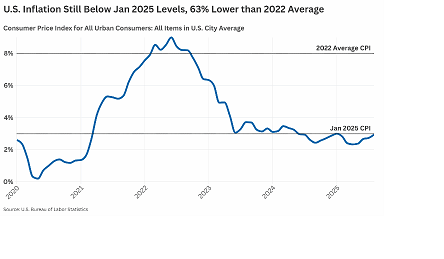
A September 25, 2025 report titled , “Tariffs Are Not Causing Inflation: Breaking Down August 2025 CPI” by Andrew Rechenberg of the Coalition for  Prosperous America argues “Inflation today is moderate, running far below the post-COVID peak and even below January 2025 levels, before any new tariffs were enacted. Furthermore, the main drivers of August 2025 inflation are housing shortages, energy demand, and food supply shocks — not tariffs.”

The report breaks down the August Consumer Price Index showing that the following drivers for inflation were:

  • Shelter: +0.4% m/m
  • Airline Fares: +5.9% m/m.
  • Beef: +2.7% m/m retail; +8% wholesale PPI.
  • Coffee: +6.9% m/m.
  • Electricity: +0.3% m/m
  • Eggs: flat m/m, but +10.9% Year over Year

Surprising to economists was the fact that many imported goods were not the drivers of inflation as shown below:

  • Autos: New vehicles rose +0.3% m/m and used vehicles +1.0% m/m
  • Steel & Aluminum: +0.4% m/m
  • Electronics: flat to +0.1% m/m
  • Pasta, Olive Oil, and Spices: 0.0–0.2% m/m

Andrew concludes: “If tariffs caused “economic disaster,” inflation wouldn’t be at 2.9% — it would look like 2022 all over again. Inflation data does not support these dire warnings. CPI rose just 0.2% in August, while PPI actually declined. As shown in Figure 1, Inflation today is running 63% below the 2022 average and even just below January 2025 inflation levels, hardly the sign of an “economic disaster.”

In reality, an examination of the Consumer Price Index (CPI) from March 2025 to July 2025 shows that the main drivers of price increases (inflation) are similar to the August report examined by CPA. 

1. Energy Prices

  • Import-related: Increases in global oil and gas prices due to geopolitical tensions or supply constraints (e.g., OPEC+ production cuts, Middle East instability) drove up domestic fuel and electricity prices.
  • Domestic: Infrastructure failures or domestic supply chain issues (e.g., refinery outages, grid failures) also boosted local energy prices.

2. Food Prices

  • Import-related: Rising prices of imported foodstuffs (such as coffee, cocoa, grains, or meat) due to poor harvests, supply chain disruptions, or currency depreciation.
  • Domestic: Domestic droughts, floods, or other adverse weather events affected local crop yields, and labor shortages increased local production costs.

3. Wages and Labor Costs

  • Domestic: Wage increases from tight labor markets or new government policies (minimum wage hikes) led to higher costs for services and goods, which was passed on to consumers.

4. Rents and Housing Costs

  • Domestic: Continued demand for housing, supply shortages, and higher mortgage interest rates pushed up rents and property costs.

As we can determine from data for the CPI from March to July 2025, the main drivers for inflation are related to domestic policies, not tariffs.  Each of these drivers could be explored in separate articles, but that would be out of my area of focus and expertise. 

Thus, I continue to support President Trump’s tariffs that will balance our trade deficit and help rebuild American manufacturing.  I still believe that fluctuating tariffs on Chinese imports that are only temporary and at lower levels won’t have the lasting effect needed to rebuild America’s industrial base.  Tariffs on Chinese imports need to be made permanent at a high level (100-125%) to influence CEOs of American companies to decide to reshore manufacturing to America, expand existing plants, and/or build plants in new locations.  This action is truly the only way to Make America Great Again.

What is the Impact of Tariffs on the Manufacturing Industry

September 23rd, 2025

The reciprocal tariffs mentioned in my previous article went into effect August 1, 2025.  These tariffs are intended to protect domestic industries from foreign competition, encourage returning manufacturing from China and other countries to the U.S, and raise revenue.  Tariffs aren’t affecting U. S. companies that manufacture Made in America products; however, they are affecting U.S. manufacturers that rely on imports for parts and subassemblies.

A tariff on imported goods may increase the cost of those goods for manufacturers that depend on imported parts or raw materials.  These cost increase may be too significant to be absorbed entirely by the manufacturer and manufacturers may also face intense market competition forcing them to absorb some or all of the added costs.  These higher costs may lead to higher prices or reduced profit margins for the company, which directly reduces their profitability. Furthermore, retaliatory tariffs from other countries can limit export opportunities for manufacturers, shrinking their revenue streams.

For example. When the U.S. Steel and Aluminum Tariffs of 2018 imposed tariffs of 25% on imported steel and 10% on imported aluminum, it had a negative impact on manufacturers that used these materials, such as carmakers and appliance manufacturers.  Ford Motor Company reported that the steel tariffs cost them $1 billion in additional expenses, leading to lower profits. Similarly, Whirlpool, a major U.S. appliance maker, saw higher costs for washing machine components and announced price increases on its products.

 However, long-term data shows that these tariffs boosted domestic production of U.S. steel and aluminum and actually saved the industry from substantially contracting further.  U.S. production of steel and aluminum has greatly increased since 2018, plants have been expanded and new plants have been built, increasing jobs in this industry.

The reciprocal tariffs President Trump promised to impose went into effect August 1, 2025.  Here’s a summary of the reciprocal tariffs on the top ten U.S. trading partners:

RankCountryU.S. Imports Value (2024, est.)Reciprocal Tariff Actions (2025)
1China$515 billionTariffs on U.S. soybeans (30%), autos (25%), pork (35%), liquefied natural gas (LNG) (25%), and whiskey (20%). Electronics and agricultural products heavily targeted.
2Mexico$385 billionTariffs mostly on U.S. pork (20%), apples (20%), cheese (25%), and various steel products (15–25%). Focus on U.S. agricultural and steel/aluminum exports.
3Canada$340 billionTariffs on steel (25%), aluminum (10%), U.S. whiskey (10%), orange juice (20%), and various household products (10–30%). Application is selective and closely mirrors U.S. tariff lists.
4Japan$170 billionTariffs on U.S. beef (38%), wine (15%), and motorcycles (20%). Also, technical restrictions on auto parts.
5Germany$145 billion*EU-wide tariffs: autos (25%), motorcycles (31%), bourbon (25%), peanuts (25%), denim (25%). Retaliation is coordinated through the EU.
6South Korea$110 billionTariffs on U.S. beef (18%), whiskey (20%), certain chemical exports (15–25%), and various machinery components (10–20%).
7United Kingdom$87 billionTariffs (via the UK’s post-Brexit regime): bourbon and other whiskies (25%), motorcycles (25%), orange juice (20%), jeans (10–15%).
8France$80 billion*EU-wide retaliation as in Germany: cheeses, bourbon, textiles (10–25%), and Harley-Davidson motorcycles (31%).
9India$73 billionTariffs on U.S. almonds (20%), apples (20%), walnuts (20%), Harley-Davidson motorcycles (50%), and medical devices (15–30%).
10Italy$68 billion*EU-wide retaliation: affected products include denim, motorcycles, whiskey, and certain agricultural goods (10–31%).

President Trump’s renewed tariff policy has affected a wide array of industries, from automobiles to electronics and telecommunications. Here’s how several key sectors have been hit, with up-to-date statistics:

1. Automobiles

  • Tariff Details: On April 3, 2025, the U.S. imposed a 25% tariff on Chinese-made automobiles and car parts.
  • Cost Increases: According to the Alliance for Automotive Innovation, average U.S. auto manufacturing costs rose by $1,800 per vehicle.
  • Price Impact: Ford and General Motors reported MSRP increases between $1,500–$2,300 for popular models, affecting consumer demand.
  • Profits: GM’s Q2 2025 earnings fell by 10%, attributing $650 million in added costs directly to tariffs.

2. Motorcycles

  • Tariff Details: Motorcycles imported from China and the EU are subject to 31% tariffs in 2025.
  • Cost Increases: Harley-Davidson estimated that tariffs have added $2,200 to the production cost of each exported bike.
  • Sales Decline: U.S. motorcycle exports to the EU dropped by 22% in the first half of 2025, according to U.S. Department of Commerce data.
  • Profits: Harley-Davidson’s international profit margins shrank by 14% compared to Q2 2023.

3. Electronic Equipment

  • Tariff Details: A 25% tariff was placed in 2025 on Chinese electronic components, including circuit boards and sensors.
  • Cost Increases: The Consumer Technology Association reported the average cost for U.S. electronics manufacturers rose by 11% across the board.
  • Price Impact: Apple raised iPad and MacBook prices by 7% this year, and smaller manufacturers like Sonos reported 12% lower earnings due to increased import costs and delayed shipments.
  • Industry-wide effect: According to the Electronic Components Industry Association, U.S. imports of certain components from China fell by 19% due to the higher costs, forcing some manufacturers to consider moving production outside the U.S.

4. Telecommunication Products

  • Tariff Details: Key telecom products—including modems, routers, and 5G networking gear—now face a 15% tariff when imported from China in 2025.
  • Cost Increases: Cisco Systems reported a $300 million increase in production expenses over the first two quarters of 2025, which it directly attributed to these tariffs.
  • Price Impact: U.S. telecom providers such as AT&T and Verizon announced average price hikes of 8% on internet hardware and new installations.
  • Market Share: U.S. telecom equipment exports to Asia declined by 15%, largely because of reciprocal tariffs on American products.

The electronics industry, characterized by complex global supply chains, has been particularly affected by U.S.-China trade tensions. Tariffs on Chinese-made circuit boards and components have increased costs for American manufacturers of computers, smartphones, and consumer electronics. Many smaller manufacturers, lacking the resources to absorb higher costs or negotiate new supply contracts, have faced shrinking profit margins and, in some cases, layoffs or business closures.

Here are examples of the effect on specific companies:

  1. Tesla: With the reintroduction of 25% tariffs on Chinese-made electric vehicles and batteries in 2024, Tesla has seen increased costs for its U.S.-assembled vehicles that use Chinese batteries and electronics. The company announced in May 2025 that the price of its Model Y and Model 3 would rise by $2,000 in North America, citing higher costs for batteries and electronic components. Elon Musk publicly stated that profit margins had dropped in Q2 2025 as a direct result of the tariffs.
  2. Caterpillar and Construction Equipment:
    Caterpillar, a leading U.S. maker of construction and mining equipment, relies on imported steel and engine parts from Asia. Trump’s new tariffs on Chinese and Southeast Asian metals have increased input costs by an estimated $200 million in 2024 alone. The company’s quarterly earnings report in July 2024 cited tariffs as a key factor in a 12% drop in net profit.
  3. Apple and Consumer Electronics:
    Apple, which assembles many of its products in China, is facing new 2024 tariffs on imported computer parts and finished devices. This has forced Apple to increase the prices of iPads and MacBooks in the U.S., and the company warned investors that gross margins would be tighter in the second half of 2024. Smaller electronics makers have reported even greater challenges, with some delaying product launches or laying off staff.
  4. General Motors (GM) and Car Parts:
    GM sources many car components, such as sensors and wiring harnesses, from Chinese suppliers. The 2024 tariffs have pushed up the cost of these parts, forcing the company to trim its profit outlook for the year. In its June 2024 investor call, GM confirmed that U.S. consumers would see higher prices for popular models like the Chevrolet Equinox and Silverado.

Why Tariffs Are Affecting the Manufacturing Industry So Greatly

For the past 30 years, outsourcing has been a cornerstone of U.S. manufacturing. First, manufacturers outsourced to Mexico, Puerto Rico, and the Philippines.  After China was granted Most Favored Nation status in the year 2000, manufacturers turned to Chinese suppliers for components, subassemblies, and finished goods, leveraging advantages of lower cost labor and materials, as well as less regulatory and environmental burdens. Many of my previous articles have outlined in detail the adverse effects of outsourcing to China on the U.S. manufacturing industry. 

Now, the introduction of these new tariffs is fundamentally changing this equation, turning an once cost-saving strategy into a financial burden for many U.S. manufacturers. Outsourcing has now become more expensive in the following ways:

1. Direct Tariff Costs

  • Tariff Rates: Tariffs on Chinese goods are now as high as 25% on electronics parts, 20% on automobile components, and 15% on telecom equipment. Any component or assembly imported from China is now subject to these elevated fees.

2. Supply Chain Disruption and Rushed Re-Sourcing

  • Supplier Shifts: Many manufacturers tried to pivot quickly to suppliers in Vietnam, Mexico, or India to avoid tariffs, but these regions often do not have the scale, experience, or infrastructure China offers.
  • Startup and Transition Costs: Changing suppliers requires significant investment, including qualifying new vendors, adapting designs to new materials, and sometimes retooling factories.

3. Increased Lead Times and Logistical Challenges

  • Shipping Delays: With tariffs in place, the process of importing from China became slower due to increased customs inspections and complex paperwork.
  • Inventory Costs: Companies like Apple and Dell reported having to maintain higher inventory levels—tying up capital and storage space—to avoid disruptions in the event of customs-related delays at ports.

4. Loss of Economies of Scale

  • Production Costs: Many U.S. manufacturers once benefited from China’s massive scale, which kept per-unit costs very low. With some companies moving only part of their production elsewhere to avoid tariffs, both U.S. and Chinese suppliers often increased prices due to reduced order volumes, further eroding cost advantages.

Outsourcing to China, once a reliable way to cut costs, has become a liability under the 2025 tariffs.  The solution to avoid paying tariffs is to “reshore” – return manufacturing to America.  It may be difficult if not impossible to find U.S. suppliers for some commodities, such as some electronic components. Manufacturers can get help finding U.S. manufacturers to replace their Chinese vendors through consulting services offered by The Reshoring Initiative at this link.

In addition, we may need to establish Federal grants similar to SBIR grants for companies to startup producing critical components again the in U.S. The end goal is worth doing whatever it takes to rebuild American manufacturing to the point where we are once again self-sufficient in producing the goods we need to protect the health and welfare of all Americans and remain an independent nation by having the goods we need to protect our national security and sovereignty.

What Have Been the Effects of President Trump’s Tariffs?

August 5th, 2025

During his campaign for re-election for President, President Trump pledged to address the unfair and unbalanced trade that the U.S. has experienced for many years.  Contrary to many politicians, President Trump kept his campaign promise by establishing an America First Trade Policy in which trade and economic policies would “put the American economy, the American worker, and our national security first.”  He announced, “I am establishing a robust and reinvigorated trade policy that promotes investment and productivity, enhances our Nation’s industrial and technological advantages, defends our economic and national security, and — above all — benefits American workers, manufacturers, farmers, ranchers, entrepreneurs, and businesses.” 

The remedies to address unfair and unbalanced trade included investigating “the causes of our country’s large and persistent annual trade deficits in goods, as well as the economic and national security implications and risks resulting from such deficits, and recommend appropriate measures, such as a global supplemental tariff or other policies, to remedy such deficits.”

As CNN Business reported, “In April, Trump imposed “reciprocal” tariffs as high as 50% on most of America’s trading partners.”. On April 9, President Donald Trump gave the world a three-month window to negotiate trade deals with the United States or face higher “reciprocal” tariffs. With just five days remaining in that tariff moratorium, the White House is expected to begin delivering a message to a dozen or so countries: Time is up, and here’s your new tariff rate.”

The article stated that Trump “told reporters that he would notify 10 to 12 nations a day over the course of the next five days, detailing their new tariffs in letters that the White House would begin sending on Friday. In most cases, the new rates would go into effect August 1, Trump said. “They’ll range in value from maybe 60% or 70% tariffs to 10% and 20% tariffs, but they’re going to be starting to go out sometime tomorrow,” Trump said. “We’ve done the final form, and it’s basically going to explain what the countries are going to be paying in tariffs.”

A July, 19, 2025, ABC News article titled, “What have Trump’s tariffs achieved so far? Experts weigh in,” Max Zahn wrote “The Trump administration touts tariffs as part of a wider set of “America First economic policies,” which have “sparked trillions of dollars in new investment in U.S. manufacturing, technology, and infrastructure,” according to the White House’s website.

The article stated, “Scores of companies have pledged new investment in the U.S., including tech giants Apple and Nvidia, pharmaceutical companies Merck and Johnson & Johnson as well as automakers Hyundai and Stellantis, the White House says. The whole idea is to encourage reshoring of manufacturing and change the balance of trade. That could all have some positive impact,” Morris Cohen, a professor emeritus of manufacturing and supply chains at Duke University, told ABC News.”

The Trump Effect page on the White House website states, “Since President Donald J. Trump returned to office, his America First economic policies have sparked trillions of dollars in new investment in U.S. manufacturing, technology, and infrastructure…The U.S. has seen a surge of private and foreign investment that are fueling job growth, innovation, and opportunity across every corner of the country. The website provides a list of the major investments by foreign countries and companies at this link.

Adding up the totals on the link comes to about 40 billion dollars. Of course, these pledges were made under threat of high tariffs, so time will tell if the companies and countries keep their pledges.

On July 29th, MSN Markets Today reported “The U.S. trade deficit in goods narrowed to the lowest level in nearly two years in June as imports fell sharply, cementing economists’ expectations that trade likely accounted for much of an anticipated rebound in economic growth in the second quarter.

The goods trade gap narrowed 10.8% to $86.0 billion last month, the lowest level since September 2023, the Commerce Department’s Census Bureau said. Economists polled by Reuters had forecast the goods trade deficit would rise to $98.20 billion. Imports of goods decreased $11.5 billion, or 4.2%, to $264.2 billion, the lowest level since March 2024. The decline was led by a 12.4% plunge in consumer goods imports.” 

On Sunday, August 3, 2025, the English edition of Trending News & Research reported:  “The US government under Donald Trump is collecting more money than ever from import tariffs, with customs duty revenue crossing $100 billion in fiscal year 2025—more than double what it brought in just five years ago. Treasury and Homeland Security figures suggest the final tally could reach $300 billion by year’s end, fueled by sweeping tariffs imposed on goods from over 100 countries, including India, Brazil, Russia, China and Canada. Customs duties now make up nearly 5% of total federal revenue, up from an average of 1.6% in previous decades. July alone saw the US collect a record $28 billion in tariff duties, with economists projecting that number could climb as high as $37 billion per month from August onward, when new rate hikes take effect.”

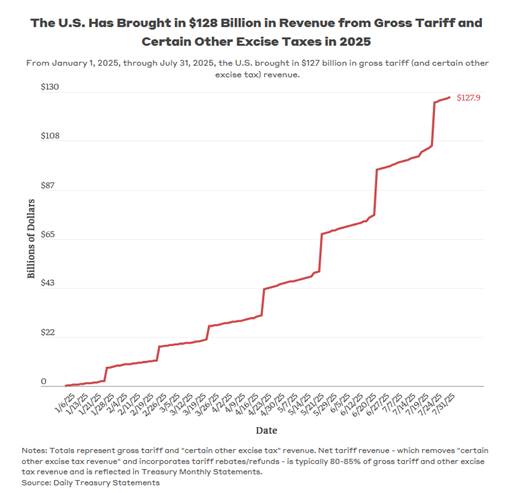
The Bi-Partisan Policy Center Tariff Tracker shows that the U.S. has brought in $128 billion in revenue from gross tariffs and other excise taxes in 2025 as shown by the following chart.

Note: “An important caveat is that the above data represent gross tariff and certain other excise tax revenue (emphasis ours)…Net tariff revenue in recent years has been 80% to 85% of gross tariff and certain other excise tax revenue.”

The Global Business Alliance recently published a Country-By-Country Reciprocal Tariff Rates Schedule available at this link:  GBA notes “This document serves as a reference tool for country-by-country tariff rates. As they are subject to change at any time, depending on the progress of trade negotiations and President Trump’s discretion, updates to the following table will not be instantaneous. Barring any additional extensions or individual agreements, these rates are expected to go into effect on August 1, 2025.”

Of course, not everyone is happy with the tariffs. Companies that focus on selling imported goods, such as clothes, toys, consumer electronics, and electronic and electrical products are being hit the hardest due to rising costs, and small businesses that rely on imported materials from China to produce their products are also being hit hard due to rising costs.  The problem is that for some products, there are no longer any U.S. sources.

As long tariff rates get imposed, rescinded, increased or reduced, it will make inventory management complicated as businesses big and small have to decide how and when to allocate capital. They have to decide whether to stockpile inventory before more increases come down the line or do they minimize inventory to preserve cash. Larger businesses will be better able to absorb the tariff costs or negotiate alternative supply cost arrangements than small business.

It takes time, resources, and administrative skill to navigate the kinds of sweeping changes to operations that tariffs require.  Small business owners will need to navigate sourcing new suppliers, deal with increased paperwork and compliance costs, and decide how and when to use cash reserves to navigate the new playing field that tariffs require.

If international tariffs become permanent as I have recommended, they will transform business models, market dynamics, and innovation in the global economy. Tariffs will engender supply chain disruption away from previously reliable partners, modify product reformulation to use different inputs unaffected by tariffs, and strategic repositioning in the market based on new cost structures. It’s going to become crucial to build relationships with domestic suppliers.

One of the goals of tariffs is to help domestic industries expand as it pushes consumers to buy from U.S. brands. The danger is that tariffs may lead to higher domestic prices as imports become more expensive, competition is reduced, and prices increase as U.S. companies are able to charge more.

We will likely see a faster adoption of automation and utilization of AI to offset input costs and domestic alternatives to imported materials. This will create new business opportunities for U.S. manufacturers. 

This transition to a new global playing field maybe difficult for some, but it is necessary if the U S. ever hopes to become self-sufficient again in producing the goods we need to protect the health and welfare of all Americans and remain an independent nation by protecting our national security and sovereignty.

Does the One Big Beautiful Bill Help Rebuild American Manufacturing?

July 22nd, 2025

In my January article titled, “What Legislation Should Congress Pass to Help Rebuild American Manufacturing? I made several recommendations.  Now, we will examine what provisions the One Big Beautiful Bill (OBBB) included that would help achieve the goal of rebuilding American manufacturing.

I asked one of my long-time business colleagues, Bruce Knowlton, to examine what tax benefits the OBBB provides for American manufacturers.  Bruce recently retired from being a long-time partner at Moss Adams LLP in San Diego and will begin teaching tax accounting at San Diego State University this fall.  He provided his analysis of the OBBB provisions with regard to the following tax-related recommendations I made in my article:

1.  Immediate cost recovery for investments in the types of machinery and equipment:

Bruce said “this was enacted and made permanent and called ‘bonus depreciation.’  It also increased the Section 179 expensing for companies that buy assets up from $1 million to $2.5 million.  This is now phased out when assets purchased exceed $4 million.  Please note that Section 179 expensing requires a business tax profit to the extent of the expensing but bonus depreciation does not.  A new provision was added to award manufacturers who build new manufacturing facilities (i.e. building structures) in terms of their “Qualifying Production Property” with 100% depreciation vs. a normal 39-year tax life.  This generally covers facilities used directly in the manufacturing process with construction starting in the U.S. after 1/19/25 and finished by 12/31/28 with a placed in-service date of after July 4, 2025 and before January 1, 2029.”

2. Immediate write-offs for investments in research and development: 

Buce said this was enacted. “The research credits also remain as is.  That said now a manufacturer that has gross revenue of no more than $31 million can go back and amend returns starting with their 2022 return to expense their previously capitalized R&D costs to get refunds.  Further, larger companies can elect to amortize the remaining capitalized R&D costs for 2022-2024 over a one- or two-year period.”

3. Reduce corporate tax rate to 15% from the 21% of the TCJA

Bruce said, “The corporate tax rate remains at 21% as it has been under TCJA. There was a permanent extension of the 20% qualifying business tax deduction which applies to closely held business (nonpublic companies) organized as S corporations or LLCs to continue their top marginal rate at 29.6% versus 37% for their individual U.S. resident owners. 

There was also a change in the business interest expensing rule that limits that deduction to 30% of EBITDA (earnings before income tax, depreciation and amortization) vs. EBIT (earnings before interest and taxes) currently.  Smaller companies with revenue of $31 million or less are still exempt from this rule. There were reductions for international companies as well to potentially lower the overall foreign intangible income tax.”

He added, “There were also a couple of indirect benefits.  One was the carve out reporting of overtime for their employees who receive overtime pay to qualify them for the new tax deduction of overtime pay.  The other was to expand the eligibility for qualified small business stock issued after 7/24/25 and the income exemption amounts on a sale of that stock as well as a shorter vesting period vs. the previous 5-year cliff vesting that was required.”

An article titled, “One Big Beautiful Bill Act” Tax Policies: Details and Analysis,” published on July 4, 2025 by the Tax Foundation stated the  OBBB Act would:

  • Permanently restore immediate expensing for domestic research and development (R&D) expenses; small businesses with gross receipts of $31 million or less can retroactively expense R&D back to after 12/31/21; all other domestic R&D between 12/21/21 and 1/1/25 can accelerate remaining deductions over a one- or two-year period.
  • Permanently reinstate the EBITDA-based limitation on business net interest deductions.
  • Permanently restore 100 percent bonus depreciation for short-lived investments.
  • Temporarily provide 100 percent expensing of qualifying structures, with the beginning of construction occurring after Jan. 19, 2025, and before Jan. 19, 2029, and placed in service before Jan. 1, 2031.
  • Make the Section 199A pass-through deduction permanent; increase phase-in range of limitation by $50,000 for non-joint returns and $100,000 for joint returns; create a minimum deduction of $400 for taxpayers with $1,000 or more of qualified business income (QBI) for material participants.
  • Implement a 1 percent floor on deduction of charitable contributions made by corporations.
  • Eliminate clean electricity production credit (45Y) and investment credit (48E) for projects placed in service after 2027, except for projects that begin construction within 12 months of passage and baseload power sources such as nuclear, hydropower, geothermal, and battery storage; introduce restrictions related to foreign entities of concern (FEOC).
  • Extend the clean fuel production credit (45Z) until 2030 and expand eligibility.
  • Introduce FEOC restrictions for several other credits, including the nuclear production credit (45U), the clean fuel production credit (45Z), the carbon oxide sequestration credit (45Q), and the advanced manufacturing production credit (45X); alter phaseouts and eligibility for 45X and 45Q.
  • Require intangible drilling and development costs to be taken into account for the purposes of computing adjusted financial statement income.
  • Add income from hydrogen storage, carbon capture, advanced nuclear, hydropower, and geothermal energy to qualifying income of certain publicly traded partnerships treated as C corporations.”

It is anticipated that these tax changes will help American manufacturers be more competitive in the global economy, but they do not specifically address the unfair trade practices, currency manipulation, product dumping, and Intellectual Property Theft done by China.  It would take passage of other bills to fulfill some of the other recommendations I made in my January article, namely:

Impose a Market Access Charge (MAC) as proposed by Dr. John R Hansen, (PhD economist and  Economic Advisor, The World Bank (retd.)  “Forcing foreigners to pay a market access charge (MAC) if they want to dump their speculative money into America’s financial markets when US trade deficits show that the global demand for dollars and dollar-based assets like stocks and bonds is already excessive. In addition to encouraging the dollar to move to a more competitive level, thus boosting economic growth and family incomes, the MAC could also generate hundreds of billion dollars of new government revenue per year.

Pass a Patent Reform Bill to restore inventors’ rights and end abuses by the Patent Trial and Appeal Board (PTAB)

A new bill similar to HR 8134, the Restoring America’s Leadership in Innovation Act (RALIA), introduced by Rep. Thomas Massie (R-KY) and Rep. Marcy Kaptur (D-OH) in the previous session of Congress would be supported  by the largest inventors’ organization, US Inventors.

Revoke China’s Most Favored Nation Status (aka Permanent Normal Trade Relations (PNTR) that was granted by President Clinton on October 10th, 2000 when he signed the U.S.-China Relations Act of 2000 into law. 

“Passing such a bill should be a major priority for the 119th Congress as soon as possible. Without PNTR status, all products from China would by default be subject to higher tariffs. This would reduce off-shoring by discouraging American investors and corporations from doing business in China. It would increase reshoring and diminish demand for Chinese goods, bolstering the sales of American manufactured products.”

Reduce the Allowed Value of De Minimis imports from the $800 allowed by the Trade Facilitation and Trade Enforcement Act of 2015 to a lower de minimis threshold.

The Coalition for a Prosperous America states: “U.S. companies and workers are subjected to a new level of job-destroying competition. Illicit drugs, such as fentanyl, and counterfeit goods are shipped directly to US consumers while evading detection. The predictable result is a major calamity putting U.S. producers and traditional retailers out of business and destroying jobs.” CPA urges “Congress to lower the de minimis threshold to $9 among other reforms.”

The One Big Beautiful Bill is a first step in passing legislation that would help in rebuilding American manufacturing’s capacity and eliminate dependence on China and other adversarial nations. Passing the other bills recommended by this article would especially help rebuild manufacturing capacity in industries that are critical to U.S. economic and national security. They would stop the destruction of American industry and innovation, the loss of high-paying manufacturing jobs, and the collapse of communities. They would help to create prosperity for our children and grandchildren and ensure that they will continue to live in a free country. 

Why Trump’s Tariffs on China Should Become Permanent and How to Make it Happen

June 18th, 2025

It’s been a volatile few weeks for Trump’s tariffs since he announced a 10% tax on all imported products from more than 50 countries, and placed additional duties on items from some of the largest U.S. trading partners, including Canada, Mexico, the European Union, and China.  The additional tariffs have ranged from 25% on Canada, Mexico, and the European Union to 125% and 145% briefly on China.  The imposition of these tariffs brought many countries to the negotiating table in the past two months, resulting in trillions of dollars of proposed investment in the U.S. in an attempt to reduce the additional tariffs.

Trump’s tariffs had an immediate beneficial effect on the U.S. trade deficit, according to an article titled “Goods Trade Deficit Plummets in April,” in the Wall Street Journal on May 30, 2025. The article reported that “The U.S.’s trade deficit for goods shrank substantially in April, as new tariffs weighed on imports.”

  • Goods imports fell by 20% to $276.1 billion while exports rose 3.4% to $188.5 billion.
  • It was the biggest one-month drop in goods imports on record
  • This yielded a goods trade deficit of $87.6 billion, down from $162.3 billion in March”

President Trump has touted trillions of dollars of investments into the U.S. brought about by deals he has negotiated after the imposition of tariffs and threats of higher tariffs.  The White House website provides a partial list published a partial list titled “The Trump Effect,” — which it said demonstrated “his America First economic policies have sparked trillions of dollars in new investment.”

On April 11, 2025, I was interviewed by Conner Lee, a reporter for The Epoch Times, on my opinion of Trump’s tariffs.  The article ran online on April 14th and in the paper for the week of or the week of April 16-22nd in the California section  I was quoted as saying, “Michele Nash-Hoff, president of ElectroFab Sales, a California-based manufacturers’ representative firm, said that businesses will know within the next three to six months whether the tariffs will be long-term.

“The tariffs will be an additional major driver to returning manufacturing to America, especially if the tariffs are not just temporary if they’re long-term,” she told The Epoch Times.

Nash-Hoff thinks the tariffs are not going to have an impact on inflation like some people are fearing. She referenced the 2018 U.S. tariffs on steel, aluminum, and some imports from China, which were followed by only about a 0.5 percent rise in the inflation rate.

She said the latest tariffs will benefit the U.S. economy by creating more American jobs, which means more people paying taxes. That, in turn, will help reduce the country’s annual trade deficit and lower its national indebtedness, she said.”

I believe that another trade deal with China that includes low rates of tariffs won’t work any better than the trade agreement President Trump negotiated in his first term.  China has violated the terms of that agreement just as it did the terms of becoming a member of the World Trade Organization in the year 2000. 

To ensure that China honored the terms of the WTO agreement, the United States–China Economic and Security Review Commission (informally, the U.S.–China Commission, USCC) was established on October 30, 2000.  The USCC has been “responsible for providing recommendations to Congress based on their findings on bilateral trade with the People’s Republic of China, evaluating national security and trading risks in all industries and conducting research on China’s actions.”  The Commission held hearings and submitted an annual report to Congress.

 Year after year, the Commission reported how China violated the WTO agreement, but no punitive actions were taken by Congress for 17 years. The reports repeatedly cited China’s unfair trade policies of intellectual property theft, government subsidies to domestic manufacturers, product dumping at below cost to capture market share of particular industries, fraudulent labeling, trans-shipping, and undervaluing their currency.  I have read several of the reports in the past and wrote articles about the findings. The article I wrote about the 2021 report can be found at this link.

In the May 19, 2025 Epoch Times article titled “Despite Negotiations, China Finds Ways to Circumvent US Tariffs,” Antonio Graceffo wrote “Even as Chinese leader Xi Jinping and President Donald Trump negotiate a new trade agreement, China continues to bypass U.S. tariffs through a global network of loopholes, rerouting schemes, and gray market tactics that keep its exports flowing into the United States despite trade restrictions…exploiting a combination of legal loopholes and gray zone tactics. These include exploiting postal and customs blind spots, rerouting through third countries, forged documentation, offshore assembly, and the creation of overseas distribution hubs that allow Chinese products to be re-exported under neutral labels.”

He explained, “China has also expanded its use of gray zone trade tactics by employing transshipment, committing document fraud, practicing under-invoicing, and utilizing overseas assembly. Chinese exporters are routing goods through Vietnam, Malaysia, Indonesia, Thailand, and even the European Union, where products are repackaged or relabeled to obscure their origin.”

However, if the Trump administration wants to seriously tackle the trade deficit with China, they first must handle the half a dozen lawsuits by ten states that are challenging the president’s ability to impose tariffs without the approval of Congress.  On April 23, 2025, AP News reported that “A dozen states sued the Trump administration in the U.S. Court of International Trade in New York on Wednesday to stop its tariff policy, saying it is unlawful and has brought chaos to the American economy.” The lawsuits “challenged Trump’s claim that he could arbitrarily impose tariffs based on the International Emergency Economic Powers Act.”

On Wednesday, May 28, 2025, CNN Business News reported that a three-judge panel at the U.S. Court of International Trade “ruled that President Donald Trump overstepped his authority to impose sweeping tariffs that have raised the cost of imports for everyone from giant businesses to everyday Americans.”  The ruling “stopped Trump’s global tariffs that he imposed citing emergency economic powers,” also “prevents Trump from enforcing his tariffs placed earlier this year against China, Mexico and Canada, designed to combat fentanyl coming into the United States.”

The tariffs have been reprieved from being stopped because, on Wednesday, May 28, 2025, ABC News reported that “The United States Court of Appeals for the Federal Circuit issued an administrative stay of the decision while it considers Trump’s appeal.”

The Coalition for a Prosperous America recommended action that can be taken by Congress to solve this problem in their weekly newsletter, Prosper Weekly.  CPA PRESIDENT JON TOOMEY SAID:Wednesday’s court ruling underscores the urgent need for Congress to act decisively to implement President Trump’s America First tariff strategy into law. While the administration addresses these legal challenges, Congress must seize this opportunity to legislate the President’s bold vision. Passing legislation to codify the universal 10% tariff would not only secure critical revenue to offset our unsustainable national debt and deficit, but it would also reaffirm America’s commitment to reshoring domestic industries and protecting our economic sovereignty. Without immediate action, Congress will hand China a $10+ billion refund and a receipt for American surrender. Tariffs remain the most strategic tool we have to revitalize American manufacturing, and it’s time for Congress to act.”

CPA Industry Analyst Kenneth Rapoza also recommended that Congress “remove China’s most favored nation status…[which] would immediately put China in the roughly 30% baseline tariff range. The existing Section 301 tariffs, first imposed by Trump in 2018 and extended for four years by the Biden administration in 2024, will stack on top of those, keeping China tariffs at 55%.”

I agree with the recommendation to revoke China’s most favored nation status, as I wrote about in my blog article of  June 2024, titled “Why We Must Revoke China’s Most Favored Nation Status.”  However, if the tariffs on Chinese imports are only temporary and at only a 30-55%% level, they won’t have the lasting effect needed to rebuild America’s industrial base.  In my opinion, the tariffs on China need to be made permanent at a high level (100-125%) to influence CEOs of American companies to decide to reshore manufacturing to America, expand existing plants, and/or build plants in new locations.  This action would truly set the stage to Make America Great Again.

America’s Inventor Lady

April 9th, 2025

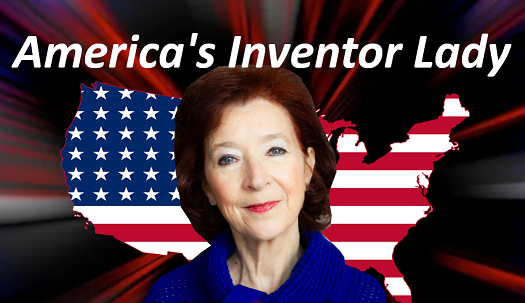
Recently, I had the pleasure of connecting with Rita Crompton, known as America’s Inventor Lady after a referral from a mutual friend who thought we had common interests because of my being involved with the San Diego Inventors Forum for about 15 years.

I asked if she had ever invented anything herself, and she said she hasn’t. I told her I hadn’t invented anything for which I had received a patent although I had developed ideas for produces in the past.  She said that she got that moniker because of her work in helping inventors get their ideas out of their heads and into the marketplace (from “mind to market”, as she says), as well as helping them get licensing agreements once their ideas are ready for the markets. She’s plied her trade in this fashion for more than the past 20 years.  I told her that I use my expertise in manufacturing to help guide inventors on how to select the right manufacturing processes and sources.

Prior to her work with inventors, she published murder mysteries, tutored middle school and high school students, and continued in volunteer capacities with various charities and professional associations with which she was affiliated. 

While she lived in Chicago for many years, she also spent time in Tulsa, Oklahoma, Marietta, Georgia, Denver, Colorado and, now, her current residence, in Eastern Tennessee.

When she moved to Denver, as a Gold Star member of the Denver Chamber of Commerce she encountered professional inventors, including three “ex-rocket scientists,” one of whom, Warren Roh, became her a mentor and trained her in the art of first finding, and successfully consummating licensing deals for inventor clients. 

In February of 2006, she and Warren Roh started The Inventors’ Roundtable™, an inventing roundtable forum which nurtured a large network of inventors in Colorado’s Front Range.   One of the main complaints the older inventors had of the local group was the cost to be a member and the overload of service providers.  Rita promised the three older inventors who helped start the Inventors Roundtable 17 years ago that it would always be free and service providers would be by invitation only and that is still true. 

After her recent relocation to Del Rio, Tennessee, and the Covid Pandemic, the IRT meetings changed to virtual meetings.  This allows the IRT to serve any inventor (rural, city or suburb) from the comfort of their home to join in, ask questions and share successes and challenges with each other.   The 2nd Thursday of the month is the IRT Virtual West and the 4th Monday of the month is the IRT Virtual East. However, anyone from anywhere can join the meeting via the posted link. 

She explained.  “The Inventors’ Roundtable is, and has always been, a free, safe environment where inventors learn about the invention process, how to protect their invention and how to get their idea to market. Service providers, by invitation only, donate their time to the inventors once a month. In addition, experienced and successful inventors mentor those just getting started learning the inventing process.”

She also spoke about her own company, FLeCusa International.  “I started FLeCusa in 2007 to help the little guy, the solo and newbie inventors”, she told me.  She said “I did it to provide a unique service to those clients, almost all of whom are without the resources available to a large corporation, but many of whom nevertheless wish to enter the marketplace or grow their business to a new level, both nationally or internationally. “In that sense, I’m kind of the inventor’s advocate, assisting to help level the playing field between them and larger, more resource-rich companies.”

She added, “My goal is to bring the corporate environment resources to the individual inventor.  I help inventors understand the inventing process, bring their invention to market, establish distribution networks, protect their intellectual property and treat their invention like a business.  My husband is my partner and he works with me in the business using his skill sets as both a transactional attorney (i.e., to prepare contracts) and part-time webmaster, using his experience with social media to manage my internet outreach and to drive traffic to my websites.  In the end, I am the inventor’s advocate to help level the playing field.

As a licensing agent, Rita gets paid when the inventor gets paid.  There is no up-front fee because she can’t promise a deal any better than other licensing company.  Rita generally focuses on consumer products.  However, she will work in Home Health Care and with environmental safety products.  “Last year a young woman who had Early Onset Parkinson and had a feeding tube through high school and college.  That feeding tube caused a horrible rash on the skin.  This was a huge problem for anyone needing a feeding tube to survive.  The inventor went to college, became a chemist, and proceeded to invent a solution to her problem.  Within a few weeks of filing the patent using one of registered patent attorneys I know, we licensed the new product to the company that makes the feeding tubes.  They had known about the problem for decades but never had a solution.  The product is now sold worldwide.”   

Rita wrote the Inventors Galaxy Guide, which she updates regularly.  The 2025 edition is ready this week. It can be downloaded for free by subscribing to the Invent America Newsletter at www.AmericasInventorLady.com.  This tool is a simple guide to help inventors understand the steps of the inventing process and the parameters for the costs at each stage. 

In March of 2024, Rita, her daughter, Kat, and her husband started going to the shows produced by ASD Market Week (Affordable Shopping Destination), which are held in March in Las Vegas, NV.  ASD Market Week is the largest wholesale retail merchandise show in the U.S. They take up to 25 inventors with them to the show each year.  “ASD Market Week was amazing this year.  We had one inventor with an athletic training tool.  We had no idea that an NFL licensing agent would be at the show with his own invention wanting to join us.  He now has three of our ASD products for his team to consider.  You just never know who will be at a show and take your product to the next level” 

I asked her how she got to have a radio show.  She said, “The HomeTalk USA radio has been on coast-to-coast radio program for more than 25 years. It is the longest running DIY radio talk show in history. Invent America Radio has been part of it for two and a half years, and ASD Market Week is one of the sponsors of our show.  It is free for inventors to be on the show, so if any inventors are interested, they can email her at rita@americasinventorlady.com.”

She mentioned that at this month’s Inventor’s Roundtable meeting, the speaker is a counselor on the R&D tax credit, who will discuss how an inventor can get a R & D tax credit after the inventor starts making money on his product.  The R&D tax credit can go back three years.  Join her for the upcoming Inventors Roundtable Meeting (it’s free!) and learn how to let the U.S. Government help you take advantage of the new R&D tax credit to recover some of the cost of getting your idea up and running.

In conclusion, we agreed that the best help inventors could get now would be to have Congress pass a Patent Reform Bill that would restore inventors’ rights and end abuses by the Patent Trial and Appeal Board (PTAB).  Hopefully, Rep. Thomas Massie (R-KY) and Rep. Marcy Kaptur (D-OH) will reintroduce HR 8134, the Restoring America’s Leadership in Innovation Act (RALIA) that didn’t get out of committee last year to be voted on by the whole of Congress.

Would the Benefits of Tariffs Outweigh the Threat of Increased Inflation

March 25th, 2025

On March 12, 2025, President Trump “imposed sweeping 25% tariffs on all steel and aluminum imported into the United States…” causing some economists to warn “that broad-based tariffs threaten to drive up prices on everything from food to new homes.” In answering the question of whether tariffs would increase inflation, we can consider whether or not inflation was increased by the imposition of Section 232 tariffs on steel and aluminum and the 301 tariffs levied on roughly half of U.S. imports from China, and we can consider the benefits achieved from these tariffs in 2018. 

Tariffs have traditionally had a two-fold purpose:  protect American manufacturers from unfair trade practices by mercantilist countries and stimulate domestic production. The Section 232 and 301 tariffs were aimed to protect the domestic steel and aluminum industries from what the government perceived as unfair competition and national security threats. Here are some benefits that were projected from these tariffs:

Section 232 Tariffs:

  1. Protection of Domestic Industries: By imposing tariffs on imported steel and aluminum, the U.S. government intended to protect and support domestic producers of these metals.
  2. Stimulating Job Growth: The tariffs were expected to create and maintain jobs in the U.S. steel and aluminum industries by making imported metals relatively more expensive compared to domestic products.
  3. Infrastructure Development: With a healthier domestic steel and aluminum industry, there was an expectation of increased capacity and capability to supply materials for critical infrastructure projects across the country.

Section 301 Tariffs:

  1. Addressing Intellectual Property Concerns: The Section 301 tariffs targeted imports from China and were aimed at addressing intellectual property theft and unfair trade practices in various industries, including steel and aluminum.
  2. Leveling the Playing Field: By imposing tariffs on Chinese goods, the U.S. sought to level the playing field for domestic steel and aluminum producers who may have been competing against subsidized Chinese products.
  3. Encouraging Fair Trade Practices: The tariffs were intended to push China towards adopting fair trade practices and addressing concerns related to market access, technology transfer, and intellectual property rights.

Here are some specific examples of how the Section 232 and 301 tariffs have benefited the U.S. steel and aluminum industries:

  1. Expanding Existing Plants:
    • Example: Nucor Corporation, a leading steel producer in the U.S., announced plans to invest $1.35 billion to build a new steel plate mill in Kentucky after the implementation of tariffs on steel imports under Section 232. This expansion will not only create more jobs but also increase production capacity, catering to the rising demand for steel products in the country.
  2. Building New Plants:
    • Example: Alcoa, a prominent aluminum producer, decided to restart its aluminum smelter in Evansville, Indiana, following the tariffs imposed on aluminum imports under Section 232. This move signifies a significant investment in building a new plant that will contribute to the growth of the domestic aluminum industry, providing employment opportunities and supporting the local economy.
  3. Adding Employees:
    • Example: U.S. Steel Corporation hired additional employees at its plant in Granite City, Illinois, in response to the tariffs imposed under Section 232. The increased demand for domestic steel prompted the company to bring back workers who were previously laid off and also recruit new talent to support the plant’s operations, showcasing the positive impact of tariffs on job creation within the industry.

Overall, the Section 232 and 301 tariffs have played a crucial role in revitalizing the U.S. steel and aluminum industries by encouraging investments in plant expansions, new construction projects, and workforce expansion, thereby fostering growth and competitiveness in these sectors.

Now, let’s examine whether or not these tariffs increased inflation since going into effect in 2018. The U.S. International Trade Commission (USITC) released the report,  Economic Impact of the Section 232 and 301 Tariffs on U.S. Industries in March 2023.  “It took an in-depth look at the effects of these tariffs on the importing industries and on industries dependent on them…over the years 2019 through 2021. In every one of the ten industries the authors studied, the 301 tariffs led to significant increases in domestic production.”  An article titled “USITC Report Shows Tariffs Boosted U.S. Production” by Jeff Ferry, Chief Economist of the Coalition for a Prosperous America, states that the key points of the report were:

  • “Section 301 and 232 tariffs boosted production in all twelve of the industries studied.
  • Price increases in the product categories targeted with tariffs were very small, in the 3%-4% range, contrary to mainstream media narrative.
  • Most of the tariffs targeted intermediate (industrial) goods. Downstream goods, including consumer goods, saw barely visible tariff-related price increases.
  • Downstream price increases due to steel and aluminum tariffs were estimated to be 0.2%.
  • Section 232 steel tariffs unleashed a huge wave of steel investment, likely creating some 20,000 direct jobs.
  • Tariffs are a valuable tool for generating growth in the U.S. economy.”

Since these tariffs were beneficial for the steel and aluminum industries, additional tariffs would be beneficial to other American manufacturing industries and help reduce our increasing trade deficits.

The Press Release on March 19, 2025 by the Coalition for  Prosperous America  titled:  “Importers Front-Run Global Tariffs; Deficit Expands a Record Breaking 34% in January” by Kenneth Rapoza states:

 “January imports rose 10% to $401.2 billion while exports rose at their usual pace, around 1% to $269.8 billion, according to the Bureau of Economic Analysis (BEA)…The January goods deficit is the biggest in years, if not ever.”

The top 10 deficit countries as measured inbillions of dollars were: “China ($29.7), the European Union ($25.5), Switzerland ($22.8), Mexico ($15.5), Ireland ($12.4), Vietnam ($11.9), Canada ($11.3), Germany ($7.6), Taiwan ($7.5) and Japan ($7.4).”

These high trade deficits explain why President Trump is proposing 25% tariffs on imports from China, Canada, and Mexico. 

On March 19, 2025, the Coalition for a Prosperous America released a memorandum titled “CPA Recommendations for Implementing Tariffs Pursuant to the America First Trade Policy” by Charles Benoit as a response to the Presidential Memorandum titled America First Trade Policy President Trump issued on his Inauguration Day.

It states: “CPA is strongly supportive of President Trump’s Trade and Tariff Agenda that seeks to broadly reindustrialize the United States and raise significant revenue as outlined in the America First Trade Policy Memorandum.”

“However, CPA cautions against adopting a reciprocal tariff strategy aimed primarily at negotiating lower foreign trade barriers and more favorable investment conditions abroad. A reciprocal tariff strategy that prioritizes foreign governments’ willingness to reduce their trade barriers or be more receptive to foreign investment is in conflict with the stated goals of the America First Trade Policy Memorandum and undermines the predictability and stability American businesses need to confidently invest in long-term domestic production.”

CPA offers the following recommendations as they relate to the use of tariffs for protection, for revenue, and for reciprocity.

Tariffs for Revenue:

  • CPA fully supports President Trump’s concept of a 10% to 20% supplemental, universal tariff. CPA estimates that even a modest 10% supplemental universal tariff would lead to $728 billion in economic growth and 2.8 million new jobs, while generating $263 billion in new federal revenue to pay for domestic tax cuts.

Tariffs for Protection:

  • Section 232 is an excellent Presidential tool for protecting American producers, and CPA applauds the Trump Administration for already initiating new Section 232 investigations on copper and lumber.
  • CPA believes it is essential that entire supply chains be considered for the successful deployment of tariffs. Conveniently, Sections I through XX (1 through 20) of the Harmonized Tariff System (HTS) are organized in this way. The Trump Administration should consider initiating a Section 232 review for each of Sections 1 through 20 of the HTS.

Tariffs for Reciprocity

Reciprocal tariffshaven’t worked to the benefit of the United States ever since the General Agreement on Tariffs and Trade (GATT) went into effect in 1948.  When the World Trade Organization was established in 1995, “every WTO Member, including the United States, has pledged maximum tariff rates applicable to every other WTO member…Under the WTO system, there’s no single maximum rate, but rather specific maximum rates — known as ‘bound rates’ — itemized across 5,000+ product categories. Bound rates for each WTO country are listed in that country’s ‘Schedules of Concessions,’ which is annexed to the General Agreement on Tariffs and Trade (GATT.)”

Supposedly level tariff rates haven’t prevented the United States from incurring an ever-increasing trade deficit with its trading partners because of mercantilist practices such as undervalued currency, subsidies to the manufacturing industries of the respective countries, intellectual property theft, and product dumping, among other practices. Thus, CPA concludes: “These reciprocity requirements have all failed while simultaneously pitting American producers against each other.” 

Instead,” CPA calls on the Trump Administration to either withdraw from the World Trade Organization entirely, or to “Unbound” the United States’ Schedule of Concessions to the GATT.”

The Trade and Tariffs page of the CPA website states, “The Coalition for a Prosperous America (CPA) has proposed a model that uses a simple, four-level structure of global tariffs at 0%, 15%, 35% and 55% (explained more in the document). CPA projects that this tariff would create 10 million new producer jobs, increasing real household incomes by 10%, grow the economy by 7% and generate $603 billion in new revenue. This revenue is more than sufficient to eliminate income taxes on the large majority of American wage earners.

The economic benefits of imposing tariffs on all imported goods can be summarized to be:

  1. Protection of domestic industries: Tariffs can protect domestic industries from foreign competition by making imported goods more expensive. This can help prevent job losses in sectors that are unable to compete with cheaper imports.
  2. Revenue generation: Tariffs can generate revenue for the government. The revenue collected from tariffs can be used to fund government programs, infrastructure projects, or reduce budget deficits.
  3. Trade balance improvement: By making imported goods more expensive, tariffs can help reduce imports and improve the trade balance of the country. This can help decrease trade deficits and strengthen the economy.
  4. Encouraging domestic production: Higher tariffs can incentivize businesses to produce goods domestically rather than importing them. This can lead to increased investment in domestic production facilities and create jobs.
  5. National security: Imposing tariffs on certain imported goods can also be used as a strategic tool to protect industries that are deemed critical to national security.

In my opinion, these benefits make tariffs an attractive alternative to the free-trade policies that have dominated the past 70 years of international trade. Protecting and encouraging more domestic production would increase manufacturing’s share of the Gross Domestic Product (GDP) and improve the financial wellbeing of many more Americans.  

Is Reshoring Making a Difference and Increasing?

March 12th, 2025

Because the U.S. trade deficit in goods and services continues to surge, many people wonder if reshoring is really happening and whether it is having a beneficial effect and increasing.

According to data from the U.S. Bureau of Economic Analysis, the U.S. trade deficit surged to a new record in January.  The “goods and services deficit was $131.4 billion in January,” ballooning up by 34% from December’s deficit of $98.1 billion.  “This was the widest deficit for a month on record, dating back to 1992, and the expansion was more than analysts anticipated.”

As usual, China ($29.7) topped the list of countries with which we have trade deficits. The other top ten were the “European Union ($25.5), Switzerland ($22.8), Mexico ($15.5), Ireland ($12.4), Vietnam ($11.9), Canada ($11.3), Germany ($7.6), Taiwan ($7.5), [and] Japan ($7.4).”

The good news is that reshoring is increasing and improving our country’s self-sufficiency capacity for goods essential to our economy and national security according to a number of recent surveys and reports.

The article titled, “The Rise of Onshore Manufacturing” in the January-February 2025 issue of Design2part magazine, reports that “Research released in November by global management consultancy Bain & Company revealed an acceleration in strategic reshoring moves by businesses worldwide—to shift operations and supply chains closer to their home markets…The survey found that the percentage of CEOs and chief operating officers who reported their companies are planning to bring supply chains closer to market rose from 63 percent of those surveyed in 2022, to 81 percent in 2024—a sharp 18 percent increase…Survey results show that the proportion of companies reporting moves to shift operations out of China rose from 55 percent in 2022, to 69 percent in 2024.”

The research stated “Factors such as geopolitical turbulence, rising costs, and pressures for reduced carbon footprints are fueling the trend toward onshoring” In addition, “reshoring as having been further stimulated by the 2022 Inflation Reduction Act (IRA). The IRA offers U.S. companies subsidies and tax credits that incentivize reshoring and near-shoring to boost domestic manufacturing and job creation…Moves toward reshoring of semiconductor manufacturing have also been intensified by the U.S. CHIPS Act, which put in place tax incentives and $52 billion in funding to stimulate U.S. domestic production of chips.”

The results of this research are corroborated by “Kearney’s 2024 annual Reshoring Index (KRI) report, which “concludes that as reshoring and nearshoring activity increase, ‘Made in America, for America’…describes the foreseeable future of industrial manufacturing in the Western hemisphere.”

The KRI was launched in 2018 to track the extent to which manufacturers are reshoring manufacturing from Asia back to the US.  “The Reshoring Index is determined by dividing the import of manufactured goods from the 14 Asian low-cost countries by the US domestic gross manufacturing output to calculate a manufacturing import ratio (MIR)”

Based on data from 2023, the report showed “US imports from 14 Asian LCCRs declined by $143 billion, from $1,021 billion in 2022 to $878 billion in 2023. The majority of the drop in Asian LCCR imports was caused by a 20 percent (or $105 billion) reduction in Chinese imports.” However, “Mexico surpassed mainland China as the largest exporter to the US. US imports of Mexican manufacturing goods grew from $320 billion to $422 billion (32 percent).”

The Kearny report also stated: “Thirty-eight percent of manufacturing executives responding are looking to continue to reshore or nearshore operations from mainland China, while another 25 percent are discussing moving operations away from India, and 14 percent are thinking about exiting Vietnam.”

The organization that originated the term “reshoring” is the Reshoring Initiative founded by Harry Moser in 2010 to help manufacturers return manufacturing to the U. S. by changing the mindset from “offshored is cheaper” to “local reduces the Total Cost of Ownership.” A Free Total Cost of Ownership (TCO) worksheet calculator is available at www.reshorenow.org.

The latest e-news by the Reshoring Initiative includes this link to take the annual industry-wide Reshoring Survey that examines manufacturers’ decisions on whether to reshore factories and supply chains. The results of the survey will be released in April.

Last year’s report featuring 2023 data showed that reshoring is continuing to climb, adding 263,583 jobs, the second highest year on record compared to 349,408 jobs in 2022.  The preliminary data for 2024 is 244,940.  The website reports “As of March 2023, we have recorded over 6400 cases of manufacturing companies that have brought work back to the U.S.” The total number of jobs created by reshoring and FDI came to 1,214,3343 at the end of 2024. 

Reprinted with permission of the Reshoring Initiative

We lost 5.8 million jobs between 2000 to 2020, and it’s taken 11 years to add the first million jobs, but only three years to add the second million.  Even at the current faster rate, it would take at least another 12-15 years to recoup the 3.8 million jobs we lost.

The key findings of the 2024 report were:

  • Geopolitical Risk is a top driving force in the reshoring and FDI trends.
  • Skilled workforce is another top factor
  • The Southern U.S. remains the most competitive manufacturing region
  • Nearshoring and trade with allies are becoming more prevalent in the shifting global dynamics
  • Wall Street is embracing reshoring, with mentions in earnings calls up sharply and
  • a 300% increase in spending on reshoring and FDI data

Foreign Direct Investment refers to foreign companies either investing in the U.S. by expanding existing U.S. plants or building new plants.

The report noted:

  • Israel – “the October 7 Hamas attack was too late in 2023 to impact 2023 data, but we anticipate it will have a ripple effect across various industries with broad economic and supply chain disruptions that will influence costs, availability of materials, and production schedules.”
  • Taiwan – “U. S. Chinese tension has been mounting for several years. Geopoliticians and corporate strategists are anticipating reshoring as insurance.”
  • China – China has the highest combination of huge trade dependency, single sourcing and geopolitical risk. Reshoring and FDI from China are near historical highs, with reshoring alone at an all-time high of 87%.”

Since these geo-political threats have only increased in the past year, there is a greater incentive to consider reshoring.  According to this report, the number of CEOs actively reshoring went from under 10% in 2012 to nearly 90% in 2023.

The latest e-news from the Reshoring Initiative states:  “the mere threat of tariffs seems to be doing a sufficient job of defining the objective: the U.S. must boost domestic manufacturing to strengthen national security, reduce the trade deficit, and support economic stability. And the Trump administration appears serious about making that happen.  Regardless of how tariffs are implemented, the pressure is driving companies to rethink their supply chains and commit to localization.” 

However, the e-news cautions: “While the mere threat of tariffs could be enough to firm up some of the plans, many projects will only move forward when the tariffs are in place and likely to remain in place for at least the next four years. As Michael Todd Speetzen?of Polaris said, “We have a presence that we would be able to leverage if we viewed this as a more permanent situation.”  The Reshoring Initiative’s industrial policy says that if tariffs are used, they should be “forever” or at least until trade in the product or with the other country becomes balanced. Companies will not make large investments if the rules are likely to change.” 

While tariffs are being criticized by economists and those who would be subject to the tariffs, it appears that tariffs could become the major driver of reshoring by American manufacturers. It could also accelerate Foreign Direct Investment as more foreign companies expand existing plants in the U.S. or build new manufacturing plants in the U.S. to avoid tariffs.

Some economists say that tariffs protect and prop up inefficient American manufacturers that should be allowed to fail if they can’t compete against foreign competitors.

I agree with the Victor Davis Hanson’s opinion about President Trump’s tariffs in his article, “Are Trump’s Tariffs Really Tariffs?”  He wrote, Consider the various Trump “tariffs” leveled by an exasperated, and now $36 trillion-indebted, America. Almost none of them meet the traditional definitions of an industry-protecting tariff. Instead, they are the last-gasp tools of American leverage used only when decades of bipartisan diplomacy, summits, entreaties, and empty threats have all failed…The Trump tariffs are the last, desperate effort to reestablish global reciprocity and keep America safe.”

American manufacturers have had to compete on an unlevel playing field in international trade for decades.  We need to do whatever it takes to rebuild our manufacturing industry to ensure that we have the commercial and military/defense products needed to keep Americans healthy and safe. If tariffs would level the playing field for American manufacturers and accelerate reshoring significantly, I’m all in favor of implementing tariffs until our trade is balanced.

What are Some Innovative Approaches to Solving the Manufacturing Skills Gap?

February 25th, 2025

The Industry 4.0 technologies of Artificial Intelligence (AI), automation, Internet of things (IoT), and robotics are transforming all sectors of our economy including manufacturing. Manufacturers are using these technologies to increase productivity and capacity, improve quality, analyze data, and improve worker safety. These technologies are actually creating more jobs within operations rather than reducing the number of workers.  A 2024 report from Deloitte and the Manufacturing Institute “claims that manufacturers could need as many as 3.8 million new workers by 2033. Roughly 1.9 million of those could go unfilled if current labor gaps remain unsolved.” 

Manufacturers need workers at every level, but especially in technical roles. Addressing the growing skills gap in manufacturing is a crucial task that requires a multi-faceted approach. Here are some strategies and innovative approaches that manufacturers can implement to bridge the gap:

  1. Collaboration with Educational Institutions: Establish partnerships with schools, colleges, and technical institutions to develop curriculum that is aligned with the needs of the manufacturing industry. This can include offering apprenticeships, internships, and hands-on training programs.
  2. Industry Partnerships: Collaborate with other companies in the industry to develop joint training programs or share best practices. This can help in addressing common challenges and promoting a culture of continuous learning.
  3. Career Counseling: Education and training institutions, as well as employers, can offer career counseling services to help individuals identify their strengths, interests, and career goals in light of technological changes. This guidance can aid in making informed decisions about education and training pathways.
  4. Personalized Learning Paths: Utilize data analytics and AI to create personalized learning paths for employees based on their skills, interests, and career goals. This can help tailor training programs to individual needs, maximizing learning outcomes.
  5. Upskilling and Reskilling Programs: Provide opportunities for current workers to acquire new skills or upgrade their existing ones through training programs. This can be done through online courses, workshops, and on-the-job training.
  6. Specialized Training: Provide specialized training in emerging technologies like machine learning, robotics, and automation to help individuals transition into new roles and industries that are experiencing growth due to technological advancements.
  7. Microlearning Modules: Implement bite-sized and interactive microlearning modules that employees can access on-demand. This approach allows for quick and targeted skill development, fitting into busy work schedules.
  8. Remote and Virtual Training: Leverage remote and virtual training platforms to reach geographically dispersed employees and provide consistent training experiences. Virtual reality (VR) and augmented reality (AR) can simulate real-world scenarios for hands-on learning.
  9. Cross-Functional Training: Encourage cross-functional training opportunities where employees can learn skills outside their immediate roles. This fosters a culture of collaboration, innovation, and adaptability within the workforce
  10. Mentorship Programs: Establish mentorship programs where experienced employees can coach and guide new hires. This can help in knowledge transfer and skill development among employees.
  11. Diversity and Inclusion Initiatives: Encourage diversity in the manufacturing workforce by implementing programs that attract underrepresented groups, such as women and minorities. This can help bring in new perspectives and talent to the industry.
  12. Certification Programs: Offer certification programs in partnership with industry organizations or educational institutions to validate employees’ skills and expertise. This can enhance employee motivation and career progression opportunities.

With rapid advancements in technology reshaping the job market, it is essential for individuals to adapt and upskill through education and training to remain competitive in their careers.  

  1. Skill Development: Education and training programs can help individuals develop the skills needed to thrive in a technology-driven economy. This includes technical skills such as programming, data analysis, and digital literacy, as well as soft skills like problem-solving, adaptability, and creativity.
  2. Lifelong Learning: Continuous education and training encourage a culture of lifelong learning, enabling workers to stay updated with the latest technological trends and job requirements. This ongoing development is essential in a world where job roles will constantly evolve due to new technologies.

In California, there are several community colleges that offer training programs in manufacturing skills to help individuals gain the necessary knowledge and expertise for careers in the manufacturing. industry. Here are some community colleges in California known for providing training in manufacturing skills:

  1. American River College (located in Sacramento) has programs in Welding Technology and Precision Machining that focus on the skills needed for manufacturing industries.
  2. Chaffey College (located in Rancho Cucamonga, San Bernardino County), offers a Manufacturing Technology program that covers topics like blueprint reading, machining, and computer-aided design (CAD).
  3. El Camino College (located in Torrance, L.A. County) offers programs in Engineering Technology that include courses in manufacturing processes, materials, and quality control.
  4. Foothill College (located in Los Altos Hills) offers programs in Advanced Manufacturing Technology that provide hands-on training in areas such as CNC machining, welding, and industrial maintenance.
  5. Sierra College – With campuses in Rocklin, Grass Valley, and Tahoe-Truckee, Sierra College offers a Mechatronics program that combines mechanical and electrical engineering skills essential for modern manufacturing processes.

Orange County

  1. Fullerton College offers programs in Advanced Manufacturing Technology that cover various aspects of manufacturing processes and technologies.
  2. Orange Coast College (located in Costa Mesa) provides training in Industrial Automation Technology, preparing students for careers in automated manufacturing systems.
  3. Santiago Canyon College (located in the city of Orange), provides training in Industrial Technology with a focus on manufacturing-related courses such as machining and industrial automation.

Riverside County:

  1. Norco College provides training in Advanced Manufacturing and Mechatronics, preparing students for careers in high-tech manufacturing industries.
  2. Riverside City College offers programs in Manufacturing Technology that include courses in CNC machining, tooling, and industrial safety.

San Diego County:

  1. MiraCosta College offers extensive certificate program including Automation Technician,  Electromechanical Technician, Electronics Technician, Machining, PLC Technician, Robotics Technician, and Welding
  2. Miramar College provides training in Advanced Manufacturing Technology that covers topics such as manufacturing processes, materials, and automation.
  3. San Diego City College offers programs in Manufacturing Engineering Technology with a focus on CNC machining, CAD/CAM, and quality control.

These community colleges in California are just a few examples of institutions that offer training and certificate programs in manufacturing skills to equip individuals with the knowledge and hands-on experience necessary for careers in the manufacturing industry training.  Many states are now providing training in manufacturing jobs through their community colleges.  Previously, I have written articles about training available at community colleges in North and South Carlina, North Dakota, Ohio, Kentucky, and Texas.

Another way to increase the number of future manufacturing workers is to start training in high schools.  Since its founding in 2011, SME PRIME®(Partnership Response in Manufacturing Education), the signature program of the SME Education Foundation has been partnering private industry with academia to build custom manufacturing and engineering programs in high schools across the country — providing equipment, curriculum, teacher training, and student scholarships along with funding for manufacturing-related extracurricular activities and program sustainability. SME PRIME is the most comprehensive manufacturing and engineering program for high school students in the country.

SME PRIME is provided at no cost to high schools, and the curriculum is tailored to meet local manufacturers’ needs and aligned with state educational standards. The SME Foundation staff coordinates program development, alleviates administrative burdens, and provides ongoing financial support provided to sustain program longevity.

There are now 112 PRIME schools in 23 states serving 10,000 students annually. The success of this program is significant because 91% of PRIME seniors choose manufacturing/engineering post-graduation from high school. There are only six high schools in California, so there is plenty of opportunity for more high schools to become PRIME schools.

Incorporating these innovative approaches and strategies will help organizations build a future-ready workforce equipped with the skills, knowledge, and capabilities needed to thrive in an evolving business landscape. Implementing these innovative approaches and strategies will help the manufacturing industry work towards closing the skills gap and ensuring a well-trained workforce for the future. By investing in education and training programs that cater to the evolving needs of the workforce, society can better equip individuals to navigate the challenges and opportunities brought about by automation and artificial intelligence.