What is the State of the American Metal Forming and Fabricating Industry

February 12th, 2013

The Precision Metalforming Association (PMA) held an executive conference in Irvine on February 6-7, 2013 for their forming and fabricating members. Attendees came from as far away as Illinois, Minnesota, and Ohio. The companies represented ranged in size from a low of 50 employees to a high of 350 employees.

On the first day, the schedule of events included presentations on business conditions and benchmarking by PMA President, Bill Gaskin. Mr. Gaskin reported that the metal forming and fabricating industry had sustained 40 months of a general upturn in business since the Great Recession officially ended in the summer of 2009.

In 2011, orders were up 8% over 2010, and shipments were up 11% over 2010. The Year to Date figures through November for 2012 showed an upturn of 6% for orders and 5% for shipments based on the control group of 100 member companies. Employment was up 4.3% on the average, and 34% of companies had openings for skilled workers.

Other good news was that metal prices in general had gone down by about 50% since 2011, except for copper and high nickel stainless steel alloys. In turn, prices that the companies get for scrap material have dropped.

Then, Kathie Poindexter, Manager of Production Marketing of Epicor Manufacturing gave a presentation on “Maximize Lean Strategies with Mobile Technologies on the Plant Floor. One of the top business drivers is utilizing an Enterprise Resource Planning (ERP) strategy to reduce cost of operations (44%) and because workers are increasingly mobile (39%).

About 35% of manufacturers provide front-line workers with mobile devices to increase worker productivity and improve collaboration. Some of the benefits of utilizing hand-held mobile devices on the shop floor in conjunction with Epicor’s ERP software solutions are:

  • Asset tracking
  • Real-time equipment usage
  • Electronic Kan Ban
  • Instant inventory counts
  • Electronic work orders
  • Maintenance scheduling
  • Quality and error proofing
  • Labor tracking per job or piece of equipment
  • Real-time production management
  • Support for lean initiatives
  • Improved decision making
  • Increased management effectiveness

Laptops, tablets, and “smart” phones utilized by field sales and service personnel provide “business anywhere, anytime” benefits:

  • Instant quotes
  • Real-time inventory
  • Immediate order processing
  • Real-time delivery status

After this presentation, the group was bused to the nearby facility of MK Products/MK Manufacturing to see how the Epicor ERP solutions have been utilized by the company. MK Products is a privately owned company, founded in 1966, to manufacture a full line of Push-Pull welding products and Orbital welding systems, welding “guns” and fusion tube welding products. The sister company, MK Manufacturing, performs contract design, engineering, and manufacturing services, including machining, fabrication, processing, and assembly.

Chris Westlake, President, conducted the tour of the over 100,000 sq. ft. facility and gave an enthusiastic description of how they have utilized the Epicor ERP solutions and hand-held mobile devices from the initial concept design to manufacturing, processing, assembly, and shipping. Real-time tracking and retrieval of inventory for use on the shop floor reduced their labor needs and improved efficiency substantially.

After dinner, I gave a presentation on “Returning Manufacturing to America,” focusing on how American metal forming and fabrication manufacturers can use the principles of Total Cost of Ownership  and the Total Cost EstimatorTM developed by Harry Moser of the Reshoring Initiative to help their customers and prospects understand the benefits of returning manufacturing to America.

I presented case studies showing that many manufacturers often make the decision to offshore based on faulty assumptions that prove to be far off from reality in execution. Many times the anticipated cost savings in offshoring have been offset by the hidden costs and risk factors in doing business offshore. This has resulted in an increasing number of companies, even multinational corporations such as General Electric and NCR, to return product line manufacturing to the United States. The Reshoring Initiative estimates that about 10% of manufacturers have “reshored” resulting in 50,000 jobs.

The next day featured breakfast and a tour of the re-opened Amada America, Inc. Solution Center in Buena Park California. The Solution Center is Amada’s equipment showcase and technical center for the western United States. Amada America, Inc. was established in Seattle, Washington in 1971 and has been located in California since 1973. Its company headquarters are located in a nearby building in Buena Park.

Amada America COO and President, Mike Guerin, began the tour with overview of Amada’s history as a company in Japan and America. What was exciting to me was the fact that in 2011 Amada made a decision to manufacture laser-cutting machines in America, opening a new plant recently in Brea, California to do so, with plans to also manufacture turret presses and brakes at the facility in the future.  The main reasons are:  lower labor rates in the U. S. than Japan, reduced transportation costs, and proximity to their major market.

The facility tour was conducted by Joe Greeninger, Division Manager, and featured several new models of fiber laser machines with 3-axis linear drive systems, traditional servo-driven lasers, turret presses, automation equipment, and press brakes.

The technical capabilities of the new fiber laser machines were quite impressive compared to CO2 laser cutting systems. Some of the advantages are:

  • No harmful emissions because they don’t require gas to generate the laser beam
  • Expanded capabilities – can cut copper, brass and titanium in addition to aluminum and steels and can cut thinner gauge material
  • Lower maintenance because there are no mirrors in the laser source

After returning from the tour, the attendees participated in a business roundtable discussion of “hot button” business issues. The top issues were:

Skilled workers  – A few of the companies attending were providing training in-house using ToolingU curriculum and others were using paying for employees to take classes at local community colleges. One of the Illinois companies had an apprenticeship program through the Technology Manufacturing Association in Illinois. California attendees from Walker Corporation mentioned getting training through a private company in San Bernardino, Technical Employment Training, Inc. Training is also available through California’s Manufacturing Extension Program (MEPs), CMTC in southern California and Manex in northern California. I shared information about the new Workshop for Warriors in San Diego providing training for veterans in machining, sheet metal fabrication, welding, and manufacturing software.

Economy – Manufacturers need certainty to be able to plan, and there is no certainty with the fear of sequestration, high federal budget deficits, and national debt. Companies are remaining lean and not adding people unless need to replace someone or need special skills.

One company shared how they reduced utility costs by paining walls white and converting from pneumatic to electric compressors. Another company shared that their utility company did and energy assessment and provided them with free lighting to reduce energy usage.

Health Care – Most of the companies pay for all or most of their employees’ health insurance now, but it will be cheaper to pay penalty when Obamacare goes into full effect. Question is whether they can get and retain skilled employees if do not provide some health care benefit. One company pays for cost of “Medigap” insurance to retain older skilled workers when they qualify for Medicare.

Doing business in California – California attendees reported that their supply chain is going away, their Workers’ Compensation insurance costs are higher, and regulations by Cal OSHA, Cal EPA, and the Air Quality Monitoring District are more stringent than federal regulations. In addition, the cost of living, housing prices, and taxes are higher than other states. The only advantages most could see were the great weather and that California seems to be a hotbed of invention/innovation by startups coupled with a strong angel and Venture Capital investor network.

Sustaining Lean – Attendees agree that you need a lean “champion” and cultural change to succeed. Engaging customers to help and networking with others is important. Setting an annual goal of regularly scheduled Kaizen events is beneficial. The ERP system you use can help of hurt lean sustainability.

Taxes – It is important to get elected representatives at the state and federal level to realize that 60-70% of manufacturers are sub-chapter “S” corporations so they are taxed at the individual rate. Reducing taxes for “C” corporations as is being discussed will not help these companies. The R&D tax credit needs to be made permanent instead of renewed every year. The Value Added Taxes (VATs) charged by most other countries were discussed, but no one thought they would be seriously considered in the near future.

Suggestions for the next executive conference included having a sub-group for technical personnel to share knowledge and case studies on how to make particular parts and having a tour of a metal forming and fabricating member company near the conference location.

It is great that the U. S. metal forming and fabricating industry has remained strong, but it would be even better if more manufacturing sectors were doing as well so they could be providing more jobs. One of the reasons that metal forming and fabricating industry is so doing so well is that new, state-of-the-art equipment is very automated and highly efficient so it is less labor intensive than many other manufacturing industries. Transportation costs for metal parts, especially larger parts, cost more than plastic or rubber parts so there is more incentive for original equipment manufacturers to use vendors that are closer to them. This means that there has been less outsourcing offshore for metal formed and fabricated parts than plastic and rubber parts. As transportation costs and labor rates increase even more than they already have, there will be even less incentive to offshore metal formed and fabricated parts in the future.


What Do American Manufacturers Owe Their Country?

February 5th, 2013

Last week The Economist conducted an on-line debate on the question:  Do multinational corporations have a duty to maintain a strong presence in their home countries? After a very intense written debate between Harry Moser, former president of GF AgieCharmilles  and founder of the Reshoring Initiative, and Jagdish Bhagwati, Professor of Economics and Law, Columbia University, the vote was 54% “yes,” and 46% “no.”

The moderator of the debate was Tamzin Booth, European business correspondent for The Economist, who introduced the topic by stating, “after the Great Recession, with high levels of unemployment persisting in rich countries, politicians are putting enormous pressure on firms to either keep operations at home or bring them back. The offshoring and outsourcing of work overseas have never been more unpopular. So strong is the backlash against firms which shift jobs abroad that many companies are choosing not to do it for fear of igniting a public outcry. And a “reshoring” trend, bringing factories home to America from China and elsewhere, is gathering pace and support from several American multinationals, including General Electric and Ford Motor Company.”

While Mr. Moser acknowledges that multinational corporations (MNCs) “have a responsibility to enhance shareholder return and obey relevant laws and regulations,” he believes that “MNCs also have a duty to maintain a strong presence in their country of origin,” which he defines “as investing, employing, manufacturing and sourcing at least in proportion to their sales in the origin country.”

He states, “This duty has two sources. The first is a quid pro quo for the special benefits that their charter provides. The second is based on understanding that a strong presence is almost always in the interest of their shareholders.”

In his pro argument for the first duty, Mr. Moser quotes Clyde Prestowitz: “Corporations are not created by the shareholders or the management. Rather they are created by the state. They are granted important privileges by the state (limited liability, eternal life, etc). They are granted these privileges because the state expects them to do something beneficial for the society that makes the grant. They may well provide benefits to other societies, but their main purpose is to provide benefits to the societies (not to the shareholders, not to management, but to the societies) that create them.”

This view is corroborated by a recent essay, “The American Corporation,” by Ralph Gomory and Richard Sylla, in which they provide a brief history of corporation formation in America. From 1790 to 1860, over 22,000 corporations were chartered under special legislative acts by states, and

several thousand more were chartered under general incorporation laws introduced in the 1840s and 1850s. These state granted charters were not perpetual and had to be renewed periodically, “with its “powers, responsibilities?including to the community?and basic governance provisions carefully specified.”

The essayists comment that general incorporation laws were the answer to the problem of corruption in legislative chartering, but created their own problems in the late 19th Century with the rise of “Robber Barons, both the business leaders who amassed great power and wealth in the rise of mass-production and mass-distribution industries, and the great financiers of Wall Street who collaborated with them.” The concentration of wealth and power in the hands of so few led to the passage of antitrust laws and corporate regulations at both the federal and state levels regulations in the 20th Century to prevent or rein in monopolies.

The stock market crash of 1929 and the Great Depression resulted in a multitude of “New Deal” reforms and regulations on the corporate and financial sectors to protect and inform stockholders and the general public.

Gomory and Sylla write that for decades after WWII, “the problem of corporate goals seemed under control,” and “the interests of managers, stockholders workers, consumers and society seemed well aligned” while the U. S. and the Soviet Union were fighting a Cold War.

As late as 1981, the U. S. Business Roundtable issued a statement recognizing the stewardship obligations of corporations to society:  “Corporations have a responsibility, first of all, to make available to the public quality goods and services at fair prices, thereby earning a profit that attracts investment to continue and enhance the enterprise, provide jobs, and build the economy.” In addition, “The long-term viability of the corporation depends upon its responsibility to the society of which it is a part. And the well being of society depends upon profitable and responsible business enterprises.”

Establishing plants in another country in order to do business in that country and be closer to your customers is a reasonable business decision for many companies whose products are sold globally, such as Coca Cola and other food and beverage manufacturers. I concur with Mr. Moser’s statement. “We do not question multinational companies’ right to invest offshore.” However, it is another thing to transfer all or most of the manufacturing of your products to be sold mainly in the U. S. market to another country, at the cost of hundreds, if not thousands, of American jobs.

This brings us to Mr. Moser’s second pro argument to the question; namely, “a strong presence is almost always in the interest of their shareholders.” He states that his experience with the Reshoring Initiative’s free Total Cost of Ownership Estimator™ has shown that “in their excessive focus on offshoring of manufacturing, many MNCs make suboptimal decisions, actually reducing the long-term return to their shareholders. Thus many MNCs will more fully maximise returns for shareholders if they maintain a stronger presence.”

This is because most MNCs do not accurately measure the “Total Cost of Ownership” or “landed costs” in making decisions regarding where to manufacture their products. They ignore the “hidden costs” of doing business offshore about which I have written extensively in my book , such as:  quality problems, legal liabilities, currency fluctuations, travel expenses, difficulty in making design changes, time and effort to manage offshore contract, and cost of inventory.

In addition, Mr. Moser states that the behaviors of MNCs include:

  • “Ignoring a whole range of medium-term risks: IP loss; impact on innovation; and loss of competence and control due to increasing reliance on offshore outsourcing firms. The further a firm is removed from the manufacturing of its products, the harder it is to evolve and make future related products.
  • Ignoring longer-term catastrophic risks associated with shifting their presence offshore, including the decline in American economic, technological and military strength: risk of losing sales and assets in developing countries, especially when competing with local state-owned enterprises (SOEs); loss of the government-funded R&D that gives them a head start in many technologies; loss of strong origin-country defence and legal systems that protect the corporate charter; loss of “Pax Americana” that protects their trade around the world; and populist calls for anti-MNC political actions resulting from income inequality driven by a shriveling middle class.”

One important risk that Mr. Moser did not mention is the risk of theft of Intellectual Property by offshore manufacturers, especially in China. For many years, China has been doing this by reverse engineering, counterfeiting, and cyber espionage, but it has been made easier in the past two years by the mandatory technology transfer required by the Chinese government for corporations who set up plants in China.

In his con argument, Professor Bhagwati asserts that global sourcing and locating plants around the world has happened already, and “there is little point in tilting at reality.” He states, “Multinationals’ products, after all, can now hardly even be defined as American, French or any other nationality when their parts come from every corner of the world. All that matters, he argues, is that worldwide operations bring profits to the multinational, thereby benefiting the country in which it is headquartered. , “MNC investment abroad is good, not bad, for America unless it is a result of distorting tax policies that lead to overinvestment abroad. Asking MNCs to have a presence at home, and subsidising or forcing them under threat of penalties to do so, makes little sense unless you claim that this presence produces some externalities…the benefits to the MNC, and hence to America most likely, will accrue regardless of where the MNC does R&D, in Bangalore or Boston.”

In is rebuttal, Professor Bhagwati states, “Compelling an American MNC to retain a strong presence in America would be the wrong prescription no matter which of the two rationales you accept…Forcing them to produce at home when that makes them uncompetitive in world markets is surely the wrong prescription: it makes them uncompetitive in markets which today are fiercely competitive.

While I realize and have written about the fact that American manufacturers are under a disadvantage in dealing with countries like China that practice “predatory mercantilism,” it is my opinion that American multinational and national manufacturing corporations have more than a “duty to maintain a strong presence in their home countries.” As American citizens, we “pledge allegiance to the Flag of the United States of America, and to the Republic for which it stands, one Nation under God, indivisible, with liberty and justice for all.” Thus, we owe “allegiance” to our country, which is defined as “the loyalty of a citizen to his or her government.” Other synonyms are:  fidelity, faithfulness, adherence, and devotion.

Obviously, if you are a loyal, faithful, devoted citizen of the United States this means that you take actions in your personal and business life to support your country and do not purposely take actions that may cause harm to your country. Moving a majority of manufacturing to other countries, especially China is doing harm to your country since China has a written plan to replace the United States as the world’s super power. Therefore, American multinational corporations and other American manufacturers owe allegiance to the United States of America by maintaining a strong presence in our country.


Congress Hasn’t Averted the Real Fiscal Cliff

January 15th, 2013

The “kick the can” legislation that passed in the wee hours of January 1st didn’t address the real economic issues threatening a fiscal cliff for the United States ? the massive trade deficit and the rapidly escalating national debt. This article will show how these two economic issues are interrelated.

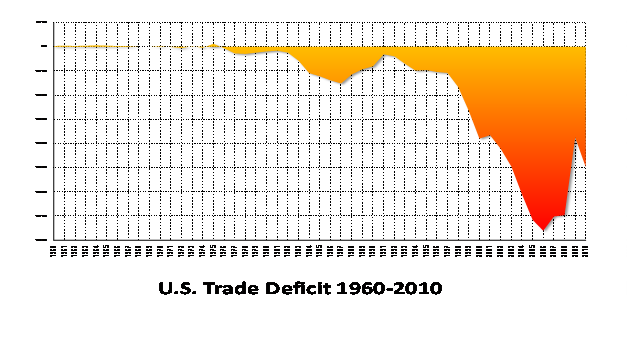
The trade deficit grew from a low of $91 million in 1969 to a peak of $698.3 billion in 2008, dropping down to$379 billion in 2009 due to the worldwide recession before climbing back up to $559.8 billion in 2011. Final figures for 2012 are not available yet, but the trade deficit through the first 11 months of 2012 is running at an annual rate of $546.6 billion.

Our trade deficit with China grew from only $6 million in 1985 to a high of $295.4 billion in 2011, after it had dropped down to $226.8 billion in 2009 during the recession. China’s portion of America’s trade deficit has nearly tripled ? from 22 percent in 2000 to 60 percent in 2009 and 52.7 percent in 2011. In the 11 years since China joined the WTO, the U.S. trade deficit with China has grown by 330 percent.

The national debt has grown from $5.6 trillion in 2000 to $16.4 trillion on January 12th. As of July 2012, $5.3 trillion or approximately 48% of the debt held by the public was owned by foreign investors, the largest of which were China and Japan at just over $1.1 trillion each.

“The estimated population of the United States is 314,243,893 so each citizen’s share of this debt is $52,304.77. The National Debt has continued to increase an average of $3.84 billion per day since September 28, 2007!”

As you can see, the debt accelerated after the economic collapse in the fall of 2008 and has continued to accelerate since because of the recession, automatic increases in unemployment benefits, food stamps, and social security payments for early retirement, as well as stimulus spending. The all-time record of increasing the debt by $1.1 trillion was set by President Bush in 100 days between July 30 and Nov 9, 2008 to avert the economic collapse of major banks and Wall Street companies. “Recessions cut tax revenues—in this case, dramatically, which accounts for nearly half of the deficit.”

According to Tom Donohue, head of the U.S. Chamber of Commerce, the nation’s largest business lobbying group, “The single biggest threat to our economic future … is our exploding national debt, driven by runaway deficit spending, changing demographics and unsustainable entitlements,” he said in his annual “State of American Business” address.

The reason why our massive trade deficit and escalating national debt are interrelated is that they share a common factor:  the American manufacturing industry and the jobs it generates or the jobs it has lost.

According to the Information Technology and Innovation Foundation report, the U. S lost 5.7 million manufacturing jobs in the decade of 2000 to 2010, more than the total number of manufacturing jobs than the rate of loss in the Great Depression (33.1 % vs. 30.9%). Manufacturing jobs now only make up 9% of the American workforce, down from about 14% in 2000. Two million manufacturing jobs were lost in the Great Recession, adding to the 3.7 million we had already lost. Less than 10% have returned since the end of the recession. The report concludes:

  • A large share of manufacturing jobs was lost in the last decade because the United States lost its competitive edge for manufacturing. It was due to a failure of U.S. policy, not superior productivity.
  • The loss was cataclysmic and unprecedented, and it continues to severely impact the overall U.S. economy.
  • Regaining U.S. manufacturing competitiveness to the point where America has balanced its trade in manufacturing products is critical to restoring U.S. economic vibrancy.
  • Regaining manufacturing competitiveness will create millions of higher-than-average-wage manufacturing jobs, as well as an even greater number of jobs from the multiplier effect on other sectors of the economy.
  • The United States can restore manufacturing competitiveness and balance manufacturing goods trade within less than a decade if it adopts the right set of policies in what can be termed the “four T’s” (tax, trade, talent, and technology).

The Economic Policy Institute briefing paper, “The China Toll,” written by Robert Scott focuses on the effects of our trade deficit with China. He wrote, “Growing U.S. trade deficit with China cost more than 2.7 million jobs between 2001 and 2011, with job losses in every state.”

“Between 2001 and 2011, the trade deficit with China eliminated or displaced more than 2.7 million U.S. jobs, over 2.1 million of which (76.9 percent) were in manufacturing. These lost manufacturing jobs account for more than half of all U.S. manufacturing jobs lost or displaced between 2001 and 2011.”

The growing trade deficit with China has been a prime contributor to the crisis in U.S. manufacturing employment. When you take into account the multiplier effect of manufacturing jobs creating three to four other jobs, the U. S. has lost six to eight million jobs as a result of the trade deficit with China alone. The Department of Commerce estimates that each $1 billion in trade deficit translates to about 13,000 lost jobs, so the $559.8 billion in the total trade deficit for 2011 represents a loss of 7,277,400 jobs. This explains why we have had a virtually jobless recovery since the end of the recession and why the unemployment rate has stayed high for so long.

The average manufacturing job nationwide pays about $40,000 per year ($20/hour). According to the 2012 federal tax table, a person making that amount of money would pay about $4,000 to $5,000 per year in taxes, depending on whether they are single or have one dependent. Without doing the complicated math to calculate the number of lost manufacturing jobs each year times the taxes those workers would have paid, you can see that the result could be trillions of dollars in lost tax revenue since the year 2000.

Adding this lost tax revenue to the cost of an unemployed worker in the form of unemployment benefits (about $15,000 year for a $40,000/year job) and possibly food stamps, you can understand the major cause of why our national debt has escalated so dramatically in the last ten years. We could raise income taxes to the highest rates of European countries such as Sweden (75%) and still not be able to pay down our national debt. The solution is not raising taxes, it is creating more tax payers, especially those employed in the higher paying jobs of the manufacturing industry. Our trade policies that result in such huge trade deficits and loss of manufacturing jobs have transformed taxpayers into tax consumers.

Because of our trade deficit with China and our national debt, we are essentially writing two checks to China every month:  one to pay for the cost of the imports we buy and the other to pay for the cost of borrowing money from China to pay for the cost of running our government.  By maintaining this trade deficit, we are sending our tax revenue to China; then, we borrow a portion of it back to pay our expenses. This is unsustainable!

We are at a cross roads in our country. We must change our tax, trade, and regulatory policies to rebuild our manufacturing industry to increase the number of taxpayers if we ever want to pay down our national debt, reduce our unemployment rates, and avoid economic collapse.


Indiana Manufacturers Have Weathered the Storm of the Great Recession

December 18th, 2012

According to results of the 2012 Indiana Manufacturing Survey: “Halftime” for Indiana Manufacturing, Indiana manufacturers have weathered the storm of the Great Recession and are well positioned to compete in the future., The report, commissioned by Katz, Sapper & Miller certified public accounting firm, was conducted by Scott A. Brown, Partner, Katz, Sapper & Miller, LLP in conjunction with Mark Frohlich, associate professor of operations management and Steven Jones, associate professor of finance  on the faculty of the Kelley School of Business Indianapolis, Indiana University.

This report has tracked Indiana manufacturing for six years, from the end of the economic boom through the Great Recession to the present. The authors “view the past year as a ‘halftime’ break for Indiana manufacturing after what proved to be an incredibly difficult first half.”

The vast majority of companies surveyed (82%) responded at the company level, while 10% are individual plants and 7% are divisions of larger organizations. Privately owned companies represent 87% of respondents and the other 13% are publicly traded companies. The average number of employees is 306, and the largest organization has 8,000 employees.

About 40% of companies rely on job shop-type production, and 41% use batch manufacturing. Very few companies operate assembly lines (8%) or continuous flow processes (11%), both of which are capital intensive and used to produce relatively standardized, high-volume items.

The three largest industry groups represented are industrial equipment (19%), automotive (19%), and aerospace and defense (10%). Another 18% of respondents are almost evenly distributed between high-tech (5%), healthcare (6%), and furniture/home goods (7%).

In the past four years since the financial crisis of late 2008, “manufacturers have faced challenges ranging from credit crunches and supplier bankruptcies to slumping consumer demand, soaring energy costs, and relentless foreign competition.” The report chronicles that “in 2008-09, Indiana manufacturers were mainly focused on cost-cutting and economic survival. By 2010-11, targeted investments aimed at growth began to reappear on the agendas of many manufacturers.” Now, four years later, “a significant majority now report that their business is either ‘healthy’ or ‘stable,’ with tougher times behind them” and “investment for growth is a priority for many companies around the state,” while “almost three out of every four manufacturers surveyed are investing for growth.”

“From a financial perspective, I think it small- to medium-sized manufacturers have made it through the Great Recession, and they’re starting to recover,” said Jones. “That is revealed in the survey responses indicating there’s less concern about working capital management and renewed focus on investment strategy, rather than cost cutting.”

“One in 10 companies surveyed plan to open new manufacturing facilities in Indiana over the next two years, and 44 percent rate their financial performance as “healthy,” a significant increase from last year’s response of 30 percent.”

The survey did find that net profit margins increased more for firms that introduced new products sometime in the two years prior. In the 2012 survey findings, the companies introducing new products increased to 44% (up from 38% in 2011), and they saw a 24% improvement in net profit margin (down from 26% in 2011.

According to survey 2012 survey results, business strategies have changed from 2011. In 2011, “the two most important underlying dimensions were superior product design and fast and reliable delivery along with superior customer service.” In 2012, “superior quality and lower selling prices have emerged as the two most important underlying dimensions on which manufacturers are differentiating their businesses.”

The authors “research reveals three key ways strategies are shifting as we move beyond the Great Recession toward a new era that is likely to be even more competitive:”

  1. Keep focused on the customer – strategies increasingly feature superior quality and lower prices, along with superior product design and customer service.
  2. Don’t underestimate the importance of technology – leading-edge technologies are playing a critical role in advancing these companies in conjunction with process improvement programs such as Lean and Six Sigma, advanced automation, and smart manufacturing technologies.
  3. Collaboration remains critical – partnerships and collaboration with up- and downstream customers and suppliers in the supply chain

Frohlich and Jones recommend, “Indiana manufacturing companies stay focused on the customer, avoid underestimating the importance of technology and know that collaboration remains critical.”

“These results indicate a reason to be optimistic about the manufacturing sector and jobs investment in the State of Indiana,” said Jones.

A slightly higher percentage of companies are “on-shoring” (aka “reshoring”) manufacturing back into the United States. When asked if they expect to relocate or onshore any manufacturing back to the United States during 2012-13, or alternatively, do they plan on relocating, or offshoring, any production outside the United States during 2012-2013, 9% indicated they intend to onshore and 8% intend to offshore. The top four reasons why companies are “reshoring” were:  better control over production (60%), proximity to customers and main markets (50%), closer to key suppliers (40%), and reduce total “landed” costs; i.e., customs/duties, transportation, warehousing, etch (40%). The main reasons for offshoring manufacturing out of the United States are:  lower offshore labor costs and proximity to customers in new markets.

“What now are recognized as systematic errors in offshoring over the past 10-15 years were a lot of mistakes based on myopic financial decision making,” said Jones. “Firms made offshoring decisions assuming exchange rates wouldn’t change, which is wholly unrealistic in currency markets. Many made these financial decisions using only the data in front of them. Additionally, the real cost of labor has gone up in China. All of this represents what, in retrospect, may be an excessive amount of offshoring in the previous decade.”

The survey revealed that the main reasons for Indiana’s competitive edge include:

  • Better access to new technologies
  • Better control over production
  • Locations closer to customers, markets and suppliers
  • Great accounting and auditing oversight

The report states, “The major remaining concern for the state is having a trained workforce that is qualified to pursue advanced manufacturing strategies.”

“These results clearly indicate a growing concern about access to an adequately trained Hoosier workforce, more so than in past years,” the report reads. “Consistent with the previous results indicating growing concerns about worker training, only 30 percent of respondents view Indiana’s workforce as a competitive advantage for the state.”

The authors conclude that “While Indiana’s manufacturers still face strong global competition, their practices and products are beginning to permeate all elements of operations; opening up new markets and sources of demand; driving innovation; and even changing industry cost structures.”

This report shows where Indiana’s manufacturers are right now, but the question is what to do next? The report indicatesa strong sense among Indiana’s manufacturers that execution is now the challenge to bringing about the new era of manufacturing. Confidence among business leaders about their progress toward this new era is strong, and their companies are taking concrete steps towards improving manufacturing…While today’s business environment provides a multitude of new challenges to manage, it also offers significant opportunities for those who can master its dynamics.”

The survey found that a new manufacturing era is on the horizon, and “there is widespread agreement about what the next era of manufacturing will look like. It is one where manufacturing is not only a separate strategic initiative, but also something fully integrated into the strategy and operations of a company. For example, manufacturers will need to develop a broader sense of what value creation means to customers as a whole.”

The underlying tone in this year’s report is that “the next five years could well determine not only the fate of some firms, but also, in significant ways, the success of Indiana and that of our country in the global economy for years to come…Manufacturing can and should continue to thrive if the right policies and strategies are pursued. Real and fundamental changes are continuing to take place across manufacturing in all kinds of capabilities.”

The authors conclude that “the message is clear: Indiana (and American) manufacturing has survived a tough first half. Now it must move forward to remain competitive in the future.”

This report is another example of how American manufacturers can survive and even grow and prosper in the face of global competition. The companies doing the best have implemented many of the recommendations contained in the chapter ? “What can manufacturers do to save themselves? ? in my book, Can American Manufacturing be Saved? Why we should and how we can. Innovative new products, fast, reliable delivery, superior customer service in conjunction with applying the principles and tools of Lean and Six Sigma are a few of the suggestions from this chapter. I encourage everyone to read the new 2012 edition of my book to find out what you can do as a manufacturer to grow and succeed, what national policies need to be changed and implemented to foster success of this critical sector of our economy, and what you can do as an individual to save American manufacturing.


Chinese Innovation Mercantilism is Hurting American Manufacturers

December 11th, 2012

On Wednesday, December 5, 2012, Robert D. Atkinson, President of the Information Technology and Innovation Foundation (ITIF), testified before the House Science Committee Subcommittee on Investigations and Oversight in a hearing on “The Impact of International Technology Transfer on American Research and Development.” His testimony was based on his book, Innovation Economics: The Race for Global Advantage (Yale University Press, 2012) and the ITIF report, “Enough is Enough:  Confronting Chinese Innovation Mercantilism,” released February 2012.

Atkinson began his testimony by stating, “A nation’s investments in research and development (R&D) are vital to its ability to develop the next-generation technologies, products, and services that keep a country and its firms competitive in global markets. Until recently, corporate R&D was generally not very mobile, certainly not in comparison to manufacturing. But in a “flat world” companies can increasingly locate R&D activities anywhere skilled researchers are located…. the United States has seen its relative competitive advantage in R&D and advanced technology industries decline. While the United States still leads the world in aggregate R&D dollars invested, on a per-capita basis it is falling behind.”

He testified that the “decline in America’s innovative edge is due to a number of factors, not the least of which are failures of federal policy, such as an unwillingness to make permanent and expand the R&D tax credit, limitations on high-skill immigration, and stagnant federal funding for R&D. But the decline is also related to unfair practices by other nations that collectively ITIF has termed as ‘innovation mercantilism.’”

The ITIF report cited above states that these policies “include currency manipulation, relatively high tariffs (three times higher than U.S. tariffs), and tax incentives for exports.” In addition, “some policies help Chinese firms while discriminating against foreign establishments in China. These policies include “discriminatory government procurement; controls on foreign purchases designed to force technology transfer to China; land grants and rent subsidies to Chinese-owned firms; preferential loans from banks; tax incentives for Chinese-owned firms; cash subsidies; benefits to state-owned enterprises; generous export financing; government-sanctioned monopolies; a weak and discriminatory patent system; joint-venture requirements; forced technology transfer; intellectual property theft; cyber-espionage to steal intellectual property (IP); domestic technology standards; direct discrimination against foreign firms; limits on imports and sales by foreign firms; onerous regulatory certification requirements; and limiting exports of critical materials in order to deny foreign firms key inputs.”

The report explains that “in the last decade China has accumulated $3.2 trillion worth of foreign exchange reserves and now enjoys the world’s largest current account balance. In 2011, it ran a $276.5 billion trade surplus with the United States. This ‘accomplishment’ stems largely from the fact that China is practicing economic mercantilism on an unprecedented scale. China seeks not merely competitive advantage, but absolute advantage. In other words, China’s strategy is to win in virtually all industries, especially advanced technology products and services… China’s policies represent a departure from traditional competition and international trade norms. Autarky [a policy of national self-sufficiency], not trade, defines China’s goal. As such China’s economic strategy consists of two main objectives: 1) develop and support all industries that can expand exports, especially higher value-added ones, and reduce imports; 2) and do this in a way that ensures that Chinese-owned firms win.”

The report states that “because China is so large and because its distortive mercantilist policies are so extensive, these policies have done significant damage to the United States and other economies…The theft of intellectual property and forced technology transfer reduce revenues going to innovators, making it more difficult for them to reinvest in R&D. The manipulation of standards and other import restrictions balkanizes global markets, keeping them smaller than they otherwise would be, thereby raising global production costs…if Chinese policies continue to be based on absolute advantage and mercantilism…the results will be more of the same: the loss of U.S. industrial and high-tech output, and the jobs and GDP growth that go with it.”

Chinese mercantilist policies are unprecedented in their scope and size. Atkinson testified, “A principal arrow in China’s innovation mercantilist quiver is to force requirements on foreign companies with respect to intellectual property, technology transfer, or domestic sourcing of production as a condition of market access. While China’s accession agreement to the WTO contains rules forbidding it from tying foreign direct investment to requirements to transfer technology to the country, the rules are largely ignored.”

He added, “Rather than doing the hard work to build its domestic technology industries, or better yet focus on raising productivity in low-producing Chinese industries, China decided it would be much easier and faster simply to take the technology from foreign companies… China’s government unabashedly forces multinational companies in technology-based industries—including IT, air transportation, power generation, high-speed rail, agricultural sciences, and electric automobiles—to share their technologies with Chinese state-owned or influenced enterprises as a condition of operating in the country.”

The ITIF report explains that in 2006, “China made the strategic decision to shift to a “China Inc.” development model focused on helping Chinese firms, often at the expense of foreign firms. Chinese leaders decided that attracting commodity-based production facilities from multinational corporations (MNCs) was no longer the goal…The path to prosperity and autonomy was now to be ‘indigenous innovation’…”

The document “advocating this shift was ‘The Guidelines for the Implementation of the National Medium- and Long-term Program for Science and Technology Development (2006-2020)’…to ‘create an environment for encouraging innovation independently, promote enterprises to become the main body of making technological innovation and strive to build an innovative-type country.’”

Some 402 technologies, from intelligent automobiles to integrated circuits to high performance computers were included so that China could seek the capability to master virtually all advanced technologies, with the focus on Chinese firms gaining those capabilities through indigenous innovation.

However, China is not alone in trying to force the transfer of technology and R&D from foreign multinationals ? Indonesia, Malaysia, India, Portugal, and Venezuela have the same goal.

Why do so many nations engine in innovation mercantilism? Atkinson testified that there are two principle reasons. “First, these nations have embraced a particular and fundamentally limited model of economic growth that holds that the best way to grow an economy is through exports and shifting production to higher-value (e.g., innovation-based) production. Moreover, they don’t want to wait the 20 to 50 years it will take to naturally move up the value chain through actions like improving education, research capabilities, and infrastructure, as nations like the United States did. They want to get there now and the only way to do this is to short-circuit the process through innovation mercantilism. This explains much of China’s economic policies. The Chinese know that to achieve the level of technological sophistication and innovation that America enjoys will take them at least half a century if they rely on only their own internal actions. So they are intent on stealing and pressuring as much of American (and other advanced nations’) technology as they can to their own companies. If you can’t build it, steal it, is their modus operendi.”

Atkinson added that the second reason why these nations do this is because they don’t believe in the rule of law and the principles of free trade like Western nations and much of Europe do. These nations also “work on the ‘guilt’ of Western, developed nations. The narrative goes like this: the West has used its imperialist powers to gain its wealth, including at the expense of poor, developing nations and now it wants to “pull the ladder” up after it. This means turning a blind eye to intellectual property and giving our technology, including pharmaceutical drugs, to nations almost for free. After all, we are rich and they are poor because we are rich.”

The reality is that forced technology transfer is enabling China and other nations to gain global market share. It is doing “considerable harm to U.S. technology companies and to the U.S. economy, if for no other reason than reducing their profits and ability to reinvest in the next wave of innovation.”

Atkinson posed the question, “So what should the U.S. government do? He responded that “this is a difficult question because if there were easy solutions, they would have been done by now.” He recommended the following actions:

  • Try to do more through conventional trade dispute channels and expand funding for the U.S. Trade Representative’s Office (USTR) so it can do more.
  • Ensure that future bilateral trade and investment treaties (BIT) contain strong and enforceable provisions against forced technology and R&D transfer.
  • Congress should make it clear that it will not judge any administration by whether a BIT with China is concluded, but rather by if the United States made a strong effort to conclude a treaty that provided full protection against mercantilist practices like forced transfer of R&D.
  • Congress should pass legislation that allows firms to ask the Department of Justice for an exemption to coordinate actions regarding technology transfer and investment to other nations.
  • Congress should exclude mercantilists from the Generalized System of Preferences (GSP).

Finally, he recommended that the United States actively explore alternatives to the WTO and  pursue a two-pronged trade strategy, continuing as best it can to improve conventional trade organizations like the WTO, but also creating alternative “play-by-the-rules” clubs of like-minded countries.

He concluded his testimony stating, “Pressured or mandatory technology transfer by other nations has, is, and will continue to negatively impact American R&D and innovation capabilities. It’s time for the federal government to step up its actions to fight this corrosive mercantilist practice.”

Curbing Chinese mercantilism must become a key priority of our trade policy if we want to address this serious threat to American manufacturers and the U. S. economy.


How Some Manufacturers are Successful in Competing Globally

December 4th, 2012

While attending the FABTECH Expo in Las Vegas last month, I interviewed several companies that all or the majority of their manufacturing in the U. S. to find out what they are doing to successfully compete in the global marketplace.

The first company was Laserstar Technologies, located Riverside, RI, and I interviewed Peter Tkocz, Regional Sales Mgr., southwestern States. Laserstar makes laser welding and marking equipment using the “free-moving” concept they development, enabling users to eliminate costly fixturing devices, benefit from pin-point accuracy, increase the range of assembly and repair applications and minimize the potential hazards of heat damage. Peter told me that the company is 55 years old and started making jewelry. When jewelry making went overseas in the 1990s, he said that the company had to reinvent itself and get into new markets to survive. They set a goal to enhance the quality, performance, and innovation of their products, programs and services on a continuing basis and became a “lean” manufacturing company.

Since, then, they have developed a diverse customer base of six major markets:

  • Medical – cardiac pacemakers, defibrillators, guide wires, catheters, hearing aids, orthodontic appliances, prosthetics and surgical tools
  • Dental – crowns and bridges, partial and implant fabrication and repair.
  • Electronics – a wide variety of different materials, component parts or final assemblies
  • Aerospace
  • Micro technology – wide range complex applications for laser welding and marking
  • Tool and die repair – ideal for modifications and repairs on molds, tools and dies as the process is quick, precise and will not damage surrounding surfaces.
  • Jewelry – a fast fix to repair jewelry and eyeglasses, and their new Fiber star machine can weld down to 12 microns, which is critical for high-end gem stones

LaserStar’s Research & Development laboratory is focused on inventing new technologies that change markets and create business opportunities, utilizing input from customers. Laserstar sells through learning centers vs. distributors, and the three learning centers at their headquarters in Rhode Island, California, and Florida. Their laser education courses provide a solid foundation of fundamental laser welding and laser marking skill sets to immediately gain a revenue impact for the new or existing iWeld, LaserStar or FiberStar laser welding or laser engraving system.

I next interviewed Dan Moiré, Sr. V. P. Sales of TRYSTAR, located in Faribault, Minnesota. TRYSTAR is a leading domestic manufacturer and international distributor of portable and permanent power solutions, industrial cables and power accessories. The company began operations as Bridgewater Tech, an industrial cable wholesaler founded in 1991. It wasn’t long before they realized there was room for innovation and improvement in the safety and performance of the products they were selling. As a result, they began manufacturing their own welding and grounding cables under the TRYSTAR brand in 1993.

As the superiority of TRYSTAR cables became evident throughout the industry, they expanded operations to offer customers greater versatility and reliability in the field, and as the brand became well known, the company transitioned from Bridgewater Tech to TRYSTAR.

Dan Said that today, TRYSTAR offers a wide range of capabilities specifically designed with the end-user in mind. They provide efficient, customized solutions, made with only the highest quality raw materials, manufactured on site, and serviced by their own professionals. Their factory is as vertically integrated as possible, and they provide customers with a full range of professionally packaged industrial products and services. They even extrude their own cable and do sheet metal fabrication and welding in-house.

TRYSTAR was the first to…

  • introduce sequential foot-marking to the welding cable industry, reducing the chance of waste
  • introduce custom-printed, colored cable, reducing the chance of theft on the job site
  • market a color-coded, insulated inner safety liner, designed to alert the cable’s user to any damage or wear and minimize problems in the field
  • produce a true Arctic weather cable that remains flexible to -57°C
  • introduce an improved clear-sheathed grounding cable that is flexible from -40°C to +105°C, allowing for safer grounding of high power lines during outages
  • introduce environmentally responsible, recyclable packaging for cable products
  • provide direct-to-market, completely assembled cable products, with unique and specific job identifiers, delivered directly to the job site

Kevin Duhamel, Product Sales Mgr at Gorbel was my next interview. Gorbel has over 30 years experience providing overhead handling solutions to customers in a wide range of industries. They have a comprehensive line of Crane Technology products, including work station bridge cranes, patented track cranes, I-beam jib cranes, gantries, and work station jib cranes. They also have an exciting line of Ergonomic Lifting products, featuring our G-Force® Intelligent Lifting Device, our Easy Arm® Intelligent Lifting Arm, and our G-Jib®. Their newest line, Tether Track Fall Arrest Safety Systems, provides a turnkey fall protection solution that exceeds OSHA safety standards. –

They have been in business since 1977 and are the largest U. S. manufacturer of lifting devices and cranes. Kevin said that their G-Force unit can lift up to 1320 lbs with higher speed and precision than chain hoists. They have two manufacturing plants in the U. S. – Fishers, NY and Pell City, AL – and sell to Europe, Canada, Mexico, and South America from their U. S. plant. They have a plant in Tianjin, China to market to customers such as John Deere and Caterpillar that have plants in China. About 90% of their business comes from North America and Mexico. They are very vertically integrated and qualified to have their product stickers say “Made in USA.”

I met and spoke to several of the top executives at TigerStop, located in Vancouver, WA, including president and founder Spencer Dick. Spencer founded TigerStop in 1994 and focuses on developing new product lines and enhancing their current products to simplify production processes for their customers.

TigerStop® LLC, is the global leader in stop/gauge and pusher systems that includes precision measuring systems, saws, and material handling equipment. National Sales Mgr., Erland Russell, told me that their products can easily integrate with most machinery used in the woodworking, metal, fenestration and plastics industries. He said that one of their models can measure and precisely saw material up to 20 ft. in length. TigerStop maintains an aggressive research and development program with over 100 patents awarded or pending.

TigerStop’s manufacturing is very vertically integrated in their Vancouver plant, but they also have an additional manufacturing and distribution facility in Wierden, Netherlands. The TigerStop distribution network spans six continents and their products are supported in five languages. TigerStop provides world-class customer support through experienced service technicians, on-going dealer training, and online technical resources.

Next, I interviewed Mike Albrecht, National Sales Mgr., at the Scotchman Industries booth. Scotchman Industries, Inc. is a leading manufacturer of metal fabrication equipment, accessories, and custom tools, such as ironworkers, cold saws, band saws, tube and pipe notchers, and measuring systems for nearly half a century.

Art Kroetch founded Scotchman Industries in the early 1960s to make and sell farm-related products, such as pickup stock racks, corral panels, gates and chutes. In 1966, Scotchman Industries purchased the patent for a hydraulic ironworker, the first machine of its kind in the world, and began manufacturing ironworkers. This machine, using hydraulic pressure, created up to a 35-ton force that could punch, bend and shear metal.

In 1978, Scotchman Industries purchased Excel Manufacturing Ltd. of Winnipeg, Manitoba, Canada, and was able to provide a line of ironworkers that ranged from 30-ton to 90-ton capacities for the world market. Today, Scotchman Industries, Inc. has a complete line of thirteen different ironworkers, ranging in capacities from 45 to 150 tons, with component tool design, and a fully integrated European style; both are available in either single or dual operator models. Scotchman has successfully acquired and maintained a large portion of the ironworker market.

Scotchman Industries is proud to be an American manufacturer who has always been export-minded. The company was given the President’s “E” Certificate for Exports in 1981 by the Secretary of Commerce, for excellence in its increased exporting of products. Today Scotchman Industries continues to export their products to many countries around the world.

Scotchman is located in Philip, SD; Mike said that all of their products are manufactured in the USA. They have donated equipment to the Workshops for Warriors located here in San Diego, CA.

Finally, I interviewed Heather Gaynor, Marketing Communications Mgr., at Swagelok, located in Solon, OH. Swagelok is a privately-held company that manufactures designs, manufactures, and delivers an expanding range of the highest quality fluid system products and solutions, such as tube fittings, valves, regulators, hoses and other products that are vital to fluid system solutions in industries such as power generation, oil and gas production, chemical processing, biopharmaceutical, research, semi-conductor manufacturing and more. They manufacture everything in the U. S. and are very vertically integrated.

Swagelok products and services are delivered locally through a network of more than 200 authorized sales and service centers that support customers in 57 countries on six continents.

While the products and services of the companies I interviewed are quite different, there are common threads:

  • All of the products are sold to other businesses (referred to as B-B) instead of to consumers.
  • The products fill specific needs and requirements of other manufacturers.
  • All of the companies manufacture their products in America.
  • The companies export their products to other companies

In addition, three of the six companies are privately held so that that management isn’t under the pressure to maximize quarterly profits and can focus on long-term company goals.

What this shows is that American manufacturers with unique products that satisfy customers’ needs can compete successfully in business-to-business global markets where the predatory mercantilist countries of China, Korea and India haven’t targeted to take over the market and destroy their American competition. If American manufacturers truly had a level playing field provided by “smart” trade agreements instead of the current lopsided, dumb agreements we have in place now, they would be able to compete successfully in the global marketplace. It is time to address the predatory mercantilist practices of these countries. Designating China as a currency manipulator would be a good start!


New Products and Education Highlighted at Las Vegas FABTECH Expo

November 27th, 2012

The annual FABTECH expo was held November 12-14 at the Las Vegas convention center. It is the largest metal forming, fabricating, welding and finishing event in North America and only comes to the west once every three to four years. The other rotating locations are Chicago, IL and Atlanta, GA.

FABTECH is co-sponsored by five industry-leading associations: the American Welding Society (AWS), the Fabricators & Manufacturers Association, International (FMA), the Society of Manufacturing Engineers (SME), the Precision Metalforming Association (PMA), and the Chemical Coaters Association International (CCAI).

The first day’s attendance was a record high of over 15,000, and show organizers reported that 25,903 attendees walked the more than 450,000 net square feet of floor space during the three-day show to see live equipment demonstrations, compare products side-by-side and find cost-saving solutions. Because of the Las Vegas location, many attendees probably came to have fun over the weekend and attended the show the first day. I visited the show on the second and third day so I missed the huge crowd of the first day. It was my first FABTECH show, and it was overwhelming in size and scope. I haven’t seen exhibitor displays as large since the heyday of the Los Angeles WESTEC show in the early 1990s.

I was curious to see if attendees were going to the show to browse or actually place orders. Judging by the number of “sold” signs on equipment and my interviews with exhibitors, attendees were placing orders and not just browsing. Exhibitors speculated that many were buying to take advantage of the “accelerated depreciation for the purchase of capital equipment” that will expire on December 31st, unless Congress extends the current tax rates (referred to as the Bush tax cuts).

The October issue of West Manufacturing News reported, “FABTECH’s annual expo comes as manufacturing continues to lead the American economy out of the recession…Offshored work is returning home and profits at manufacturing companies increased 25% in 2011.”

Out of the more than 1,100 manufacturers participating in the expo, 274 companies were displaying new products. There were 113 new products in the welding section alone, and the rest were displayed in the forming and fabricating, finishing, metal forming, and tube bending, pipe and wire forming sections.

I met the COO of Lincoln Electric, Christopher Mapes, while standing in line at Starbucks, and he arranged for me to have a demonstration of their new VRTEX® virtual reality arc welding training simulator. These computer based training systems are educational tools designed to supplement and enhance traditional welding training. They allow students to practice their welding technique in a simulated and immersive environment. The VRTEX® systems promote the efficient transfer of quality welding skills and body positioning to the welding booth while reducing material waste associated with traditional welding training. I actually got to put on the helmet and perform a virtual weld. I have watched welding in the shops I have represented over the years, but it was my first time to actually perform a virtual weld. I immediately saw how great the training system would be for training the next generation of workers in programs such as the Workshops for Warriors I wrote about in October.

The FABTECH educational conference held simultaneously with the three-day expo included an unprecedented number of sessions on such manufacturing topics as laser and water jet cutting, product finishing and coatings, forming and fabrication, lean, online and social marketing, metal stamping, tube and pipe ending, and welding. The educational sessions were available for half-day, all-day and a three-day program. The education programs and special events were packed with attendees.

There was at least one special event each day:  On day one, there was a workshop on “Lean Manufacturing for Managers” and a “State of the Industry:  Manufacturers’ Executive Outlook.” On day two, there were three special events:  “Post-Election Analysis:  How the Results Impact U. S. Manufacturing; the “American Jobs for American Heroes,” in which Steve Nowlan, President, Center for America (CFA), briefed attendees on the opportunity for manufacturers to hire military veterans for skilled manufacturing jobs. The American Jobs for America’s Heroes is an alliance of the National Guard, CFA, Corporate America Supports You (CASY) and the Military Spouse Corporate Career Network (MSCCN) to help 60,000 unemployed National Guard members, veterans and spouses find skilled jobs in the private sector. The final event was a presentation by Harry Moser, President of the Reshoring Initiative on “To Offshore or Reshore? How to Objectively Decide!” I attended the “Post Election Analysis” and “To Offshore or Reshore? special events.

According to the after-show press release, at the State of the Industry roundtable with manufacturing CEOs, the CEOs concurred that growth in manufacturing should continue for the next year; however, all said a stumbling block to growth is the lack of skilled workers in manufacturing. The CEOs emphasized that manufacturers need to be more aggressive in influencing parents of students, having students influence each other and have school be a more active voice in recruiting potential workers.

The Post-Election Analysis panel featured Washington insiders Paul Nathanson, Founding Partner, Policy Resolution Group, Omar Nashashibi, The Franklin Partnership LLP, and David Goch, Webster, Chamberlain & Bean, all of whom have long track records in representing manufacturing interests.

They discussed the so-called looming fiscal cliff, tax reform, and other issues that will impact manufacturers. Paul Nathanson said, “Manufacturers need certainty to plan and there are major challenges ahead because of tax increases with the expiration of current tax rates and new taxes under Obamacare.” He feels something will get done before end of year and doesn’t think that sequestration will go in effect.

Omar Nashashibi said, “The new Congress will look at tax reform. The expiration of current taxes and Obamacare taxes represents $5.4 trillion of tax increases. The President proposed 28% taxes for corporations, but that doesn’t affect 70% of businesses that are LLCs, LLPs, partnerships, or sole proprietorships.

David Goch said, “Congress will do what they have done in the past – a 6-9 month ‘punt.’ The continuing resolution for funding ends March 31st if the debt limit isn’t reached sooner.” He warned the audience not to be surprised if the “carbon tax” reappears. “A recent Brookings Institute report proposed a “carbon tax” that would result in $1.2 trillion revenue over 10 years. It would make economists happy as it encourages investment vs. consumption. It would make Republicans happy because there would be no new taxes, and it would make environmentalists happy.”

They all believe that Congress will reach a deal to at least move the deadline for a debt deal before the end of the year. All agreed that the manufacturing sector has gained influence in Washington over the past two years and encouraged manufacturers to get involved in advocacy efforts for the industry via their trade associations.

While I am an authorized speaker for the Reshoring Initiative, I attended Harry Moser’s presentation on Tuesday afternoon to see if he had any new data that I could add to my own presentation. I appreciated being reminded that W. Edwards Deming’s “4th Key Principle for Management,” in Out of the Crisis, was:  “End the practice of awarding business on the basis of price tag. Instead, minimize total cost.” If companies had been practicing this principle for the past 20 years, we would have had far less manufacturing sourced offshore.

Moser’s Total Cost of Ownership (TCO) calculator enables companies to calculate the cost of all of the variables, including the hidden costs and risk factors, of doing business offshore.  Moser stated, “Manufacturers have to look at the total costs of offshoring to reliance that the savings gained might not e as significant as they think…Once you factor in tariffs, shipping costs, increase inventor because of delivery delays, quality control and communication issues, it’s a financial win to bring certain types of manufacturing back to North America.”

Some of the new data included in his presentation was:

  • 61% of larger companies surveyed “are considering bringing manufacturing back to the U.S.” (MIT forum for Supply Chain Innovation 1st Qtr. 2012)
  • 40% of contract manufacturers have done reshoring work  this year (MFG.com 4/12)
  • Percentage of U.S. consumers who view products Made in America very favorably: 78%  (2012) up from 58% (2010) (AAM June 28-July 2, 2012)
  • 76% are more likely to buy U.S. product
  • 57%  are less likely to buy Chinese product  (Perception Research Services Intl. survey 7/12, 1400 consumers)

According to the Reshoring library of case studies, the top four industries that have reshored are:

  • Electronic equipment, appliances & components
  • Transportation equipment
  • Machinery
  • Furniture

The main reasons why companies are reshoring are:

  • Wage and currency change
  • Quality, Warranty, Rework
  • Delivery
  • Travel Cost/Time
  • Inventory

Moser believes that just by using the TCO calculator, 25% of manufacturing offshored could return to America, representing about 300,000 jobs. In conclusion, Moser recommends:

  1. Keep existing domestic sources
  2. Shift outsourcing back to U. S.
  3. Repurpose own offshore to serve the offshore market and incrementally invest domestically to serve domestic market.
  4. Shut own offshore facility and build new domestic facility.

In the after show press release, John Catalano, FABTECH show co-manager, said, “We’ve received great feedback from attendees and exhibitors. Attendees were impressed with the size and scope of the show and the vast array of new products and technologies on display. Exhibitors were enthusiastic and report that sales activity was brisk and leads were plentiful.”

Mark Hoper, FABTECH show co-manager, said, “If you can take the pulse of the economy by what’s happening in manufacturing, then you have to be optimistic that we are headed for economic growth, said. A constant theme I heard both on the show floor and at the seminars was that, while challenges and uncertainties remain, most manufacturers believe that their businesses are headed for continued growth in 2013.”

Mark your calendar to attend FABTECH 2013, which will be held on November 18-21 at McCormick Place in Chicago, IL.


“Lame Duck” Congress Should Pass These Two Important Bills

November 12th, 2012

While the focus of the “Lame Duck” Congress will be to keep us from falling off the cliff of financial ruin from reaching the debt ceiling and sequestration, there are two bills passed by one body of Congress but not the other that should be passed. Both of these bills would be beneficial to America’s manufacturing industry.

The first bill addresses a topic many Americans supported during the latter part of Governor Mitt Romney’s campaign for president ?  he “took a hard line in his campaign, promising to cite China for its currency peg on day one of his presidency. National polling makes clear that the American people overwhelmingly support such action on China’s brazen violations of world trade law, including its currency undervaluation.”

The Currency Exchange Rate Oversight Reform Act of 2011 (S. 1619) is an international trade bill that would establish US duties on imports from countries with undervalued currencies. The bill was approved by the Senate on October 11, 2011 by a vote of 63-35, but H.R.639, the Currency Reform for Fair Trade Act, has not been brought up for a vote yet in the House of Representatives even though it has strong bipartisan, majority support with 234 lawmakers, including 65 Republicans, as cosponsors. U.S. Rep. Sander Levin, D-MI and ranking member on Ways and Means, introduced the legislation. The bill remains in the Ways and Means Subcommittee on Trade.

Speaker of the House John Boehner (R-OH) has continued to block a vote on the bill despite overwhelming support. Speaker Boehner has said in statements that the United States should not dictate currency policy for another country and that he will oppose attempts to bring this bill to the floor for vote. It is clear that Speaker Boehner is single-handedly thwarting the majority will of both Congress and the American people. It is hard to understand why Boehner would stand in the way of such modest legislation to address China’s mercantilism.

On the Senate website, Sen. Sherrod Brown (D-OH) said, “China’s currency manipulation has already cost 3 million American jobs–2 million of which came from our manufacturing sector. The bill that passed [Oct. 11] could create 1.6 million American jobs.”

In 2010, the House passed a similar bill, H.R.2378, the Currency Reform for Fair Trade Act, by a strong, bipartisan vote of 348-79, including 99 Republicans, but the Senate failed to pass their version of the bill.

The problem of Chinese currency manipulation has actually gotten worse in the past year since the Senate bill passed. The New York Times’ Keith Bradsher “reports that Beijing has actually depreciated its currency more of late.  The Yuan fell nearly 1 percent against the dollar last month, and Bradsher says this is the “largest drop since Beijing officials unpegged the currency from the dollar in July 2005. The fact that Beijing can adjust its currency so precisely is proof yet again that it deliberately manipulates the Yuan to gain an export advantage.”

We cannot continue to run up a massive trade deficit with China. The U.S. trade deficit in goods and services increased from $500 billion in 2010 to $558 billion in 2011, an increase of $58 billion (11.6 percent). The massive sales of Chinese exports to the U.S. is fueled by China’s deliberately undervalued currency. By pegging its currency to the dollar at an artificially low rate, Beijing is making sure that its exports are exceedingly cheap in the U.S. Conversely, U.S. exports are more expensive due to this preferential currency rate.

How would this bill help? The bill calls for the Treasury Department to identify countries whose currencies are undervalued, and then instruct the Commerce Department to impose duties on imports from those aforementioned countries. Key points of the Currency Exchange Rate Oversight Reform Act of 2011 include:

* Improves the oversight of the currency exchange rate by the Treasury.

* Clarifies the countervailing duty law to address currency under-evaluation.

* States that Commerce may not refuse to investigate a subsidy allegation. This clarification is supported by the WTO’s Appellate Body and is a key element in the previous Brown-Snowe currency bill and in HR 2378, which passed in September 2010.

* Triggers a series of consequences, including:  Immediate: “consider designation of a country’s currency as a ‘priority’ currency when determining whether to grant the country ‘market economy’ status for purpose of U.S. antidumping law.”

After 90 days: “forbid federal procurement of goods and services from the designated country unless that country is a member of the WTO Government Procurement Agreement,” and “forbid Overseas Private Investment Corporation financing or insurance for projects in the designated country.”

After 360 days and failure to adopt appropriate policies: “The administration must require the U.S. Trade Representative to request dispute settlement consultations in the World Trade

Organization with the government responsible for the currency,” and “require the Department of Treasury to consult with the Federal Reserve Board and other central banks to consider remedial intervention in currency markets.”

The bill also stipulates that “countries that fail to fix their currencies would be subject to higher anti-dumping duties and other penalties, such as a procurement ban, not receiving financing from the Overseas Private Investment Corporation, and U.S. opposition to multilateral bank financing for the targeted countries.”

Passage of this bill would be an obvious step forward to provide a level playing field for America’s manufacturers and their workers.

The other important bill, “The American Manufacturing Competitiveness Act” (HR-5865), co-sponsored by Illinois Reps. Dan Lipinski (D) and Adam Kinzinger (R), passed the House on September 12, 2012 by a vote of 339-77.

“H.R. 5865 establishes the American Manufacturing Competitiveness Board within the Department of Commerce to advise the President on issues affecting manufacturing in the United States. The board would be required to perform a comprehensive analysis of the nation’s manufacturing sector and, using results from the analysis, develop a strategy to improve the competitiveness of domestic manufacturing efforts. Results from the analysis and strategy would be available to the President to comply with the bill’s requirement to publish a strategy in 2014 and again in 2018 to promote growth in the nation’s manufacturing sector.”

The board would consist of 15 members: five from the public sector appointed by the President, including two governors from different parties; and 10 people from the private sector appointed by the House and the Senate, with the Majority appointing three and the Minority appointing two from each chamber.

In preparing the analysis, the board would be required to study, among other things:

  • The current environment for manufacturing, including government policies—at the international, federal, state, tribal, and local levels—that affect the sector;
  • Forecasts, both short- and long-term, for domestic and international trends in manufacturing;
  • Actions by federal agencies that affect manufacturing; and
  • Factors that affect the growth and stability of the sector such as workforce skills;
  • Trade, energy, and monetary policies; research and development; and protections for intellectual property.

Using results from the analysis, the board would be required to develop a strategy to improve the competitiveness of the nation’s manufacturing sector. The bill would require the strategy to include recommendations to eliminate or consolidate government programs, improve interaction between the government and the manufacturing sector, and amend any regulations that put the industry at a competitive disadvantage in international markets.

The final report also would be required to include a plan to implement the strategy, including an estimate of the cost to implement it as well as recommendations for ways to cover those costs.

In April 2011, The Information Technology& Innovation Foundation (ITIF) released a report, “The Case for a National Manufacturing Strategy,” that made a strong case for such a strategy. Authors Stephen Ezell and Robert Atkinson present information on five key reasons why manufacturing is important to the U.S. economy:

1.      It will be extremely difficult for the United States to balance its trade account without a healthy manufacturing sector.

2.      Manufacturing is a key driver of overall job growth and an important source of middle-class jobs for individuals at many skill levels.

3.      Manufacturing is vital to U.S. national security.

4.      Manufacturing is the principal source of R&D and innovation activity.

5.      The manufacturing and services sectors are inseparable and complementary.

The authors also present three primary reasons on why the United States needs a manufacturing strategy:

1.      Other countries have strategies to support their manufacturers and by lacking similar strategies we are therefore forcing our manufacturers to compete at a disadvantage.

2.      Systemic market failures mean that absent manufacturing policies, U.S. manufacturing will underperform in terms of innovation, productivity, job growth, and trade performance.

3.      If a country loses complex, high-value-added manufacturing sectors, it is unlikely to get them back, even if the dollar were to decline dramatically.

While not perfect, this bill would be a good start in developing a national manufacturing strategy. Contact your senator or representative to urge them to vote on these bills.


“Lame Duck” Congress Must Act to Prevent Sequestration

November 6th, 2012

The clock is ticking ? only 55 more days until sequestration takes effect on January 2, 2013. For the uninformed, sequestration is the across the board 10 percent cut in discretionary spending in the budget, including the Department of Defense budget, that is mandated by the Budget Control Act of 2011. The mandatory entitlement spending of the federal budget, Social Security, Medicare, Medicaid, will continue to grow, along with the interest on the national debt.

If Congress is unable to reach a compromise on how to reduce our 16 trillion dollar national debt, over $500 billion dollars in cuts to the defense budget over the next decade would be mandated to start January 2nd, translating into a cut of about $55-60 billion for 2013.

Our government took drastic action to prevent the bankruptcy of General Motors, but the effect of sequestration would be like both General Motors and Ford going bankrupt. It would not only affect all of the major defense prime contractors, but would affect their subcontractors, and in turn, their vendors, all the way down to the bottom of the defense and military supply chain. The lower tiers of the supply chain are nearly all small businesses, many of them disadvantaged businesses in the minority, veteran, or women-owned categories.

After three and a half years of a weak recovery, the last thing we need is a drastic cut in defense and military spending. In many regions of the country, defense and military spending has been the major factor in helping a region to recover. My hometown of San Diego is one of these regions that would be impacted severely.

According to the San Diego Military Advisory Council (SDMAC) 2012 Economic Impact Study, “a total of $20.6 billion of direct spending related to defense was estimated to flow into San Diego County during fiscal year 2012,” and “the military sector is responsible for 311,000 of the region’s total jobs in 2012 after accounting for all of the ripple effects of defense spending. This represents one out of every four jobs in San Diego.”

“Defense?related activities and spending were predicted to generate $32 billion of gross regional product (GRP) for San Diego County in fiscal year 2012,” more than the total economic output estimated for Colorado Springs, Colorado, or El Paso, Texas.

The report states that “dollars linked to national security enter San Diego through three primary channels: wages and benefits for active duty and civilian workers; benefits for retirees and veterans; and direct spending on contracts, grants, and small purchases” by the military and other Department of Defense (DoD) agencies. San Diego will not be immune to planned cutbacks in troop levels and spending by the DoD. The Marine Corps is expected to see its size gradually reduced over the next five years primarily through attrition and a reduction in recruiting, but the number of Navy personnel based in San Diego is projected to increase in fiscal year 2013 with the return of a second aircraft carrier, the USS Ronald Reagan, and the potential addition of a third aircraft carrier.

In the San Diego region, the manufacturing industry is the largest business sector that provides goods and services to the military. One-third of all companies reported some dependency on the defense industry. Over 1,700 companies of the San Diego companies profiled on the Connectory.com database of primary industries reported that military and government contracts make up a portion of their market share, so “an orchestrated approach to future defense downsizing and its impact on the manufacturing sector is needed.”

Larry Blumberg, SDMAC Executive Director, states, sequestration is “a mindless way of doing business.” The 2013 Defense budget “submitted to Congress on February of this year was designed to provide the resources to support the National Defense Strategy which was released in January 2013. Across the Board cuts to the Defense Budget make the Strategy “Un-Executable”, which is not in our National best interests.”

Nearly all of the major defense prime contractors ? BAE Systems, Boeing, General Dynamics, General Atomics, Lockheed-Martin, Northrop Grumman, and United Technologies ? have a presence in the San Diego region.

According to an editorial by the president of the National Defense Industry Association, Lawrence Farrell Jr., about “$22 billion of the sequester cut of $54 billion for fiscal year 2013 will come from operations and maintenance accounts. About $21 billion of the reductions will be from investments in new weapons systems and technology.” He also wrote, “With or without sequester, the near term reality for defense is military forces will be smaller, and weapons a bit older unless planned acquisition catches up with aging systems. Every branch of the military needs to modernize their aging fleets.”

On Aug. 6, 2012, Defense Secretary Leon E. Panetta said, “I’ve made clear, and I’ll continue to do so, that if sequestration is allowed to go into effect, it’ll be a disaster for national defense and it would be a disaster, frankly, for defense communities as well…Panetta called sequestration “an indiscriminate formula” that was never meant to take effect. “ It was never designed to be implemented,” he said. “It was designed to trigger such untold damage that it would force people to do the right thing. He urged the defense community leaders to do what they can to ensure Congress reaches a solution that avoids sequestration.”

On September 21, 2012, Sen. John McCain, ranking Republican on the Armed Services Committee and committee Chairman Carl Levin and four other Republican and Democratic senators sent a letter to Senate Majority Leader Harry Reid (D., Nev.) and Senate Republican Leader Mitch McConnell (R., Ky.) urging their party leaders to find a way to avert the spending cuts slated to begin Jan. 2, 2013 to “send a strong signal of our bipartisan determination to avoid or delay sequestration and the resulting major damage to our national security, vital domestic priorities and our economy.’’

In an August 2012 article titled “A Smarter Way to Trim the Pentagon Budget” Charles Knight, co-director of the Project on Defense Alternatives, stated, “There are numerous ways to save defense dollars that avoid both institutional disruption and most of the economic pain associated with deep cuts to government spending. An illustrative option is the “Reasonable Defense” plan, which will soon be released in its entirety by the Project on Defense Alternatives.” The Project on Defense Alternatives is a think tank which promotes consideration of a broad range of defense options and advocates resetting America’s defense posture along more sustainable, cost-effective lines.

The plan would decrease the 2013 defense budget by only $30 billion vs. $55 billion, comparable to the 2006 defense budget adjusted for inflation, and the reduction over a 10 year period would be more gradual than the Budget Control Act cap on defense spending. Key points of the plan are:

  • The Reasonable Defense budget for ten years would cost $560 billion less than the 2013 plan submitted by the White House.
  • Over the course of ten years the White House plan is to provide the Pentagon with $5.76 trillion.
  • The Reasonable Defense budget would provide the Pentagon with $5.2 trillion over tenyears.
  • The Budget Control Act would cap defense at about $5.18 trillion.

While this plan mitigates the pain of cutting the defense budget over the next ten years, even sequestration will not solve the overall budget deficit problem. “Defense {spending} today is around 3 percent of GDP, the lowest since 2001, and comprises about 18.5 percent of federal spending, which is on par with the 20-year average.” Our deficit has been more than $1 trillion per year for the past four years, and sequestration would only cut $1.2 trillion over ten years. Yet, defense spending cuts would comprise more than 50 percent of the cuts.

The best way to solve the deficit problem is to bring manufacturing back from offshore to create higher-paying jobs for more Americans. It’s simple:  Americans with good-paying manufacturing jobs pay taxes and generate tax revenue for the government, while Americans without jobs cost the government money in the form of unemployment benefits, Medicaid, and food stamps. If we could bring back half of the 5.5 million jobs we have lost, we could reduce the federal budget deficit significantly, as well as reduce state and local budget deficits. Harry Moser of the Reshoring Initiative states that the top reasons to reshore are:

  • Brings jobs back to the U.S.
  • Helps balance U.S., state and local budgets
  • Motivates recruits to enter the skilled manufacturing workforce
  • Strengthens the defense industrial base

Regardless of the outcome of the election, the members of the “lame duck” Congress must act like statesmen instead of the intensely partisan politicians of the past several years to prevent sequestration. Call your U. S. Senator and Congressional representative to urge them to approve a budget that will prevent sequestration. Otherwise, one of  the companies that close or the jobs lost may be your own.


How do Obama and Romney Stand on Issues Affecting Manufacturing?

October 23rd, 2012

Both President Obama and Governor Romney have put the manufacturing industry as the cornerstone of their plans to strengthen the U.S. economy and revitalize business activity. How would their differing plans affect manufacturers, and which would provide the most benefits to the manufacturing industry?

Government has the most impact on the manufacturing industry with regard to its tax, regulation, energy, and trade policies, but budget priorities of an administration also have a powerful effect for the good or the bad. We will use these policies and priorities to compare the plans of President Obama and Governor Mitt Romney. Governor Romney’s plan is extracted from his “Believe in America – Mitt Romney’s Plan for Jobs and Economic Growth” available on his website. President Obama’s plan is derived from his record and his “Blueprint for an America Built to Last,” released by the White House on January 24, 2012.

Taxes:  The more taxes a business pays, the less money a business has to grow the company, buy equipment, conduct R&D, expand into new markets, and hire more workers.

President Obama’s plans include:

  • Reduce overall corporate rate to 28 percent with an even deeper cut to an effective tax rate of 25 percent for corporations manufacturing in the U. S.
  • End tax breaks for outsourcing and provide a 20 percent tax credit for expenses of moving manufacturing operations back to America
  • Expand, simplify, and make permanent the R&D tax credit
  • Extend the 30 percent-Advanced Energy Manufacturing Tax Credit for clean energy manufacturing projects
  • Introduce a new Manufacturing Communities Tax Credit to encourage investments in communities affected by job loss
  • Reauthorize 100% expensing of investment in plants and equipment

Governor Romney’s proposal includes:

  • Reduce the overall corporate tax rate to 25 percent
  • Make permanent the R&D tax credit
  • Reduce the top individual tax rate from 35 percent to 28 percent since most small businesses pay taxes at the individual level, not corporate taxes
  • Eliminate the Death Tax
  • Pursue a Fairer, Flatter, Simpler Tax Structure

Taxes on corporations and individuals will increase January 1, 2013 when the current tax rates that have been in effect for 11 years expire (referred to as the Bush tax cuts) and return to the higher rates in effect under President Clinton. There are additional taxes that will go into effect at the same time as a result of the Patient Protection and Affordable Care Act, commonly called Obamacare.

As Governor of Massachusetts from 2003-2007, Mitt Romney closed a $1.3 billion state budget deficit in 2004 without raising taxes by using a combination of funding cuts, fee increases, collection of more business taxes from eliminating tax loopholes, and drawing from the state’s “rainy day fund.”

Regulations:  Regulations function as a hidden tax on manufacturers. A multitude of rules, restrictions, mandates, and directives impose stealth expenses on businesses and acts like a brake on the economy at large. The federal Office of Management and Budget own study places the annual cost of regulation on the economy at $1.75 trillion, which is nearly double the total of all individual and corporate income taxes.

President Obama’s record:

  • The Federal Register’s compendium of new rules and regulations hit a record in 2010 of 81,405 pages with a projected annual cost of compliance of $26 billion.
  • In one month alone, July 2011, the Obama administration issued 229 proposed rules, 379 final rules, and 10 economically significant rules—totaling more than $9 billion in regulatory costs.
  • The over 2,000-page Dodd-Frank Act mandates 259 rules and suggests another 188.
  • The Patient Protection and Affordable Care Act (PPACA) may generate up to 10,000 pages of regulations to implement.
  • The Credit Card Accountability, Responsibility, and Disclosure Act of 2009 produced federal restrictions on credit card companies that have led to higher interest rates, higher annual fees, and lower credit limits.

Governor Romney’s proposal:

  • Issue an executive order paving the way for Obamacare waivers for all 50 states and work with Congress to accomplish full repeal
  • Seek to repeal Dodd-Frank and replace it with a streamlined regulatory framework
  • Eliminate the regulations promulgated in pursuit of the Obama administration’s costly and ineffective anti-carbon agenda
  • Press Congress to reform our environmental laws and to ensure that they allow for a proper assessment of their costs
  • Order all federal agencies to initiate repeal of any regulations issued by the Obama administration that unduly burden the economy or job creation
  • Impose a regulatory cap that forces agencies to recognize and limit these costs
  • Restore a greater degree of congressional control over the agency rulemaking process

Trade: The U. S. had an overall trade deficit of $558 billion in 2011, but our deficit with China was $295.5 billion, and the combined deficit with Canada and Mexico rose to a combined $185 billion of the total. In fact, we have a trade deficit with 66 countries. Both President Obama and Governor Romney support current trade agreements and propose additional agreements.

President Obama – As a candidate in 2007 and 2008, he said, “there’s no doubt that NAFTA needs to be amended,” in December 2007 at the Des Moines Register debate, and at a June 2008 speech in Flint, MI, he said,” If we continue to let our trade policy be dictated by special interests, then American workers will continue to be undermined, and public support for robust trade will continue to erode.”

But as president, he pushed hard for passage of the trade agreements with Korea, Colombia and Panama, which were passed and signed in October 2011, all drafted on the NAFTA template. He has instructed his team at the U.S. Trade Representative’s office to spearhead the proposed Trans-Pacific Partnership, a trade agreement involving nine Pacific region nations, including Vietnam and Brunei, two undemocratic countries with serious and well-documented human and labor rights problems.

Unlike his predecessors, he has imposed tariffs on imported Chinese products that have been determined to be “dumping, such as the 2009 tariff on imported Chinese tires, and the recent Commerce Department final determination of anti-dumping duties from just over 31 percent up to 250 percent on photovoltaic solar cells, and anti-subsidy duties of up to more than 15 percent were also recommended.

His Blueprint states that he will:

  • Create a new trade enforcement unit that will bring together resources and investigators from across the Federal Government to go after unfair trade practices in countries around the world, including China
  • Enhance trade inspections to stop counterfeit, pirated, or unsafe goods before they enter the United States
  • Put American companies on an even footing by providing financing to put our companies on an even footing.

Governor Romney – As a candidate, he supported the free trade agreements with Korea, Colombia and Panama and also calls for passage of the Trans-Pacific Partnership, in addition to new FTAs with nations such as Brazil and India.

Romney would pursue the “formation of a ‘Reagan Economic Zone.’ This zone would codify the principles of free trade at the international level and place the issues now hindering trade in services and intellectual property, crucial to American prosperity and that of other developed nations, at the center of the discussion.”

Romney proposes to get tough with China in the following ways:

  • Impose “targeted tariffs” or economic sanctions for unfair trade practices or misappropriated American technology
  • Designate China as a currency manipulator and instruct the Commerce Department to impose countervailing duties
  • Improve enforcement at the border by allocating the necessary resources to investigate the actual point of origin for suspect products arriving on our shores
  • Impose harsher penalties on those who would circumvent our laws

Energy:  The manufacturing industry both produces and uses energy; therefore, government policies affecting energy have a major impact on the growth, development, and financial position of manufacturers. Energy policy is critical to our country’s economic future, and we have the natural resources we need to be more energy independent.

President Obama’s plan:

  • Promote safe, responsible development of the near 100-year supply of natural gas, supporting more than 600,000 jobs while ensuring public health and safety
  • Incentivize manufacturers to make energy upgrades, saving $100 billion over the next decade
  • Create clean energy jobs in the United States

President Obama’s Track Record:

  • Imposed a moratorium in 2010 on underwater drilling that eliminated more than 10,000 jobs and cost $1 billion in lost wages.
  • Delayed the construction of the Keystone XL Pipeline, which would bring enormous supplies of Canadian tar sands oil from Alberta to the U. S and create an estimated 25,000 to 100,000 American jobs.
  • Proposed a cap-and-trade system that was a complex plan for allowing industries to trade the right to emit greenhouses gases, which failed to pass Congress.
  • Under Obama, the EPA has issued a 946-page hazardous air pollutants” rule mandating “maximum achievable control technology” under the Clean Air Act, which could put 250,000 jobs in jeopardy.
  • New regulations for industrial boilers—the so-called “Boiler MACT”—may put another 800,000 jobs at risk.

Governor Romney’s proposed energy policy focuses on significant regulatory reform, support for increased production, and funding basic research instead of specific technologies, including the following:

  • Streamline and fast-track the permitting process for exploration and development of oil and gas
  • Consolidate procedures for issuing permits so that businesses have a one-stop shop for approval of common activities
  • Overhaul outdated legislation such as the Clean Air Act, Clean Water Act, and other environmental laws
  • Reform the regulatory structure of the nuclear industry
  • Inventory our nation’s carbon-based energy resources
  • Explore and develop our oil reserves wherever it can be done safely, taking into account local concerns, including the Gulf of Mexico, both the Atlantic and Pacific Outer Continental Shelves, Western lands, the Arctic National Wildlife Refuge, off the Alaska coast, and the more recently discovered shale oil deposits
  • Partner with  our neighbors Canada and Mexico to develop their oil reserves
  • Pave the way for the construction of additional pipelines that can accommodate the expected growth in Canadian supply of oil and natural gas
  • Extract natural gas by means of “fracking” (hydraulic fracturing, coupled for these purposes with horizontal drilling)
  • Redirect government funding of clean energy spending towards basic research and development of new energy technologies and on initial demonstration projects that establish the feasibility of discoveries

Manufacturing has been a key driver of what limited economic recovery we have had since 2009 and will play a major role in U.S. economic success in the future if it gets the right support. On the surface, Obama and Romney seem to have roughly the same economic goals – stimulate job creation, boost American competitiveness in the global market and drive down the deficit, but as we have seen, their plans for reaching these objectives differ greatly. I urge everyone to carefully compare their plans and what they have said and done before choosing for whom to vote. Don’t waste the precious freedom to vote that our ancestors risked or gave their lives to gain.