China Poses Increasing Threat to U. S. Economy and National Security

November 29th, 2011

Last week the U.S.-China Economic and Security Review Commission submitted their annual report to Congress.  The Commission was created on October 30, 2000, by the Floyd D. Spence National Defense Authorization Act of 2001.  The 418-page unclassified report reveals the increasing threat that China poses to the U. S. economy and national security, so one can only imagine how much more serious threats were detailed in the separate classified report that was also submitted.  The report covers the following areas (abbreviated):

•Proliferation Practices—The role of China in the proliferation of weapons of mass destruction and other weapons (including dual-use technologies);

• Economic Transfers—The qualitative and quantitative nature of the transfer of U. S. production activities to China, including the relocation of high technology, manufacturing, and research and development facilities, the impact of such transfers on U. S. national security, the adequacy of U. S. export control laws, and the effect of such transfers on U. S. economic security and employment;

• Energy—The effect of the large and growing economy of China on world energy supplies and the role the U. S. can play (including joint research and development efforts and technological assistance), in influencing the energy policy of China;

• U. S. Capital Markets—The extent of access to and use of U. S. capital markets by China, including whether or not existing disclosure and transparency rules are adequate to identify China companies engaged in harmful activities;

• Regional Economic and Security Impacts—The triangular economic and security relationship among the United States, [Taiwan] and China (including the military modernization and force deployments of China aimed at [Taiwan);

• U. S.–China Bilateral Programs—Science and technology programs, the degree of noncompliance by China with agreements between the U. S. and China on prison labor imports and intellectual property rights, and U. S. enforcement policies with respect to such agreements;

• World Trade Organization Compliance—The compliance of China with its accession agreement to the World Trade Organization (WTO);

• Freedom of Expression—The implications of restrictions on speech and access to information in China for its relations with the U. S. in the areas of economic and security policy.

Since it would difficult to summarize the key points of the whole report, this article only highlights the areas posing a threat to the economy and national security of the U. S.

The report states that China is now the second-largest economy in the world and the world’s largest manufacturer, surpassing the U.S. in this ranking for the first time.  Its market exceeds that of the U. S. in industries such as automobiles, mobile handsets, and personal computers.  China’s gross domestic product (GDP) has grown from $1.32 trillion in 2001 to a projected $5.87 trillion in 2011, representing an increase of more than 400 percent.

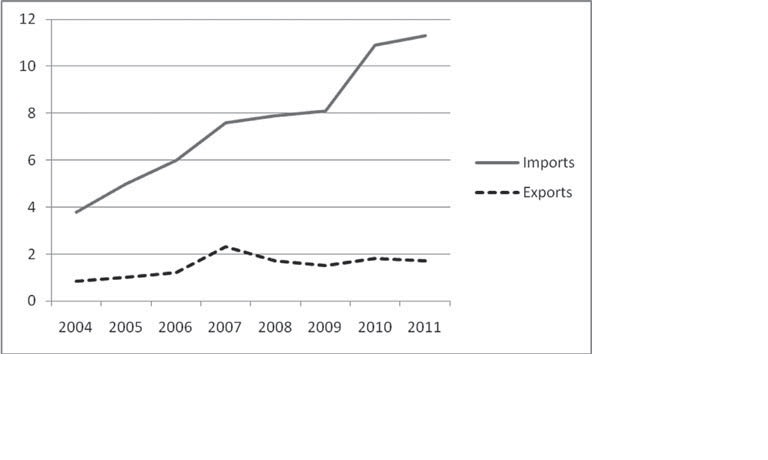
China continues to maintain an export-driven economy with policies that subsidize Chinese companies and undervalue their currency (renminbi or RMB).  While the RMB rose by roughly 6 percent over the last year, it is still widely believed to be undervalued by as much as 30-40 percent.  “For the first eight months of 2011, the U.S. trade deficit with China increased 9 percent over the same period in 2010.  The U.S. trade deficit with China is now more than half of the total U.S. trade deficit with the world.  In the year to date ending August 2011, the United States exported about $13.4 billion in advanced technology products to China, but imported over $81.1 billion in advanced technology products from China, for a deficit of about $67.7 billion.  This is a 17 percent increase in the advanced technology products deficit for the same period over the previous year, ending in August 2010.”

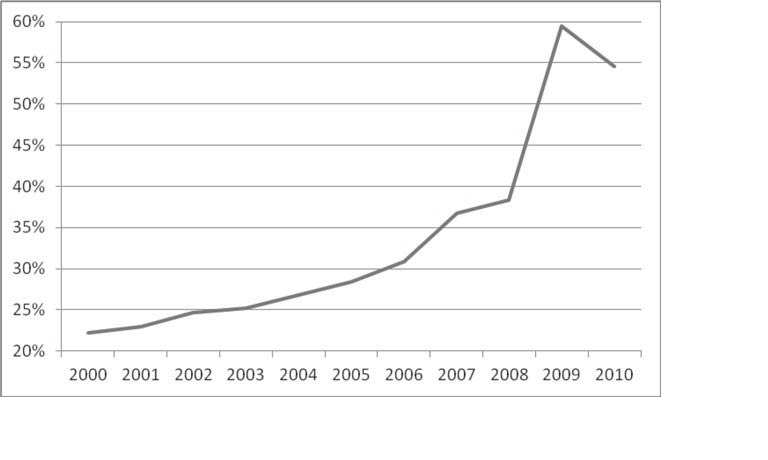
The Chinese economy and its product exports are moving up the value chain.  On a monthly basis, the U. S. now imports roughly 560 percent more advanced technology products from China than it exports to China.  Exports of low-cost, labor-intensive manufactured goods as a share of China’s total exports decreased from 37 percent in 2000 to 14 percent in 2010.

“China’s foreign currency reserves are skyrocketing. A major contributor to this phenomenon is China’s continued policy of maintaining closed capital accounts.  China’s foreign currency reserves exceed $3 trillion, three times higher than the next largest holder of foreign currency reserves, Japan.”  Building currency reserves is one of the main goals of China’s predatory mercantilism trade policies.

China’s domestic money supply is becoming out of control. “Between 2000 and 2010, China’s money supply grew by 434 percent.  China’s money supply is now ten times greater than the U.S. money supply, despite the fact that China’s GDP is only one-third as large.”

The Commission reported that China assumed a more assertive role on the global stage in 2011 as shown by a more aggressive trade agenda, a push for a larger role in international institutions, and provocative moves in the South and East China Seas.  These actions are a result of China’s growing economic prominence and resource needs, as well as China’s view that the U. S. is in decline while China is ascendant.  “Chinese policies have had an impact on the       U. S., ranging from a negative effect on the economy to increased pressure from some parts of the international community for the U. S. to ensure the security of the global commons.”

Last year, the Commission highlighted China’s backsliding from market reforms in favor of an increased role of the state in the economy, which continued in 2011. “China subsidizes its state-owned enterprises to the detriment of both private Chinese firms and international competitors. The Chinese government’s special treatment of state-owned enterprises (SOEs) is of particular concern to U.S. businesses, as it can overcome comparative advantages of competitors, harming American economic interests.  China’s SOEs are also an issue of contention in government procurement, as China seeks to wall off a large portion of its economy from foreign competition.” The Commission estimates the SOE sector accounts for nearly 40 percent of China’s economy, but if the output of urban collective enterprises and government-run proportion of township and village enterprises are considered, the broadly defined state sector likely surpasses 50 percent.

China appears to be reversing the privatization reforms of the past two decades and renewing use of industrial policies aimed at creating SOEs that dominate important portions of the economy, especially in the industrial sectors reserved for the state’s control.  “The Chinese government promotes the state-owned sector with a variety of industrial policy tools, including a wide range of direct and indirect subsidies, preferential access to capital, forced technology transfer from foreign firms, and domestic procurement requirements, all intended to favor SOEs over foreign competitors.”

In 2010, the amount of foreign direct investment (FDI) flowing into China jumped to $105.7 billion, up from $90 billion in 2009.  Foreign-invested enterprises were responsible for 55 percent of China’s exports and 68 percent of its trade surplus in 2010.  The value and scope of U.S.-China bilateral investment flows have expanded significantly in the past ten years.  However, U.S. direct investment in China is more than 12 times greater than Chinese direct investment in the United States.  Official U.S. statistics show that U.S. cumulative FDI in China was $60.5 billion in 2010.  What this means is that American companies and companies from other foreign countries are investing money in China through expanding, building or buying plants in China, buying equipment, and hiring workers.

On the other hand, there has been a more than 100 percent year-on-year growth of Chinese investment in the United States during the past two years.  Chinese investments have focused on manufacturing and technology, with an emphasis on brand acquisition. The report notes that some critics of China’s foreign direct investment in the U. S. contend that these investments are focused on acquiring and transferring technology to Chinese firms.  The Chinese Ministry of Commerce estimated that in 2010, cumulative Chinese FDI in the United States was $4.9 billion.

Due to the considerable government ownership of the Chinese economy, Chinese companies supplying products to the U.S. government or acquisition by Chinese companies of U.S. firms with sensitive technology or intellectual property could be harmful to U.S. national interests.  The Committee on Foreign Investment in the U. S. investigates the national security implications of mergers and acquisitions by foreign investors of U. S. assets.

In March 2011, China ratified its 12th Five-Year Plan (2011– 2015), a government-directed industrial policy that focuses on the development and expansion of seven strategic emerging industries:  new-generation information technology, high-end equipment manufacturing, advanced materials, alternative-fuel cars, energy conservation and environmental protection, alternative energy, and biotechnology.  The report predicts that China will likely continue to combine targeted investment with preferential tax and procurement policies to ensure that Chinese firms emerge as global leaders, or national champions, in these industries within the next five years.

China’s continuing lack of enforcement of intellectual property rights and indigenous innovation plans that limit government procurement to Chinese companies are problematic.  In addition, China maintains policies of forced technology transfer in violation of international trade agreements and requires the creation of joint venture companies as a condition of obtaining access to the Chinese market.

“Foreign-invested enterprises seeking to be considered for government procurement contracts or public works projects are expected to file for patents and copyrights within China in order to qualify for preferential treatment in government contracting.  Foreign affiliates risk the unintended transfer of their technology to Chinese firms if they do so, because of the nature of the Chinese intellectual property system and the lax enforcement of intellectual property laws and regulations in China.”  In 2001, China agreed to stop explicitly requiring foreign companies to surrender their technology in return for market access and investment opportunities, but the government still employs several tactics to coerce foreign firms to share trade secrets with Chinese competitors. China’s industrial policy seeks to circumvent accepted intellectual property protections and to extort technology from U.S. companies.

China continues to be one of the largest sources of counterfeit and pirated goods in the world (confirmed by the recent Senate hearings on counterfeit parts in the defense and aerospace supply chain.)  “The Chinese government itself estimates that counterfeits constitute between 15 and 20 percent of all products made in China and are equivalent to about 8 percent of China’s gross domestic product (GDP).  Chinese goods accounted for 53 percent of seizures of counterfeits at U.S. ports of entry in 2010, and the U.S. International Trade Commission estimates that employment in the U. S. would increase by up to 2.1 million jobs if China were to adopt an intellectual property system equivalent to that of the U. S.”

China progress in its military modernization efforts poses an increasing threat to U. S. national security.  “The People’s Liberation Army (PLA) is acquiring specific means to counter U.S. military capabilities and exploit U.S. weaknesses.  Since January 2011, China has conducted a flight test of its next-generation fighter aircraft, continued development of its antiship ballistic missile, and conducted a sea trial of its first aircraft carrier. These developments, when operational, will allow China to better project force throughout the region, including the far reaches of the South China Sea.”

The Commission reports that the PLA’s military strategy is designed to provide the army with the means to defeat a technologically superior opponent, such as the U.S. military. It focuses on controlling the regions surrounding China, especially the western Pacific Ocean, degrading an opponent’s technological advantages, and striking first in order to gain surprise over an enemy in the event of a conflict.  While U.S. bases in East Asia are vulnerable to PLA air and missile attacks, Japanese, Philippine, and Vietnamese bases are just as vulnerable, if not more so.

China has demonstrated progress in modernizing the PLA over the past year, and recent developments confirm that the PLA seeks to improve its capacity to project force throughout the region.  Continued improvements in China’s civil aviation capabilities, as first noted in the Commission’s 2010 Annual Report, enhance Chinese military aviation capabilities because of the close integration of China’s commercial and military aviation sectors.

Tensions continued in 2011 between China and other claimants in the South China Sea territorial disputes as well as with Japan over territory in the East China Sea.  China’s policy in the region appears driven by a desire to intimidate rather than cooperate.  Despite intermittent statements of cooperation, Chinese assertiveness in the South China Sea indicates that China is unlikely to concede its sovereignty claims. Many of China’s activities in the region may constitute violations of the United Nations Convention on the Law of the Sea and the Declaration on the Conduct of Parties in the South China Sea.  An implication of China’s growing assertiveness, especially its harassment and intimidation of foreign vessels, is the growing risk of escalation due to miscommunication and miscalculation. As chances of confrontation grow, so could the consequences for the U. S., especially with regard to the Philippines, with which the United States holds a mutual defense treaty.

In 2011, as in previous years, the U.S. government, foreign governments, defense contractors, commercial entities and various nongovernmental organizations experienced a substantial volume of actual and attempted network intrusions that appear to originate in China.  “Of concern to U.S. military operations, China has identified the U.S. military’s reliance on information systems as a significant vulnerability and seeks to use Chinese cyber capabilities to achieve strategic objectives and significantly degrade U.S. forces’ ability to operate.”

The report identifies China as one of the top space powers in the world today, and the implications of China’s civil and military space activities are dangerous to the U. S.  China’s leadership views all space activities through the prism of comprehensive national power, using civil space activities to promote its legitimacy in the eyes of its people, to produce spin-off benefits for other industries, and for military-related activities.  The nation’s capabilities, which are state of the art in some areas, follow from decades of substantial investment and high prioritization by China’s top leaders.  The prestige of space exploration and the national security benefits of space systems serve as primary motivators for Chinese decision makers.

China’s civil space programs have made impressive achievements over the past several decades.  “If Chinese projections hold, these programs are poised for continued accomplishments over the next ten to 15 years, such as the development of a space laboratory and eventually a space station. As part of an active lunar exploration program, China may attempt to land a man on the moon by the mid-2020s.”

China seeks new opportunities to sell satellites as well as satellite and launch services in international commercial space markets. Chinese firms’ prospects for greater success remain uncertain over the near term.  However, China’s international space-related diplomatic initiatives and their firms’ ability to offer flexible terms on sales to developing countries may provide additional opportunities.

China views all space activities in the context of ‘‘comprehensive national power.’’ This concept includes many dimensions, but military aspects are fundamental.   “PLA’s primacy in all of China’s space programs, including nominally civil activities, illustrates this emphasis.”  For example, China appears to be making great strides toward fielding regional reconnaissance-strike capabilities.  China has also continued to develop its anti- satellite capabilities, following up on its January 2007 demonstration that used a ballistic missile to destroy an obsolete Chinese weather satellite, creating thousands of pieces of space debris.  “In addition, authoritative Chinese military writings advocate attacks on space-to-ground communications links and ground-based satellite control facilities in the event of a conflict.”

“In the military sphere, China appears to seek ‘space supremacy.’  The PLA aims to implement this policy through two tracks.  First, they increasingly utilize space for the purposes of force enhancement.  The best example is China’s integration of space-based sensors and guided weapons.  Second, they seek the capabilities to deny an adversary the use of space in the event of a conflict.  To this end, China has numerous, active, counterspace weapons programs with demonstrated capabilities.”

These threats to America’s economy and national security need to be taken seriously.  Perhaps if the executives of American manufacturing companies would read this report, or at least the executive summary, they would change their minds about sourcing their R&D and manufacturing in China and investing in expanding, building or buying manufacturing plants in China.  China is no friend to the U. S. and Americans better wake up to that fact before it’s too late.


What Led to the Problem of Chinese Counterfeit Parts?

November 15th, 2011

Last week, the Senate Armed Services Committee reported that an investigation found and examined about 1800 cases of suspected counterfeit electronic parts dating from 2009 to last year, totaling about a million individual components.  Tracing the supply chain, 70% of the components came through China, where a variety of methods were used to misrepresent the parts as new and genuine.  Hearings now being conducted by Senator Carl Levin (D-Michigan) and Senator John McCain (R-Arizona).

At a news conference on Monday, November 7, 2011, Sen. Carl Levin told reporters, “There’s a flood of counterfeit parts entering the defense supply chain.  It is endangering our troops and it is costing us a fortune.”

Sen. John McCain said the investigation documents the alarming “threat counterfeit parts pose to the safety of our men and women in uniform, to national security and to our economy.”  He added, “We can’t tolerate the risk of a ballistic missile interceptor failing to hit its target, a helicopter pilot unable to fire his missiles, or any other mission failure because of a counterfeit part.”

This dangerous state of affairs has taken over 20 years to develop and is a complex web of unintended consequences of seemingly innocuous changes in policies.  There are four main reasons for the problem of Chinese counterfeit components:

1.      Mil. Spec. qualified components replaced by off the shelf components

2.      “Buy American” requirements relaxed

3.      Manufacturing outsourced offshore, mainly in China

4.      Rapid obsolescence of components, especially micro chips

It all started with the scandals of the 1980s over the $600 toilet seats and $400 wrenches that President Reagan’s Defense Department, under Caspar Weinberger, was accused of wasting its money on by the Democrat-controlled Congress.

At the time, the news media ignored reasonable voices pointing out that tooling often has to be made to produce metal, plastic, rubber, and fiber glass parts in certain manufacturing processes.  This tooling cost then has to be amortized into the piece price of the part; i.e., tooling cost divided by the number of parts ordered plus piece price equals selling price. Since defense and military parts are produced in much lower volume than commercial products, the amortized tooling costs add much more to the part cost than it does for commercial parts.

The $600 toilet seat was actually a uniquely shaped, molded fiberglass shroud that fits over the toilet and had to satisfy specifications for vibration resistance, weight, and durability for the P-3C Orion antisubmarine aircraft, which went into service in 1962.  Since the airplane had been out of production for years, new tooling was required to produce the part.  The price reflected the design work and the cost of the equipment to manufacture them, and Lockheed Corp. charged $34,560 for 54 toilet covers, or $640 each.  The president of Lockheed at the time, Lawrence Kitchen, adjusted to the price to $100 each and returned $29,165.

Because of the public outcry over these scandals, the procurement regulations were changed.  The Defense Department, branches of the military, and their supply chain of vendors were allowed to purchase commercial off the shelf parts (COTS) if they met the same fit and function of parts made to strict military specifications.  In the early 1990s, most commercial parts were still being made in the United States, with some outsourcing to the Philippines, Hong Kong, and Singapore, so this change was pretty safe.  Permitting commercial parts to replace Mil. Spec. parts probably drove out of business the small companies that catered exclusively to the military and that provided traceability, per Mil. Spec., for parts supplied to government agencies, military contractors, and subcontractors.  This was all done in the name of cost savings.  Now, however, most commercial electronic components and micro chips are fabricated in China.

Second, after the end of the Cold War and the successful conclusion of the first Gulf War, the provisions of the “Buy American Act” were eased to allow purchasing off the shelf commercial parts from foreign countries by the Defense Department and other government agencies.  Previously, parts, assemblies, and systems were required to be substantially made in the United States or in a NATO country, such as Great Britain, France, and Germany.

This led to parts being made in China as more and more American companies started to outsource manufacturing in China either by selecting Chinese companies as vendors or setting up their own manufacturing plants in China.   This trend accelerated after China received “most favored nation” status with the approval of the World Trade Organization treaty in the year 2000, and American companies started to build semiconductor wafer fab plants in China to produce micro chips.

The problem with counterfeit parts is not something new to industry – there were always a small number of rejected parts that went out the “back door” of companies to be sold on the black or “gray” markets by individual employees.  What is new is the purposeful production of counterfeit parts by a foreign government, namely, China, as a form of economic warfare and counter espionage.

Brian Toohey, president of the Semiconductor Industry Association (SIA), testified Tuesday before the Senate Armed Services Committee calling counterfeit parts “a ticking time bomb.”   He added, “The catastrophic failure risk inherently found in counterfeit semiconductors places our citizens and military personnel in unreasonable peril,” said Toohey. The SIA estimates that counterfeits cost US-based semiconductor companies more than $7.5 billion a year.

EBN Editor, Barbara Jorgensen wrote in her blog, “Counterfeits have been appearing in the consumer and industrial sectors for as long as anyone can remember, but their presence in mission-critical defense equipment and military and passenger aircraft threatens lives  The efforts have a ways to go, but the dialogue between industry associations such as the SIA and the Defense Department and Justice Department are a major step in the right direction.”

Bruce Rayner, Contributing Editor, EE Times, wrote “counterfeiting is on the rise and it is getting harder to detect.  Counterfeit computer hardware, including chips, was one of the top commodities seized in 2010 by the US Immigration and Customs Enforcement agency (ICE) … up five-fold over 2009…The reason for the increase is that there’s a lot of money to be made.  Many obsolete components are in demand by the military because they need to repair very old equipment, such as 1980s-vintage fighter jets.  But the parts are no longer manufactured, and only a few authorized distributors stock the vintage components.  In some cases, the only place to buy these chips is from independent distributors or brokers who don’t have formal sourcing relationships with the original component manufacturer. They buy them over the Internet from sources they don’t know and who can’t validate their authenticity.”

The August 2011 issue of Industry Week reported, “In 2010, government agents seized fake goods totaling $188.1 million, which if genuine would have been worth $1.4 billion.  Goods from China accounted for 66% of the value of seizures by U. S. Customs and Border Protection.”  In the same article, Wes Shepherd, CEO of Channel IQ, said that the outsourcing of manufacturing in China combined with online selling “introduced the specter of counterfeiting as a much more serious problem.”

Joe O’Neill, owner of O’Neill Technologies and formerly with Intel, Samsung and Toshiba, told me in an interview, “the counterfeit problem is a product life cycle mismatch between consumer and more traditional applications, such as industrial, medical, and defense.  The life cycle of micro chips, also referred to as micro processors and controllers, are very short in the networking, computer, and telecommunications industries.  The life cycle of a cell phone model may range from six to 12 months, while industrial and military products may have a life cycle of decades.  Products for the military are a small piece of the market so there is a real problem with part obsolescence.  Availability of these parts that have been made ‘end of life’ force manufacturers to go into the Gray Market or other non-traditional sources to keep their factories supplied with parts.  There are a few companies that specialize in making obsolescent microprocessors for industrial, medical or military manufacturers by “cloning” the parts.” One such company is Innovasic, which makes the X86 series of Intel and AMD micro processors.

During the Senate hearings, part of which I watched after work, photos of bins of electronic parts were shown as Thomas Sharpe, V. P. of SMT Corporation, described visiting electronic component marketplaces in July 2008, where scrapped electronic parts were washed in rivers or left for the daily monsoon rains, dried on river banks, and collected in bins to be ready for counterfeit processing.  Counterfeiters buy used parts for pennies in the street markets of Shenzhen and other Chinese cities, re-mark them, fix broken leads and buff them up, then ship them to brokers in the West who unknowingly or knowingly sell them to other brokers or to OEMs for multiples of what they paid.

Last year, the Department of Justice’s Task Force on Intellectual Property was created specifically to prosecute counterfeiters, and last week Stephanie McCloskey was sentenced to 38 months in federal prison for her role in a scheme by VisionTech Components to import fake chips from China into the U. S. that were sold to a variety of customers including defense contractors and the military.

Until we implement more stringent procurement regulations, strengthen “Buy American” procurement regulations for defense and military components, and return more manufacturing to the United States from offshore, it will be up to manufacturers to have a system to detect and deter counterfeits.  Many defense contractors have put in place strict regimen for inspecting, testing, and reporting counterfeits, but all companies need to be vigilant by inspecting, testing, and reporting.


Why John Stossel is All Wet ? “Buy American” is Smart, not Stupid

November 8th, 2011

John Stossel’s blog article on WorldNetDaily® on November 1, 2011, “The stupidity of ‘Buy American,’ is based on a premise so fallacious that one wonders how a usually intelligent commentator like Stossel could have been taken in by it.

The premise is that “we should buy things where they’re cheapest.  That frees up more of our resources to buy other things, and other Americans get jobs producing these things,” according to the explanation of why “Buy American” is “nonsense” by economist David Henderson of the Hoover Institution.

First of all, “buying things where they’re cheapest” isn’t always the best decision on where to spend your money ? the old adage “you get what you pay for” is more often true.  Most of the everyday items that people buy today at “big box” and other retail outlets are being manufactured in China and other countries in Asia.

What do you get for your money when you buy products that are made in China and other Asian countries?  Clothes and shoes that don’t fit or fall apart, toys that choke or strangle children, baby buggies, strollers, and cribs that maim or even kill, household items that either don’t work properly, cause fires, and explode, and tainted food.  The U. S. Consumer Protection Safety Commission’s website provides a monthly list of products that have been recalled, and month after month, more than 90% are made in China.   For example, there have been eight recalls thus far in November, and seven of the eight products were made in China.  In October, there were 21 product recalls: 12 were made in China, two were made in Taiwan, two were made in Vietnam, two were made in Mexico, and three were made in the U. S.  The products ranged from glass bowls and toys to tents, battery packs, and baby strollers.

Recently, a Senate Armed Services Committee investigation led by Sens. Carl Levin (D-MI) and John McCain (R-AZ) reviewed more than 100,000 pages of DOD documents and found that U.S. Department of Defense had purchased counterfeit electronic parts (defective and with “back doors”) from China in 1,800 cases, running to more than 1 million parts.

Second, buying cheap goods that are made offshore only creates American jobs if you use the money to buy American products.  If you just buy more products made “offshore,” you don’t create any new American jobs.   About the best it does is keep people who work in wholesale and retail employed.  That’s why tax rebates and refunds haven’t created the jobs that were expected.  Consumers used the extra money to pay down debt, add to savings, or bought the everyday products that are now made mostly in China.

Why does it matter where products are made and why is it smart to “Buy American?”  A  report released in April 2011 titled, “The Importance and Promise of American Manufacturing, Why It Matters if We Make It in America and Where We Stand Today,” co-authored by Michael Ettlinger and Kate Gordon of the Center for American Progress provides the answer to these questions.  The Center for American Progress is a nonpartisan research and educational institute dedicated to promoting a strong, just and free America that ensures opportunity for all.

The authors opine that “Manufacturing is critically important to the American economy.  For generations, the strength of our country rested on the power of our factory floors—both the machines and the men and women who worked them.  We need manufacturing to continue to be bedrock of strength for generations to come … The strength or weakness of American

In addition to maintaining our standard of living as Americans, there are several other important reasons why it’s smart to “Buy American.”  They are:

Manufacturing is critical to our national defense ? American manufacturers supply the military with the essentials needed to defend our country, including tanks, fighter jets, submarines, and other high-tech equipment. The same advances in technology that consumers take for granted support the military, particularly soldiers fighting overseas.

The U.S. cannot rely on other countries to supply its military because their interests may run counter to its own.   America cannot risk being held hostage to foreign manufacturers when it comes to products that are essential for its national security and the U.S. military. It is crucial that key components and technologies that are critical to the production of U.S. weapons and the related industrial capacity to produce such items be located within the United States.

Manufacturing supplies millions of jobs ? Manufacturing jobs are the foundation of the U.S. economy and the basis for its middle class. Manufacturing provides high-paying jobs for nearly 12 million Americans.

Manufacturing Jobs Pay Higher Wages than Service Jobs ? Manufacturing wages and benefits are approximately 25 – 50 percent higher than in non-manufacturing jobs.

In an opinion article in Industry Week magazine, John Madigan, a consultant with Madigan Associate, wrote “Jobs paying $20 per hour that historically enabled wage earners to support a middle-class standard of living are leaving the U.S… only 16% of today’s workers earn the $20-per-hour baseline wage, down 60% since 1979.   Service and transportation jobs, per se, cease to exist in the absence of wealth. Rather, they exist and thrive as by-products of middle-class incomes buying products and services.”

Manufacturing Creates Secondary Jobs ? There is a multiplier effect of manufacturing jobs that reflects linkages that run deep into the economy. For example, every 100 steel or automotive jobs create between 400 and 500 new jobs in the rest of the economy. This contrasts with the retail sector, where every 100 jobs generate 94 new jobs elsewhere, and the personal and service sectors, where 100 jobs create 147 new jobs.  It is manufacturers who hire services such as banking, finance, legal, and information technology.

Manufacturing is the Engine of American Technology Development and Innovation ? American manufacturers are responsible for more than two-thirds of all private sector R&D, which ultimately benefits other manufacturing and non-manufacturing activities. More than 90 percent of new patents derive from the manufacturing sector and the closely integrated engineering and technology-intensive services.

Manufacturing R&D is conducted in a wide array of industries and businesses of all sizes. The heaviest R&D expenditures take place in computers and electronics, transportation equipment, and chemicals (primarily pharmaceuticals.)

Manufacturing is an incubator for technology and science, which require proximity to facilities where innovative ideas can be tested and worker feedback can fuel product innovation. Without this proximity, the science and technology jobs, like customer service jobs, follow the manufacturing jobs overseas.

Manufacturing Generates Exports — The United States was the world’s first-largest exporter until 1992 when Germany took over this position.   Germany remained number one until 2009 when China surpassed it to become the world’s top exporter, and the United States fell to being the third-largest exporter.  The difference between the top three was small:  Germany exported $1.17 trillion compared to the $1.057 trillion of the U. S., but China’s exports were $1.2 trillion in 2009.

Manufactured goods make up more than 60 percent of the value of U.S. exports, double the level of ten years ago. While agricultural exports amount to about $50 billion a year, manufacturers export about that much each month.  High tech products are America’s largest export sector, and the European Union was the top importer of these goods, followed by Canada, and Mexico.

Manufacturing Supports State Economies ? Manufacturing is a vital part of the economies of most states – even in those areas where manufacturing has declined as a portion of the Gross State Product (GSP). As a share of GSP, manufacturing was among the three largest private-industry sectors in all but ten states and the District of Columbia. Manufacturing is the largest sector in ten states and in the Midwest region as a whole. It is the second largest in nine states, and the third largest in 21 others.

For the past decade, manufacturing corporations paid 30 to 34 percent of all corporate tax payments for state and local taxes, social security and payroll taxes, excise taxes, import and tariff duties, environmental taxes and license taxes.  Since many small manufacturers are not incorporated and pay individual taxes as sole proprietors, the tax revenue generated by all manufacturers is impossible to calculate.

In summary, it’s smart, not stupid to “Buy American” because manufacturing is the foundation of the U.S. national economy and the foundation of the country’s large middle class. Losing the critical mass of the manufacturing base will result in larger state and federal budget deficits and a decline in U.S. living standards. This, in turn, would result in the loss of a large portion of our middle class, which depends on manufacturing jobs. America’s national defense will be in danger, and it will be difficult, if not impossible to maintain the country’s position as the world’s super power.  “Buying American” will help ensure that American manufacturing survives and grows in the global economy.

What Can I do to “save” American Manufacturing?

October 25th, 2011

You may feel that there is nothing you can do as an individual to stop the total destruction of American manufacturing and watch the United States go over the precipice. Don’t think this way!   American activist and author, Sonia Johnson said, “We must remember that one determined person can make a significant difference, and that a small group of determined people can change the course of history.” Eleanor Roosevelt echoed this sentiment saying, “Never doubt that a small group of thoughtful, committed citizens can change world; indeed, it’s the only thing that ever has.” Remember that our country was founded by a small group of people that did indeed change the world by forming the United States of America.

Here are suggestions of what each one of us can do:

As a Consumer:  It matters if we buy American-made products.  First, our addiction to imports has helped create our high trade deficit, especially with China, where most of the consumer goods we import are manufactured.  Second, American-made products create American jobs.  Each time you choose to buy an American-made product, you help save or create an American job.

Look at the country of origin labels of goods when you go shopping. Most imported goods are required to have these labels.  Buy the “Made in U.S.A.” even if it costs more than the imported product. It is a small sacrifice to make to insure the well being of your fellow Americans. The price difference you pay for “Made in USA” products keeps other Americans working.

If the product you are looking for is no longer made in America, then avoid countries such as China, who have nuclear warheads aimed at American cities. It would not be an exaggeration to say that American consumers have paid for the bulk of China’s military buildup. American service men and women could one day face weapons mostly paid for by American consumers. Instead, patronize impoverished countries such as Bangladesh or Nicaragua, which have no military ambitions against the United States.

In addition, you will be reducing your “carbon footprint” by buying a product made in America instead of a product that is made offshore that will use a great deal of fossil fuel just to ship it to the United States.

If you have a “Made in USA” appliance that needs repair and all the new ones are imported, have it repaired. If it can’t be fixed, and it is a small appliance that you can live without, then don’t buy a new one.

We Americans buy many things that we really don’t need just because they are so cheap. If a product that you are considering purchasing is an import, ask yourself, “Do I really need this?” If you don’t need it, then don’t buy it.

If you are willing to step out of your comfort zone, you could ask to speak to the department or store manager of your favorite store. You could tell the person that you have been a regular customer for x amount of time, but if they want to keep you as a customer, they need to start carrying some (or more) “Made in USA.” products.  If you buy products on line or from catalogs, you could contact these companies via email with a similar message. Your communicating with a company does have an effect because the rule of thumb in sales and marketing is that one reported customer complaint equals 100 unreported complaints.

If you think that Americans no longer care about where goods are made or have concerns about the safety of foreign products, you may be surprised to learn that poll after poll shows that the majority of Americans prefer to buy American.

A nationwide poll conducted by Sacred Heart University in September 2007 found the following:

  • 68.6 percent of Americans check labels for information like manufacturer, nation of origin and ingredients
  • 86.3 percent of Americans would like to block Chinese imports until they raise their product and food safety standards to meet U.S. levels.3

Buying American has been made even easier by a book by Roger Simmermaker – “How Americans Can Buy American: The Power of Consumer Patriotism” released in March 2008 and updated in 2010.  According to Simmermaker, “buying American” is not just about buying “Made in USA.”  “Buying American, in the purest sense of the term, means we would buy an American-made product, made by an American-owned company, with as high a domestic parts content within that product as possible . . . ‘American-made’ is good. ‘Buying American’ is much better!”

One of our greatest statesmen, Thomas Jefferson, stated, “I have come to a resolution myself, as I hope every good citizen will, never again to purchase any article of foreign manufacture which can be had of American make, be the difference of price what it may.”

Simmermaker has made it easy by listing companies and their nation of ownership. You can see his list of American-owned companies at his website: www.howtobuyamerican.com However, Simmermaker’s website isn’t the only one available. You can also check many other websites, found simply by “Googling” “buy American.” These include:

www.buyamericanmart.com

www.ionlybuyamerican.com

www.madeinusa.org

www.americansworking.com

www.shopunionmade.org

www.MadeInUSAForever.com

www.stillmadeinUSA.com

There are also brick and mortar stores springing up around the country that are either stocking only “made in America” products, such as the American Apparel stores or primarily “made in America” products, such as the Urban Outfitters stores.

As American consumers, you have many choices to live safely and enjoy more peace of mind with American products. It’s high time to stop sending our American dollars to China while they send us all of their tainted, hazardous, and disposable products. If 200 million Americans refuse to buy just $20 each of Chinese goods, that’s a four billion dollar trade imbalance resolved in our favor – fast!

As a Voter:  There’s only one way for manufacturers to find relief from high taxes, burdensome regulations, and unfair trade laws and that’s through Washington, D.C.  Voter apathy is partially responsible for the state of our affairs as a country. Too many people have decided that there is nothing we can do on an individual basis and have even stopped voting.

Americans have been “sold down the river” by politicians on both sides of the aisle – Democrats and Republicans. Democrats profess to support “blue collar workers” and unions, yet NAFTA and the WTO treaties were approved and went into effect under the presidency of Democrat Bill Clinton. Republicans profess to support business, yet they primarily support large, multinational corporations, rather than the small businesses that are the engine of economic growth in the U.S. and the foundation of the middle class.

In his 2008 book, “Where Have all the Leaders Gone” Lee Iacocca said, “Am I the only guy in this country who’s fed up with what’s happening? Where is our outrage? We should be screaming bloody murder. We’ve got corporate gangsters stealing us blind. The most famous business leaders aren’t the innovators, but the guys in handcuffs. And, don’t tell me it’s all the fault of right wing Republicans or liberal Democrats. That’s an intellectually lazy argument and it’s part of the reason that we’re in this stew. We’re not just a nation of factions. We’re a people and we rise and fall together.  We didn’t elect you to sit on your butts and do nothing and remain silent while our country is being hijacked and our greatness is being replaced with mediocrity.  What is everybody so afraid of?  Why don’t you guys in Congress show some spine for a change?”

In a poll asking Americans if they’ve ever contacted their elected representatives, eight out of ten said that they never had. It’s never been easier to contact members of Congress. All you have to do is click on www.house.gov or www.senate.gov and type in your zip code, and you’re automatically directed to your representative. A window automatically pops up where you can type a message to that representative.  It takes less than two minutes, on average.  Well, we now need to let our elected representatives know how we feel about the bad trade laws, bad tax laws, and over burdensome regulations on manufacturers. It’s time to shed apathy, become involved, and vote.

If people whose lives are affected by manufacturing would contact their legislators and tell them they want trade reform and tax reform and would follow up to watch to see how they voted, the results would be amazingly effective.

We cannot afford to export our wealth and be able to remain a first-world country. We cannot lose our manufacturing base and be able to remain a “superpower.” In fact, we may not be able to maintain our freedom as a country because it takes considerable wealth to protect our freedom. You can play a role as an individual in saving our country ? the company you save or the job you save by your actions may be your own.

How Can We Attract Youth to Manufacturing Careers?

October 18th, 2011

If we want to attract today’s youth to manufacturing careers, we need to change their perceptions about what the manufacturing industry is like and show them what great career opportunities exist in the industry.  If more people would watch TV programs such as “How it’s Made” and “Made in America,” they would soon realize that manufacturing has changed for the better – it’s cleaner and high tech compared to what it was a generation or two ago.

In a blog article, Derek Singleton, ERP Analyst for Software Advice, wrote, “This means reacquainting youth with the process of designing and building products from an early age – and then providing the creative freedom to build those things on their terms.”  He shared two examples from industry and suggested a third:

  1. Manufacturing summer camps – A recent New York Times article highlighted an innovative summer camp, called Gadget Camp, where teenagers learn how to build things from concept to creation. Attendees are required to design a product through computer-aided design (CAD) technology and oversee the design to completion.
  2. Gamification of manufacturing – Gamification is a hot topic in many aspects of business at the moment – one driven by the idea that adding gaming elements to non-gaming activities encourages action and participation. It’s a movement that seeks to capitalize on our youth’s obsession with video games as well as our competitive nature. According to Diana Miller and Simon Jacobson’s recent Gartner First Thing Monday Morning newsletter, Invensys has been using 3D gaming technology to teach new hires how to operate oil refinery equipment for the past few years. In the same vein, Siemens recently released Plantville, a program designed to teach manufacturing processes and technologies to young people and new hires.
  3. Restore shop classes to our high schools – The elimination of these courses from our school systems has inevitably had a negative impact on the way we view making a living with our hands. We can all learn from building something with our hands because it teaches us a different way to think. And more importantly, hands-on learning through shop classes helps young people move an idea from concept to creation – which is useful regardless of one’s future occupation.  (quoted with permission)

The good news is that more than one non-profit organization has recognized the need to introduce the opportunities of engineering and manufacturing careers to middle school age youth because by high school, students may already be on a different career track.  The benefits of summer camps for middle school youth is why the Fabricators and Manufacturers Association, International (FMA) sponsored the Gadget Camp mentioned above.  FMA sponsors the Nuts, Bolts and Thingamajigs Foundation (NBT) whose mission is to nurture the tinkering spirit.

NBT and the National Association for Community College Entrepreneurship (NACCE) have partnered together to launch a unique summer camp program that combines elements of manufacturing and entrepreneurship—how things are made and how businesses develop. The summer camp will eventually develop into a national program with as many as 300 locations across the United States.

FMA also offers grants for manufacturing summer camps at numerous locations across the country.  Each camp is aimed at changing the image of manufacturing for youths. Through partnerships with nonprofit organizations, such as the Boys and Girls Clubs of America, FMA provides guidelines on the basic structure of how a camp should be conducted.  The organizations then use their community resources to develop the camps based on local manufacturing needs.

The camps provide a positive hands-on experience so young people will consider manufacturing as a career option. They target youths at the critical level of early secondary education, exposing them to math, science and engineering principles, and giving them opportunities to see the technology being used in industry and the high level of skills that will be required from the workforce.

Campers design and build a product experiencing the start to finish satisfaction of creating something they can show off with pride. Throughout the process, they learn how to do CAD design and operate various kinds of manufacturing machinery under the close supervision of expert manufacturing trainers.

They also tour local manufacturing facilities learning what kinds of jobs exist, what skills and training are required, and how those businesses developed. They have the opportunity to hear directly from local manufacturing company owners how they started their businesses, applying basic entrepreneurship principles to understand how a single product idea becomes a business.

Another non-profit organization with similar goals is Project Lead The Way® (PLTW).  The list of PLTW sponsors includes such companies as:  BAE Systems, Biogen Idec, Boeing, Caterpillar, Chevron, General Atomics, Intel, Lockheed Martin, Northrop Grumman, Qualcomm, Solar Turbines.  Non-profit sponsors include the Girard Foundation, the McCarthy Foundation, and TechAmerica (formerly AeA).

PLTW has been working since 1997 to promote pre-engineering courses for middle and high school students. PLTW forms partnerships with public schools, higher education institutions, and the private sector to increase the quantity and quality of engineers and engineering technologists graduating from our educational system.  The PLTW curriculum was first introduced to 12 New York State high schools in the 1997-98 school years. A year later, PLTW field-tested its four unit Middle School Program in three middle schools. Today, the programs are offered in over 1,300 schools in 45 states and the District of Columbia.

The Society of Manufacturing Engineers Education Foundation is one of the major funders of Project Lead the Way® and sponsors a  week long day camp for 6th – 8th graders, called Gateway Academy, which is a project based, hands-on curriculum designed by PLTW to introduce middle school students to the fundamentals of science, technology, engineering and math.  Campers work together in a fun, exciting environment using leading-edge technologies to sample such disciplines as robotics, aeronautics and eco-design.  They brainstorm ideas, solve problems and build bridges, race cars and other working models. Participation in a Gateway Academy prepares students for the middle school Gateway to Technology pre-engineering curriculum.  The PLTW Middle School program is called Gateway To Technology, consisting of nine-week, stand-alone units, which can be implemented in grades six through eight, as determined by each school. The curriculum exposes students to a broad overview of the field of technology.  The units are:

  • Design and Modeling
  • The Magic of Electrons
  • The Science of Technology
  • Automation and Robotics
  • Flight and Space

SME also sponsors the ”Manufacturing is Cool” award winning, interactive website, which challenges and engages students in basic engineering and science principles and provides interesting and useful educational resources for teachers.  This fun and information rich website was recently “re-engineered” (updated) and marketed around the country.  SME has received positive feedback from teachers, parents, and students about its usefulness.  This website is a good start towards fulfilling the “Gamification of manufacturing” mentioned by Mr. Singleton.

There is also good news with regard to Mr. Singleton’s suggestion of restoring shop classes to schools.  States are starting to add shop classes back into the curriculum.  During his terms as California’s governor from 2003-2010, Arnold Schwarzenegger identified workforce skills, referred to as Career Technical Education (CTE), as a priority for California.  The passage of the education bond in 2006 provided $500 million for CTE initially, and subsequent budgets have continued to fund the program.  The State plan was approved by the California State Board of Education on March 12, 2008 and approved by the U.S. Department of Education on July 1, 2008.  The CTE is delivered primarily through K-12/adult education programs and community college programs.  The Career Technical Education includes the following:

K-12/Adult Programs:

  • Elementary school awareness and middle school introductory CTE programs
  • High school CTE, offered through 1,165 high schools in single courses, in course sequences or through over 300 integrated “learning communities”
  • ROCPs offering career pathways and programs through 74 ROCPs
  • Adult education offered through 361 adult schools and over 1,000 sites
  • Apprenticeship offered through over 200 apprenticeship program and adult schools

Community College

  • Occupational programs offered at all 109 colleges, leading to certificates, associate degrees, and transfer to four-year universities
  • Noncredit instruction for short-term CTE programs offered by 58 colleges
  • Apprenticeship offering over 160 apprenticeship programs at 39 colleges
  • Middle College High Schools (13) and Early College High Schools (19)
  • Tech Prep programs delivered through 80 Tech Prep “consortia,” comprising 109 colleges and their feeder high schools
  • Economic and Workforce Development Program activities implemented through 115 “regional delivery centers” and 10 initiatives in emerging industries
  • Contract education provided to organizations for their employees

This is a good start, but we have a long way to go if we want to have enough skilled workers to replace the “baby boomers” as they retire over the next 20 years.  Perhaps when more young people have exposure to the various career opportunities in manufacturing and realize that manufacturing careers pay 25-50 percent higher than non-manufacturing jobs, they will choose to be part of modern manufacturing.

What’s Being Done to Address the Lack of Skilled Workers?

October 11th, 2011

For the past 15 years, manufacturing companies have been focused on training existing employees in the tools and methodologies of lean manufacturing and Six Sigma in order to improve efficiency, productivity, quality, and customer service to be more competitive in the global economy. However, this training doesn’t address the lack of workers trained in the specific skills needed for today’s advanced and higher tech manufacturing.

Mark Tomlinson, CEO of the Society of Manufacturing Engineers, sees the skilled worker shortage as an iceberg looming on an uneasy sea.  “We’re just approaching it; we haven’t hit it yet but we know it’s there,” he says. “People are starting to see it. They just don’t know how to deal with it…Now there is an increased need to fill manufacturing jobs associated with aerospace, energy, medical device manufacturing and aspects of transportation,” Tomlinson says.

At the imX event in Las Vegas that I attended September 12-14, 2011, I interviewed Experience Partner companies that are very involved in workforce development and training.  Mark Logan, V. P. Business Development & Marketing, Mag IAS, LLC said that MAG has a very comprehensive training program.  MAG America restarted its apprenticeship program in 2005 in partnership with local community colleges. Students in the program work full-time at MAG while taking college classes, working toward an associate’s degree. MAG invests approximately $200,000, including tuition, salary and benefits, for each apprentice earning a degree. This program gained national attention in an NBC Nightly News report “America at the Crossroads.”

Other internal programs include Future Leaders and the Accelerated Leadership Program (ALP), which are designed to fill the pipeline at the company’s management and executive levels.  Future Leaders participate in a one-year program combining classroom training with developmental assignments and mentoring from senior managers.  Accelerated Leadership candidates are employees who have the potential to assume executive-level positions within MAG, and the program provides a series of high-impact job assignments coupled with advanced educational opportunities.  The company also has co-operative education programs with a number of well-known regional and national engineering schools.  MAG IAS joins manufacturing leaders Boeing, Caterpillar, United Technologies and others as the newest partner in MIT’s prestigious Leaders for Global Operations (LGO) dual-degree graduate program that equips students with master’s degrees in engineering and management.

Another Experience Partner, Sandvik Coromant, provides training for their employees in collaboration with technical schools and colleges in addition to performing internal training utilizing curriculum they have developed, according to Robert Page, Productivity Center and Training Manager.  They also provide training for their customers at Smart events in metal cutting technology ranging from the basics of terms and definitions to specialized metal cutting of “hard” parts in super alloys.

Another imX Experience Partner was Fanuc FA America, one of the world’s leading factory automation companies.  Fanuc has developed simulator software, which is ideal for training.  Mark Brownhill, Program Manager, Machine Tool Distributor/Education, said, “We offer regular training programs for end-users as well as machine tool builders, agents or distributors. The training combines practical lectures with hands-on lab exercises to ensure that you get the value-added skills needed.  Our NCGuide simulates the CNC operator environment featuring, by selection, ISO programming or Fanuc Job Shop Programming Software while our NCGuidePro provides development tools as used by machine builders and OEMs.  Both these products run on standard PC equipment with no need for additional hardware.”  Fanuc also has two training centers, one near Chicago and one that just opened in Cypress, California.

Since its founding in 1932, the Society of Manufacturing Engineers (SME) has provided lifelong-learning programs, certification and skills assessment, technical resources, publications and industry expertise through its members.  SME has several certification programs in specialized fields that are used by both industry and academia to develop today’s and tomorrow’s workforce, such as Certified Manufacturing Technologist, Certified Manufacturing Engineer, Lean Certification, and Green Manufacturing Specialist.

In 2010, SME acquired Tooling University LLC (Tooling U) based in Cleveland, Ohio. Tooling U provides online training to more than 1,200 manufacturing companies and 400 educational institutions.  With more than 400 unique titles, Tooling U offers a full range of content to train machine operators, welders, assemblers, inspectors, and maintenance professionals. Tooling U online classes help to round out SME’s current offering of instructor led training, certifications, webinars, books and videos.

A free Workforce 2021 Readiness Assessment was introduced at the Tooling U booth at the imX event.  This customized and targeted workforce assessment program gives manufacturers the opportunity to assess their own capabilities in the face of challenges they will need to solve before they are confronted with the severe skilled workforce shortages predicted by 2021.  The first component of the assessment requires companies to answer questions about how they are preparing to meet the needs of the 2021 workforce.  Tooling U and SME professional development experts were available to explain solutions for readiness deficiencies identified in the assessments.

After the imX event, I interviewed two of Tooling U’s clients.  One client is Midmark Corporation, which brings efficient patient care to millions of people each day in the human and animal healthcare industries around the world. Midmark is committed to providing innovative products and services for the medical, dental and veterinary healthcare equipment industry. Headquartered in Versailles, Ohio, Midmark Corporation maintains four subsidiaries in the United States and has over 1,100 employees worldwide.

Casey Webster, Human Resources Manager, said, “We are experiencing a shortage of skilled machinists.  So far this year, Midmark has hired 7 machinists from the outside.  Finding this talent was a major struggle.  We tried several different recruiting tactics such as advertising in the newspaper, online, offering referral bonuses, radio ads, and professional recruiting services.”  She said, “We chose Tooling U because it was recommended to us by Edison Community College.  After doing some research and course trials, we decided to partner with Tooling U.  The kind of training courses we are utilizing includes 45 online modules and five labs.  It was important that we implement a program that allowed teammates to confirm their learned knowledge.  Once a teammate completes a set of online modules, he attends an eight-hour, hands-on lab at Edison Community College.  Classes range from mathematics, blueprint reading, cutting, lathe, mill, turning, and CNC.   The Tooling U training program has benefited our company by:

1.      Providing development opportunities to current teammates wanting to become machinists

2.      Reducing training time

3.      Verification program that a teammate has the skills to be successful in a machining role

Kellogg Community College, located in Battle Creek, MI, is the other client I interviewed.  Chris Walden, Interim Director, Workforce Services, said, “Manufacturers are coming to us as part of the ‘Michigan Works’ program.  We purchased full-year subscriptions to ToolingU courses in machining and welding because they are the perfect supplement for lab and class work.  The ToolingU courses are a cost-efficient and beneficial tool and have saved taxpayers thousands of dollars by our not having to develop our own curriculum.  The courses are translatable to both certificate programs and associate degrees.”  He added that the current president of the college, Dr. Dennis Bona, started out as a welder in private industry, and then became a part-time welding instructor before going on to higher education so he is very supportive of workforce training programs.

Another trade organization that also provides workforce training is The Fabricators and Manufacturers Association, International (FMA).  The FMA champions the success of the metal processing, forming, and fabricating industry.  FMA educates the industry through the following programs:

FabCast – FMA’s webinar platform to deliver live, interactive technical education programs directly to shops on such topics as laser cutting, roll forming, metal stamping, etc.  Companies can train their whole team at once, even from multiple locations.   Companies can break up full days of instruction into modules and spread out over a period of time. (i.e. two hours four days a week, four hours once a week for a month).

Precision Sheet Metal Operator (PSMO) Certification – FMA’s PSMO Certification is the metal fabricating industry’s only comprehensive exam designed to assess a candidate’s knowledge of fundamental precision sheet metal operations.

On-site – Live training conducted at a company on their equipment. Rather than releasing a limited number of staff to attend an off-site training program, it can be more cost effective to bring the expert into a facility to work with all team members engaged in a particular process.  Training can be offered modularly and when needed (first, second, third shifts or weekends).

FMA’s e-Fab – online training that allows a company to get the training they need, when they need it.  E-Fab courses combine a full day’s worth of instruction by FMA’s leading subject matter experts with the flexibility of online delivery. The training is available 24/7, 365 days a year.

Educating current and future manufacturing workers is critical for the health and growth of the manufacturing industry, and the training programs provided by SME and FMA will aid in addressing the lack of skilled workers.

Why is there a lack of skilled workers with such high unemployment?

October 4th, 2011

The national unemployment rate has ranged between 9 to 10 percent for nearly three years, representing 14-15 million workers and another 8-9 million workers that are considered underemployed.   The unemployment rate for the manufacturing industry jumped from 8.3 percent in December 2008 to a high of 13.0 percent in January 2010, but has ranged from a high of 9.9 percent in January 2011 to a low of 8.9 percent in August.

We have lost more than 5.5 million manufacturing jobs in the past decade, and over 57,000 manufacturing companies have gone out of business.  Aren’t there enough workers who lost jobs to fill the needs of companies that have survived and are now experiencing the recovery of the manufacturing industry?   With over 20 million many unemployed or underemployed workers, why is there a lack of skilled workers?

The main reasons for the lack of workers with the specific skills needed by today’s higher technology manufacturers are:

  • Unemployed workers mainly come from industries that have been decimated by offshoring
  • Fewer people choosing manufacturing as a career choice because of poor image
  • Attrition from retirement that is getting worse as baby boomers start to retire

First of all, a large percentage of the people who lost their jobs came out of industries that have been decimated by the offshoring of manufacturing – textiles, furniture, tires, sporting goods, and the garment industry just to name a few.  For example, the garment district in New York City has virtually disappeared, and now there is only one company left that makes gloves ? LaCrasia Gloves.

An added blow was the decimation of the automobile and auto parts industry during the Great Recession when North American auto production dropped from an average of 14-15 million vehicles per year down to below 10 million vehicles in 2008.

Most of these industries were dominated by large manufacturers employing hundreds to thousands of workers in plants located in the northeast, Midwest, and south.  They either worked on assembly lines or utilized specific skills suited to their industries.  In some cases, a textile plant, furniture plant, or automotive plant was the only large employer in the town.  When the plant closed, workers either had to take whatever other job they could find or relocate to another area.  If they were over the age of 55, they were fortunate to find a job at all.  In most cases, these workers didn’t have the specific skills needed in high-tech manufacturing industries.

When the manufacturing industry seems to be in a nationwide downward spiral, workers don’t even know where to relocate to find other types of manufacturing jobs.  And, if their spouse still has a good job, there is no incentive to move to where there might be an opportunity for another manufacturing job.  For example, I’m sure that only residents in the region are aware that German industrial corporation AG Siemens has a new plant in Charlotte, North Carolina and is hiring nearly 900 workers.

Another reality is that American workers in the regions of highest unemployment don’t have backgrounds in the manufacturing industry.  In fact, of the top ten cities of highest unemployment, eight are located in the mostly agricultural regions of California:  El Centro, Merced, Yuba City, Stockton, Modesto, Fresno, Visalia-Porterville, and Hanford-Corcoran.  It would be an education and logistics challenge of tremendous proportions to retrain these workers for jobs in the manufacturing industry.

Second, manufacturing’s tarnished image has led young people entering the workforce to choose other career paths.  In an article titled, “What the shortage in skilled manufacturing workers means to a hungry industry” of the e-newsletter Smart Business, Kika Young, human resources director at Forest City Gear Co. Inc. of Rockford, IL, said “Most people in Gen Y out of high school don’t think of manufacturing as a career or as a good option.  They don’t think of it as glamorous; they think of it as dark and dingy and dirty and aren’t interested in going into that.”

“ Emily Stover DeRocco, president of The Manufacturing Institute of Washington, D.C., an organization dedicated to improving and expanding manufacturing in America, said, “It’s absolutely true that the image and the definition of manufacturing in this country has not kept up with the industry.”  She added, “Companies need to invest more in employee training and make workforce skills a top strategic priority.  Our education system must also do a better job aligning education and training to the needs of employers and job-seekers. In the face of a global recession and intense international competition, American manufacturers must differentiate themselves through innovation and a highly skilled workforce.”

Third, the attrition of skilled workers through retirement, death, and disability year after year is compounding the problem.  Harry Moser, retired president of GF AgieCharmilles and founder of the Reshoring Initiative, estimates that “about 8 percent of the manufacturing workforce is lost each year due to retirement, promotion, career changes, disability, and mortality.”  In the machining industry, this means a loss of “about 20,000 to 25,000 skilled machinists per year…In contrast, only about 8,000 per year receive sufficient machining training in high school, community college and apprentice programs to be considered good recruits.”

The U.S. Bureau of Labor statistics estimate that 2.8 million, nearly a quarter of all U.S. manufacturing workers, are 55 or older.  While manufacturing has led the United States out of the recession, the improvement has been a mixed blessing because as more skilled workers are needed, the supply is limited because baby boomers are retiring or getting close to retirement.  What makes the situation worse is that there aren’t enough new ones to replace them because the subsequent generations were smaller and fewer chose manufacturing as a career.

The convergence of all of these factors has resulted in an insufficient number of workers trained for advanced manufacturing jobs.   It’s more of a skills gap in the specific skills needed by today’s manufacturers than a shortage of skilled workers.  In the past 15 years, the manufacturing industry has evolved from needing low-skilled production-type assembly workers to being highly technology-infused as it follows lean principles.

According to the 2010 Manpower Talent Shortage Survey, 14% of employers In the U.S. reported having difficulty filling key positions within their organization, down from 19% in 2009.  Among the most difficult jobs to fill in North America are those of the skilled manual trades, with electricians, carpenters, plumbers and welders among the most in-demand employees.  Jonas Prising, Manpower president of the Americas said, “The issue is not a lack of candidates, but rather a talent mismatch.  There are not enough sufficiently skilled people in the right places at the right times.  Compounding the issue is the fact that employers are seeking ever more specific skill sets, or a rare combination of skill sets, and are less willing to engage in anticipatory hiring.  This paradox adds up to a very challenging and frustrating situation at a time when people need work and employers need talent.”

In September 2011, a survey sponsored by Advanced Technology Services, Inc. (ATS) and conducted by The Nielsen Company, was released that corroborates this skilled worker shortage.  ATS is a recognized leader in outsourced production equipment maintenance, helping companies like Caterpillar, Eaton, BorgWarner and Honeywell run their factories better through equipment maintenance and related services.  The top findings of the online survey of 100 VP-level and C-level executives completed in August were:

  • 55% of largest U.S. manufacturers polled—those with $1 billion or more revenue—will be hardest hit by skill shortage costing each $100 million or more over the next 5 years.
  • 45% of the companies surveyed are encouraging their older workers to stay on the job.
  • 50% of respondents said they currently have 11 or more open positions for skilled workers, with 31% having over 20 open slots.

“This is an essential time to be in manufacturing considering other sectors are seeing hiring slow down.  Many young people overlook the opportunity and high wages that careers in manufacturing afford,” said Jeff Owens, President of Advanced Technology Services. “As you can see form the rebound and the shortage of skills that manufacturing is experiencing, opportunities for profession growth and excellent wages are plentiful for people with the technical skills required.”

The need for skilled labor in the manufacturing industry was among the leading topics of discussion at the imX event in Las Vegas on September 12-14, 2011.  Jeanine Kunz, director of professional development for the Society of Manufacturing Engineers (SME), said “If companies don’t address this shortage of qualified labor now, hundreds of thousands of jobs will go unfilled by 2021, jeopardizing our workers, our companies and our nation’s future.”

The question of what is being done to address the lack of skilled workers will be considered in next week’s article.

U. S. Lost 1.9 Million Manufacturing Jobs due to Trade Deficit with China

September 27th, 2011

According to a study released on September 20, 2011 by the Economic Policy Institute, the U.S.-China trade deficit has eliminated or displaced nearly 2.8 million jobs, of which 1.9 million or 70 percent were in manufacturing.

The study, “Growing U.S. trade deficit with China cost 2.8 million jobs between 2001 and 2010” by Robert Scott, EPI’s director of trade and manufacturing policy research, writes, “Since China entered the World Trade Organization in 2001, the extraordinary growth of U. S. trade has had a dramatic effect on U.S. workers and the domestic economy.”

The trade deficit with China grew from $84 billion in 2001, when China entered the WTO, to $278 billion in 2010.  It eliminated or displaced 2,790,100 jobs, or about 2 percent of total U.S. employment over that period. All 50 states, the District of Columbia and Puerto Rico suffered jobs lost or displaced as a result of the growing U.S.-China trade deficit.  The 10 states that suffered the biggest net losses were California (454,600 jobs), Texas (232,800), New York (161,400), Illinois (118,200), Florida (114,400), North Carolina (107,800), Pennsylvania (106,900), Ohio (103,500), Massachusetts (88,600) and Georgia (87,700). ).  These losses comprise more than 2.2 percent of total employment.

A total of 453,100 jobs were lost or displaced from 2008 to 2010 alone—even though imports from China and the rest of world collapsed in 2009 during the height of the global financial crisis.  In fact, the report notes the U.S. trade deficit with China increased $8 billion during the great recession, despite a collapse in world trade at that time.

The largest share of manufacturing jobs lost or displaced were in computer and electronic parts, accounting for more than 44 percent of the $194 billion increase in the U. S. trade deficit with China between 2001 and 2010.  In 2010, the total U.S. trade deficit with China was $278.3 billion, of which $124.3 billion was in computer and electronics parts.  This growth of the trade deficit resulted in the loss of 909,400 jobs in these industries.

Apparel and accessories lost 178, 700 jobs, textile fabrics and products lost 92,300 jobs, fabricated metal products lost 123,900 jobs, plastic and rubber products lost 62,000 jobs, motor vehicles and parts lost 49,300 jobs, and miscellaneous manufactured goods lost 119,700 jobs.   The job displacement estimates in the report are conservative and represent only the direct and indirect jobs displaced by trade and exclude jobs in domestic wholesale and retail trade and advertising.

“Global trade in advanced technology products—often discussed as a source of comparative advantage for the United States—is instead dominated by China,” the report concludes.  The U.S. had a new record $94.2 billion trade deficit in Advanced Technology Products (ATP) with China in 2010 compared to a $40.7 billion trade deficit in 2007, an increase of 45.5 percent in three years.  In contrast, the United States had a $13.3 billion surplus in ATP with the rest of the world in 2010.

The impact of the trade deficit with China extends beyond U.S. jobs lost or displaced, according to the Alliance for American Manufacturing (AAM). Competition with China and countries like it has resulted in lower wages and less bargaining power for U.S. workers in manufacturing and for all workers with less than a four-year college degree.

Cheap labor may well be the main reason for China’s manufacturing advantage, but the report cites illegal currency manipulation as a major cause of the rapidly growing U.S. trade deficit with China.  Unlike other currencies, the Chinese yuan does not fluctuate freely against the dollar, but is artificially pegged in order to boost China’s exports.  While the cost of labor affected China’s exports, the currency manipulation, which happened despite China joining the World Trade Organization in 2001, distorted its imports.

American policymakers have long assumed that as China’s huge middle class grew, U.S. companies’ sales to these new consumers would also grow.  But it did not work out that way, the EPI reports: “as a result of China’s currency manipulation and other trade distorting practices, including extensive subsidies, legal and illegal barriers to imports, dumping and suppression of wages and labor rights, the envisioned flow of U.S. exports to China did not occur.”  Added to its labor cost advantage, this currency manipulation has been devastating to many U.S. companies.

China’s currency manipulation, state-owned enterprises, heavy industrial subsidies, intellectual property theft and piracy, indigenous innovation policies, rare earth mineral export restrictions and other trade-distorting practices have caused China’s share of the total U.S. non-oil goods trade deficit to soar from 69.6 percent in 2008 to 78.3 percent in 2010.

“Unless China raises the real value of the yuan by at least 28.5 percent and eliminates other trade distortions,” the report concludes, “the U.S. trade deficit and job losses will continue to grow rapidly.”

“This report offers conclusive evidence that immediate action by the Administration is needed to curb China’s currency manipulation, which, along with China’s blatant trade violations, are having the same devastating impact on high-tech production that they’ve already had on the nation’s longstanding industrial base,” said Scott Paul, executive director of the Alliance for American Manufacturing (AAM), a partnership of America’s leading manufacturers and the United Steelworkers union.

“We urgently need a national strategy for restoring America’s global leadership in manufacturing,” he added. “Challenging China’s currency manipulation would be an important first step toward developing such a strategy.  It would not only cut unemployment, it would result in a much-needed increase in federal revenue.”

According to a blog notice by the Coalition for a Prosperous America today, Majority Leader Reid has filed for cloture on the Senate currency bill that was filed last week.  This bill is the Brown-Schumer-Graham-Snowe-Stabenow-Sessions-Casey-Burr Currency Exchange Rate Oversight Act of 2011 (S. 1619), which is the consensus bill negotiated among Senators to deal with Treasury’s oversight role as well as the Commerce Department’s role in countervailing duty investigations.  Reid’s announcement means that there will be vote on the cloture on Monday, October 3, 2011, followed by debate on the currency bill and a vote on the bill.  A similar bill, H.R.639, was introduced recently in the House and had 206 co-sponsors as of last week.

The EPI report cites Foreign Direct Investment (FDI) as another key factor in the job loss.  FDI is money invested in China by other countries, such as the United States.  It can take the form of American companies buying or building plants in China to move manufacturing operations to China.  When outsourcing to China first occurred in the mid 1990s, American companies just outsourced parts and assemblies to Chinese companies.   Then, it became the trend to outsource whole product lines to Chinese companies.  The next step was for American companies to buy or build new plants set up as subsidiaries in China to manufacture their products.  The report states that “China is the largest recipient of FDI of all developing countries and is the third largest recipient of FDI over the past three decades, trailing only the United Stated and the United Kingdom.  Foreign-invested enterprises (both joint ventures and wholly owned subsidiaries) were responsible for 55 percent of China’s exports and 68 percent of its trade surplus in 2010.  Outsourcing ? through foreign direct investment in factories that make goods for export to the United States ? has played a key role in the shift of manufacturing production and jobs from the Unites States to China since it entered the WTO in 2001.”

The EPI research does not make a forecast of how many more American jobs may be lost in the future due to China’s manufacturing cost advantages and questionable trade policies.  The damage, of course, did not suddenly end in 2010, and is almost certainly ongoing.  And, of course, “the U.S. is piling up foreign debt, losing export capacity, and faces a fragile macroeconomic environment.”

The report concludes that “the U. S. trade relationship needs a fundamental change.  Addressing the exchange rate policies and labor standards issue in the Chinese economy are important first steps.”

I think it’s high time that these issues are addressed by Congress.  I’ve watched one company after another outsource manufacturing to China in my sales territory in Southern California as a manufacturers’ sales rep for American companies.  I’ve personally witnessed my customers who are engineers and purchasing agents at these companies lose their jobs and have increasing difficulty finding replacement jobs. My career in manufacturing includes the major recessions we have experienced since 1980, and I have never known so many people out of work for so long.  The joblessness problem in the U.S. is so serious that any added erosion of employment opportunities from our trade deficits with China will make a recovery of the American economy all the more difficult.

According to a study released on September 20, 2011 by the Economic Policy Institute, the U.S.-China trade deficit has eliminated or displaced nearly 2.8 million jobs, of which 1.9 million or 70 percent were in manufacturing.

The study, “Growing U.S. trade deficit with China cost 2.8 million jobs between 2001 and 2010” by Robert Scott, EPI’s director of trade and manufacturing policy research, writes, “Since China entered the World Trade Organization in 2001, the extraordinary growth of U. S. trade has had a dramatic effect on U.S. workers and the domestic economy.”

The trade deficit with China grew from $84 billion in 2001, when China entered the WTO, to $278 billion in 2010.  It eliminated or displaced 2,790,100 jobs, or about 2 percent of total U.S. employment over that period. All 50 states, the District of Columbia and Puerto Rico suffered jobs lost or displaced as a result of the growing U.S.-China trade deficit.  The 10 states that suffered the biggest net losses were California (454,600 jobs), Texas (232,800), New York (161,400), Illinois (118,200), Florida (114,400), North Carolina (107,800), Pennsylvania (106,900), Ohio (103,500), Massachusetts (88,600) and Georgia (87,700). ).  These losses comprise more than 2.2 percent of total employment.

A total of 453,100 jobs were lost or displaced from 2008 to 2010 alone—even though imports from China and the rest of world collapsed in 2009 during the height of the global financial crisis.  In fact, the report notes the U.S. trade deficit with China increased $8 billion during the great recession, despite a collapse in world trade at that time.

The largest share of manufacturing jobs lost or displaced were in computer and electronic parts, accounting for more than 44 percent of the $194 billion increase in the U. S. trade deficit with China between 2001 and 2010.  In 2010, the total U.S. trade deficit with China was $278.3 billion, of which $124.3 billion was in computer and electronics parts.  This growth of the trade deficit resulted in the loss of 909,400 jobs in these industries.

Apparel and accessories lost 178, 700 jobs, textile fabrics and products lost 92,300 jobs, fabricated metal products lost 123,900 jobs, plastic and rubber products lost 62,000 jobs, motor vehicles and parts lost 49,300 jobs, and miscellaneous manufactured goods lost 119,700 jobs.   The job displacement estimates in the report are conservative and represent only the direct and indirect jobs displaced by trade and exclude jobs in domestic wholesale and retail trade and advertising.

“Global trade in advanced technology products—often discussed as a source of comparative advantage for the United States—is instead dominated by China,” the report concludes.  The U.S. had a new record $94.2 billion trade deficit in Advanced Technology Products (ATP) with China in 2010 compared to a $40.7 billion trade deficit in 2007, an increase of 45.5 percent in three years.  In contrast, the United States had a $13.3 billion surplus in ATP with the rest of the world in 2010.

The impact of the trade deficit with China extends beyond U.S. jobs lost or displaced, according to the Alliance for American Manufacturing (AAM). Competition with China and countries like it has resulted in lower wages and less bargaining power for U.S. workers in manufacturing and for all workers with less than a four-year college degree.

Cheap labor may well be the main reason for China’s manufacturing advantage, but the report cites illegal currency manipulation as a major cause of the rapidly growing U.S. trade deficit with China.  Unlike other currencies, the Chinese yuan does not fluctuate freely against the dollar, but is artificially pegged in order to boost China’s exports.  While the cost of labor affected China’s exports, the currency manipulation, which happened despite China joining the World Trade Organization in 2001, distorted its imports.

American policymakers have long assumed that as China’s huge middle class grew, U.S. companies’ sales to these new consumers would also grow.  But it did not work out that way, the EPI reports: “as a result of China’s currency manipulation and other trade distorting practices, including extensive subsidies, legal and illegal barriers to imports, dumping and suppression of wages and labor rights, the envisioned flow of U.S. exports to China did not occur.”  Added to its labor cost advantage, this currency manipulation has been devastating to many U.S. companies.

China’s currency manipulation, state-owned enterprises, heavy industrial subsidies, intellectual property theft and piracy, indigenous innovation policies, rare earth mineral export restrictions and other trade-distorting practices have caused China’s share of the total U.S. non-oil goods trade deficit to soar from 69.6 percent in 2008 to 78.3 percent in 2010.

“Unless China raises the real value of the yuan by at least 28.5 percent and eliminates other trade distortions,” the report concludes, “the U.S. trade deficit and job losses will continue to grow rapidly.”

“This report offers conclusive evidence that immediate action by the Administration is needed to curb China’s currency manipulation, which, along with China’s blatant trade violations, are having the same devastating impact on high-tech production that they’ve already had on the nation’s longstanding industrial base,” said Scott Paul, executive director of the Alliance for American Manufacturing (AAM), a partnership of America’s leading manufacturers and the United Steelworkers union.

“We urgently need a national strategy for restoring America’s global leadership in manufacturing,” he added. “Challenging China’s currency manipulation would be an important first step toward developing such a strategy.  It would not only cut unemployment, it would result in a much-needed increase in federal revenue.”

According to a blog notice by the Coalition for a Prosperous America today, Majority Leader Reid has filed for cloture on the Senate currency bill that was filed last week.  This bill is the Brown-Schumer-Graham-Snowe-Stabenow-Sessions-Casey-Burr Currency Exchange Rate Oversight Act of 2011 (S. 1619), which is the consensus bill negotiated among Senators to deal with Treasury’s oversight role as well as the Commerce Department’s role in countervailing duty investigations.  Reid’s announcement means that there will be vote on the cloture on Monday, October 3, 2011, followed by debate on the currency bill and a vote on the bill.  A similar bill, H.R.639, was introduced recently in the House and had 206 co-sponsors as of last week.

The EPI report cites Foreign Direct Investment (FDI) as another key factor in the job loss.  FDI is money invested in China by other countries, such as the United States.  It can take the form of American companies buying or building plants in China to move manufacturing operations to China.  When outsourcing to China first occurred in the mid 1990s, American companies just outsourced parts and assemblies to Chinese companies.   Then, it became the trend to outsource whole product lines to Chinese companies.  The next step was for American companies to buy or build new plants set up as subsidiaries in China to manufacture their products.  The report states that “China is the largest recipient of FDI of all developing countries and is the third largest recipient of FDI over the past three decades, trailing only the United Stated and the United Kingdom.  Foreign-invested enterprises (both joint ventures and wholly owned subsidiaries) were responsible for 55 percent of China’s exports and 68 percent of its trade surplus in 2010.  Outsourcing ? through foreign direct investment in factories that make goods for export to the United States ? has played a key role in the shift of manufacturing production and jobs from the Unites States to China since it entered the WTO in 2001.”

The EPI research does not make a forecast of how many more American jobs may be lost in the future due to China’s manufacturing cost advantages and questionable trade policies.  The damage, of course, did not suddenly end in 2010, and is almost certainly ongoing.  And, of course, “the U.S. is piling up foreign debt, losing export capacity, and faces a fragile macroeconomic environment.”

The report concludes that “the U. S. trade relationship needs a fundamental change.  Addressing the exchange rate policies and labor standards issue in the Chinese economy are important first steps.”

I think it’s high time that these issues are addressed by Congress.  I’ve watched one company after another outsource manufacturing to China in my sales territory in Southern California as a manufacturers’ sales rep for American companies.  I’ve personally witnessed my customers who are engineers and purchasing agents at these companies lose their jobs and have increasing difficulty finding replacement jobs. My career in manufacturing includes the major recessions we have experienced since 1980, and I have never known so many people out of work for so long.  The joblessness problem in the U.S. is so serious that any added erosion of employment opportunities from our trade deficits with China will make a recovery of the American economy all the more difficult.


imX Event Charts New Course for American Manufacturing

September 20th, 2011

Last week, I attended the imX (interactive manufacturing eXperience) in Las Vegas (September 12-14, 2011.)  The imX was jointly sponsored by the Society of Manufacturing Engineers (SME) and the American Machine Tool Distributors’ Association (AMTDA).  The event had eight eXperience partners:  DMG/Mori Seiki U.S.A., Fanuc, Kennametal, MAG IAS LLC, Makino, Methods Machine Tools, Okuma America, and Sandvik Coromant, as well as strategic media partner, Manufacturing Engineering, and three media sponsors, www.cnc-west.com, Micro Manufacturing, and Cutting Tool Engineering.

It was different than any other trade show that I have attended in the past 30 years.   What made it different was that the whole focus of the show was benefits for the attendee instead of focusing primarily on benefits to the exhibitors.  Traditional shows concentrate on bringing as many attendees as possible to the show to be sales leads for the exhibitors and may offer some technical sessions as an added draw to increase attendance.  To attend imX, you had to be invited as a guest by one of the sponsors, the eights partners, or other exhibitors in the event. The goal of imX was to chart a new course for the future of the domestic manufacturing industry by fostering collaboration among American Manufacturers of all sizes.

SME President, Paul Bradley, PE, said that this event was in development for five years.  The imX team spoke with members and customers to discover what they wanted and needed from an event. AMTDA and the eight eXperience partners identified the needs of their members and customers.  Individual meetings and group discussions between exhibitors and attendees were identified as key needs to provide a higher level of customer engagement and education to create an event that was unlike any other.  For the first time, the manufacturing industry came together not as competitors, but as collaborators with the common goal and focus of long-term industry viability.  The participants had the opportunity to meet to discuss and foster an understanding of the challenges and opportunities facing their customers and their competition and to explore the latest manufacturing technology.

imX event manager, Steve Prahalis said  that their survey of exhibitors and buyers revealed that some hadn’t been to a show in as long as five years.  Instead, they were attending corporate technical sessions at plants around the country.  They got together a roundtable of CEO’s over a period of three years to come up with ideas for a new kind of event that would be invitation only and incorporate the kind of experience the corporate technical sessions provided, but in one location and one time.

For decades, trade shows for the manufacturing industry were events at which you either exhibited or attended every year.  If you didn’t, you would be missing out on the latest trends in your industry, missing out on getting new sales leads, and missing out on networking opportunities with peers in your industry.  For show managers, it was easy to sell booth space because trade shows were the “in” thing to do, and attendance at some shows like COMDEX was as high as 250,000.

According to Prahalis, two major events changed trade shows forever:   the internet and 9/11.  It became possible to keep up with industry trends and find out information about potential sources for equipment, products and services on the internet.  If 9/11 and the subsequent recession caused you to miss a trade show, you discovered it didn’t matter as much as you thought it would.  You may have missed the networking opportunities, but LinkedIn and Facebook became the replacements.

This is why education received major emphasis at imX in the form of Learning Labs presented by the eight eXperience partners and “knowledge bars” provided by other exhibitors.  The Learning Labs provided a small setting where buyers and sellers could share information on business-critical solutions.  Each partner had from one to four theaters scheduled at one to five time slots during the three days of the event.  A few examples of the topics are:  Delivering Productivity from Art to Part, Tooling Trends and Technologies, The Fearless Use of Today’s Technology, and Training within Industry.  The Knowledge Bars were intimate sessions to discuss such trends and topics as:  manufacturing software, automation, machining, energy, aerospace and defense manufacturing, and medical manufacturing. .   Invited attendees were able to sign up ahead of time for technical sessions in the Leaning Lab and “knowledge bars.”

There was a keynote presentation and an interactive industry panel scheduled each day.  The keynote presentation on the first day featured the newly appointed National Institute of Standards and Technology (NIST) Chief Manufacturing Office, Michael Molnar.  Mr. Molnar shared information about how individual manufacturers can participate in and benefit from the new national Advanced Manufacturing Partnership recently launched by President Obama.  According to the Department of Commerce, the Partnership “brings industry, universities and the federal government together to invest in emerging technologies…building domestic manufacturing capabilities to create the new products, new industries and new jobs for our future.”

The second day’s keynote presentation featured Peter Schutz, Harris & Schutz Inc., author of The Driving Force and retired CEO of Porsche AG.  Mr. Schutz led Porsche to its peak performance during the 1980s and shared his thoughts on how the leadership of people in a company becomes the pivotal competitive edge for business in his address:  “Leadership:  Extraordinary results from ordinary people.”  I especially liked it when Mr. Schutz said, “Only you can create jobs, nobody in Washington can do it.”    He emphasized the importance of putting together a team that has “diversity,” of views, attitudes, priorities, and outlook so you can listen and learn from others in making decisions.  He advised to “always hire character and teach skills.”  He said, “labor costs globally will equalize and transportation costs are going to be critical…quality instead of cost and outperforming will become more important.”

On the third day, the keynote presenter was Jim Carroll, acknowledged as one of the world’s leading global futurists, trends, and motivation experts.  In his address on “What do world class innovators do that others don’t?” he outlined eight strategies that world class leaders concentrate on to ensure market success and seize transformative opportunities.  In these rocky times, his admonition to abandon doomsday scenarios, put things in perspective, adopt a realistic view, and don’t be afraid of thinking boldly were especially pertinent.

The interactive panels also provided opportunities for executive guests to engage directly with leading end users and industry observers on topics from future technologies to automation and benchmarking.

On Monday, the panel on “Market & Technology Outlook:  Charting a Course for the Future” featured an interactive discussion focused on the outlook of key markets and how future enabling technologies impact the way many manufacturers do business.  Featured panelists were:

  • William J. Geary, Director of Mid-Body Assembly, the Boeing Company
  • Michael Packer, V. P. Manufacturing Strategy & Technical Integration, Production Operations, Lockheed Martin
  • Peter Schutz, Harris & Schutz Inc.
  • Rob Wideboer, Executive Chairman, Martinrea International
  • Moderator:  Rick Kline Sr., President, Garner Publications, Inc.

On Tuesday, the topic was “The Edge Factor:  Best Practices in Manufacturing Automation,” in which the owners of Straitline Components shared their successful transition from a job shop to creators of  a line of mountain bike components now used by some of the top competitive racers  in the world.  Jeremy Bout, Executive Producer of The Edge Factor show, shared the video on “Mountain Biking …Getting Back to Making America Great,” showing how some of the components were made and  “the edge factor” of the quality, “made in USA” components played in the race won by Mike Montgomery, freestyle mountain bike rider.  Mike Montgomery then commented on the importance of being able to trust his safety and even his life to these quality components.

On Wednesday, the panel shared the results of a comprehensive survey of 200 machining businesses in the panel on “Top Shops:  Benchmarking Your Machining Business.”   The panel identified optimal shop floor practices, as well as operational and business metrics that define world-class competitiveness in parts manufacturing.  Derek Korn, Senior Editor, Modern Machine Shop, Ron Woosel, President, C&R Manfuacturing, Mike Dufford, V. P., Altech Machining participated in the panel moderated by Travis Egan, Publisher of Modern Machine Shop.

On the last day of the show, ImX event manager, Steve Prahalis said that attendees were giving a good rating for the event and had shared some of their experiences.  As an example, the owner of a small company from Ohio got to have a private meeting with the technical team at the Kennemetal exhibit, and they provided a solution to a key problem they were having in their shop.

Judging by what I saw at the event, I would say that ImX succeeded in accomplishing its goal to chart a new course for the future of the domestic manufacturing industry by fostering collaboration among American manufacturers of all sizes.  I am sure everyone who attended this event will look forward to attending the next eXperience.


Poll Shows Creating Manufacturing Jobs is Key to Recovery

September 6th, 2011

A July 2011 poll of 1,202 likely voters American voters conducted by The Mellman Group and Ayres, McHenry & Associates revealed that voters want Washington to act on jobs, especially in manufacturing, which they believe will help restore America’s lost status as the world’s number one economy.  Despite overwhelming public concern about these issues, fewer voters now believe the President or either party in Congress is focused on jobs than thought so in 2010.

“This poll is a stark reminder that while official Washington goes back and forth in our newest crisis, Americans still feel no one is focusing on the real problems that matter to them:  losing jobs, losing our manufacturing base, and the decline of our position in the world,” said Scott Paul, Executive Director of the Alliance for American Manufacturing (AAM).

The study finds that across the partisan spectrum, Democratic and Republican voters ranked job creation and rebuilding the nation’s manufacturing base at the top of their list of priorities.  When asked to select the most important task for Congress and the President, “creating new manufacturing jobs” ranked just below creating jobs more generally and saw a bigger gain from 2010 (up 9%) than any other option.

Americans don’t believe that Congress or the President has done enough to support manufacturing.   Poll results showed that by a more than two-to-one margin (67% to 29%) voters prefer that Washington focus on job creation rather than deficit reduction.  This was down from the 2010 poll where 94% of voters wanted Washington to focus on jobs even more than on the deficit, with 85% specifying creating manufacturing jobs, and 88% of voters wanting Congress and the President to strengthen manufacturing in the U. S.

Voters are less convinced than a year ago that Congress and the Administration are doing anything to create manufacturing jobs or to enforce fair trade.  Although manufacturing was again ranked as the most important source of economic strength (by a wide margin over both healthcare and high tech), voters gave both Congress and the President lower marks on creating manufacturing jobs or addressing trade issues than they did in 2010.

AAM’s 2010 poll first demonstrated serious voter concern about factory closings and job loss.  In the 2010 poll, there was very little difference in the opinion of Independents, Democrats, and Republicans (64%, 67%, and 66% respectively) on the viewpoint that “manufacturing is a critical part of the American economy and we need a manufacturing base here if this country and our children are to thrive in the future.”

Said Paul, “Voters see manufacturing as the key to recovery, and though it may surprise some pundits, this is the clear message from every voting demographic, including Tea Party and Republican voters.”

Along with manufacturing’s rising profile, support for “Made in America” has also skyrocketed since 2010.  Pollster Whit Ayres explains, “Americans strongly believe that we cannot be the world’s leading economy and job creator without manufacturing.  They want to be able to buy top-quality products that say ‘Made in America.'”

The poll also found concern over America’s lost standing in the world.  Pollster Mark Mellman says, “Americans no longer believe we have the world’s strongest economy.  But they do believe that a renewed focus on manufacturing jobs can turn things around.  Americans understand that manufacturing is central to creating jobs and getting the economy back on track.”   Some key findings from the poll include:

  • 90% have a favorable view of American manufacturing companies – up 22% from 2010
  • 97% have a favorable view of U. S.-made goods – up 5% from 2010
  • 94% of voters say creating manufacturing jobs is either “one of the most important” things government can do or “very important.”
  • 83% have an unfavorable view of companies that go to China to manufacture
  • 90% support Buy American policies “to ensure that taxpayer funded government projects use only U. S.-made goods and supplies wherever possible.”
  • 95% favor keeping “America’s trade laws strong and strictly enforced to provide a level playing field for our workers and businesses.”
  • 59% say we need to “get tough with China and use every possible means to stop their unfair trade practices

Only 50% of voters believe that the President is working to create manufacturing jobs – an 11% drop from 2010. Congress fares even worse – 41% say Democrats in Congress are working to create jobs, and 32% see the GOP working to create jobs.
In an Op Ed article, “How Congress can start creating jobs in the U.S,” that appeared August 15, 2011 in The Hill, Mr. Paul made the following recommendations of what Congress could do to spur private sector job creation that would not increase our federal budget deficit.

“Establish a national infrastructure bank to leverage capital for large-scale transportation and energy projects.

Reshape the tax code in a revenue neutral way to provide incentives for job creation and inward investment.  R&D tax credits should help firms that not only innovate in America but also make their products here.  Lower tax rates for manufacturing activity in America and eliminate tax shelters for hedge funds or financial transactions that have no real value.

Apply “buy America” provisions to all federal spending to ensure that American workers and businesses get the first shot at procurement contracts.

Shift some education investment to rebuilding our vocational and technical skills program, which would address looming shortages in the manufacturing sector.

Refocus the trade agenda by giving American businesses new tools to counter China’s currency manipulation, industrial subsidies, intellectual property theft and barriers to market access.

Condition new federal loan guarantees for energy projects on the utilization of domestic supply chains for construction.

In addition, President Obama could do the following on his own immediately:

Expedite small business loans through the Small Business Administration and Treasury Department to help firms expand, retool and hire.

Convene a multilateral meeting to address global imbalances and Chinese mercantilism. If China doesn’t agree to participate, designate it a currency manipulator. (China ships fully one-third of its exports to the U.S. and finances less than 10 percent of our public debt, so we have more leverage than some might suggest.)

Secure an additional agreement from all foreign and domestic car companies to increase their levels of domestic content by at least 10 percent over the next three years.

Direct the Department of Defense to leverage existing procurement to contractors that commit to increasing their domestic content of our military equipment, technology and supplies.

Approve additional applications for renewable and traditional energy projects, contingent on the use of American materials in construction.

Kick any CEO off of federal advisory boards or jobs councils who has: (1) not created net new American jobs over the past five years, or (2) is expanding the company’s foreign workforce at a faster rate than its domestic workforce. Replace them with CEOs who are committed to investing in America.”
In contrast,  Henry Nothhaft, veteran entrepreneur and author of  Great Again: Revitalizing America’s Entrepreneurial Leadership (Harvard Business Review Press, 2011) had some very different suggestions for President Obama in a Labor Day letter to President Obama published in the Wall Street Journal.  Since “100% of net job growth in the U.S. comes from entrepreneurial start-ups.” he asked:

“…why aren’t you doing everything you can to nurture start-ups and make it easier for them to access capital, grow and hire people so they can develop the breakthrough products, services and medical advances that drive our national prosperity?

He urged the President “to seek an exemption for small job-creating start-ups from the more onerous Sarbanes-Oxley rules, at least until they reach $500 million in revenues. This will help to revive the feeble IPO market, and job creation with it.”

He suggested the President and his “Republican opponents could also spur job creation by withdrawing your support for a patent-reform bill that puts the needs of big technology firms ahead of the real job creators—entrepreneurial start-ups—and that continues to divert hundreds of millions of dollars annually in patent-office user fees to other purposes …Congress has starved it of funds and created a backlog of 1.2 million patent applications waiting for examination. Your own patent office director, David Kappos, says this backlog has cost the nation “millions of jobs.”

He questioned  “why are we the only major nation on Earth that refuses to offer tax and other incentives to manufacturers who set up shop here? Every other nation in the Organization for Economic Cooperation and Development does so.”

None of the measures suggested by Mr. Paul or Mr. Nothhaft would increase the deficit.  They would work to create millions of new jobs quickly.  I agree with Mr. Nothhaft ? “Mr. President, there’s still time for you to kick-start the engine of job growth.  All you need to do is listen to the voices of entrepreneurs who create those jobs.”